What are gas turbine inlet services?
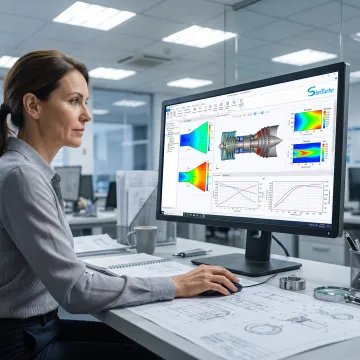
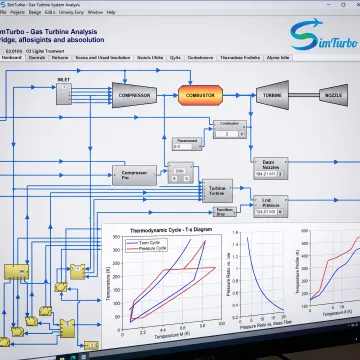
Gas turbine inlet services in this context focus on modeling and analyzing inlet conditions within a complete engine simulation. SimTurbo supports representation of inlet-related ambient conditions and pressure losses, then connects those inputs to compressors, combustors, turbines, nozzles, shafts, and controls. This helps engineers understand how inlet assumptions affect thrust or power, efficiency, fuel consumption, component matching, and operating limits.
Can SimTurbo model inlet pressure losses and ambient conditions?
Yes. SimTurbo supports altitude and ambient-condition analysis as part of gas turbine performance modeling, along with component-based system configuration and operating-point evaluation. Engineers can use these studies to assess how inlet pressure losses and changing environmental conditions influence compressor behavior, cycle performance, fuel consumption, and predicted thrust or power. Results can be compared across design and off-design cases.
Which gas turbine configurations can be studied?
SimTurbo supports complete gas turbine architecture studies, including single-spool and dual-spool turbojet configurations. Its component-based approach also covers compressors, combustors, turbines, nozzles, shafts, recuperators, regenerators, intercooling, reheating, and afterburners. This makes it useful for aerospace propulsion, industrial power generation, marine propulsion, research, and academic applications where inlet performance must be considered in context.
Can I analyze transient inlet-to-engine behavior?
Yes. Transient operation simulation can evaluate engine startup, shutdown, throttle changes, acceleration, deceleration, load changes, environmental variations, actuator dynamics, sensor response, and fault conditions. Inlet conditions can be considered alongside the rest of the modeled engine system, helping users observe dynamic response, system stability, and control performance rather than relying only on steady-state results.
Does SimTurbo support gas turbine control-system design?
Yes. The platform supports PID controller development, fuel scheduling, engine start and shutdown logic, acceleration and deceleration control, actuator and sensor modeling, gain scheduling, limiters, engine-protection systems, and FADEC-oriented logic. Engineers can use closed-loop transient simulation to validate control strategies, examine stability, identify response issues, and refine algorithms before moving toward more advanced prototyping workflows.
Who uses gas turbine inlet simulation services?
SimTurbo is designed for aerospace design engineers, gas turbine engineers, marine propulsion engineers, power-system engineers, control-system engineers, researchers, universities, and student capstone teams. It is suited to professionals evaluating engine concepts or performance and to educators teaching thermodynamics, propulsion, controls, and gas turbine engineering through interactive, industry-oriented simulation models.
Can simulation results be exported for further analysis?
Yes. SimTurbo enables data export for post-processing in commonly used engineering tools, including Excel, MATLAB/Simulink, and Python. This allows teams to incorporate simulated performance data into reports, custom calculations, optimization studies, control-development workflows, or broader research datasets. Export capability helps preserve a connected workflow from graphical model development through detailed engineering analysis.
Is there a trial or demonstration available?
SimTurbo offers a 30-day free trial with full product features for control-system design capabilities. A free 30-minute online features demonstration is also available by appointment through the SimTurbo booking calendar and is conducted via Zoom. These options allow prospective users to review the interface, ask questions about applicable workflows, and determine how the platform fits their simulation requirements.