Key Takeaways
- Transient conditions are continuous parameter changes driven by thermal inertia, mechanical inertia, and fluid capacitance
- Event duration spans 0.05 s (FOD impact) to 5 s (FAA thrust tests) to 5 minutes (full startup)
- Uncontrolled transients can cause compressor surge, thermal stress cracking, turbine overspeed, or combustor blowout
- Time-domain simulation predicts transient response and tunes controls without physical testing
- Real-time tools like SimTurbo show temperature, pressure, and speed at each station during dynamic events
What Are Transient Conditions?
Transient conditions are time-dependent states in engineering systems where process variables—temperature, pressure, flow rate, rotor speed—change continuously until the system reaches a new steady state. Time becomes an additional variable alongside position.
Steady-state vs. transient operation:
- Steady state: Variables are constant at each point; algebraic equations suffice
- Transient state: Variables are functions of both position and time; differential equations are required
The fundamental physics driving transient behavior involves three storage mechanisms:
- Thermal inertia: Components store and release heat, creating temperature lags
- Mechanical inertia: Rotating assemblies resist speed changes due to their mass
- Fluid capacitance: Gas volumes store mass and energy, delaying pressure and flow response
Because these storage effects block instantaneous response, transient analysis solves rate-of-change equations with accumulation terms in energy and mass balances.
EASA defines a transient as a predictable temperature, speed, or torque overshoot before steady-state limits are reached during normal operation, usually after rapid acceleration.
How long do transients last? Duration varies by engine size, event type, and control strategy:
| Event | Duration | Example |
|---|---|---|
| FOD impact pulse | 0.05 seconds | NASA turbofan simulation |
| Thrust response test | 5 seconds | FAA certification requirement |
| Temperature excursions | 10-30 seconds | EASA transient approval limits |
| Extended transients | Up to 2 minutes | EASA-approved temperature overshoot |
| Full power-plant startup | ~5 minutes | GE LM6000 aeroderivative |
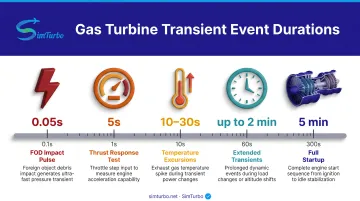
Transients span a wide spectrum: a compressor surge may clear in milliseconds, while a cold-start sequence can take minutes as thick-section components absorb heat. That range is why duration, not just peak value, matters in transient analysis.
Types of Transient Conditions in Gas Turbine Engines
Startup Transients
The cold-start sequence begins with ignition and light-off, the moment combustion begins after fuel introduction. The FAA describes light-off as a rapid heat rise, with abnormal conditions including hot starts (exceeding temperature limits) and hung starts (lighting but failing to accelerate normally).
Key challenges during startup:
- Rapid temperature gradients between hot gas paths and cold metal structures can cause thermal stress cracking if acceleration is too rapid
- Fuel flow must be carefully scheduled to prevent overtemperature and compressor surge
- Rotor acceleration is limited by both mechanical stress and operability margins
SimTurbo models engine startup as a time-dependent simulation, tracking speed, temperature, mass flow, and surge-margin behavior. Engineers can watch fuel scheduling, ignition timing, and acceleration control interact during light-off and spool-up, with transient parameters shown on real-time graphs and thermodynamic cycle diagrams.
Load Change Transients
Throttle movements create load-change transients as the engine adjusts from one power setting to another. When a pilot advances the power lever, fuel flow increases, combustor temperature and pressure rise, and the rotor begins to accelerate. However, power output lags behind fuel input due to compressor and turbine inertia.
NASA research demonstrates that large thrust transients reduce compressor operability margin, creating a fundamental trade-off: fuel-command limiting protects against stall, surge, and blowout but slows response. The FAA requires engines to reach 95% rated takeoff power within 5 seconds from flight idle during certification testing.
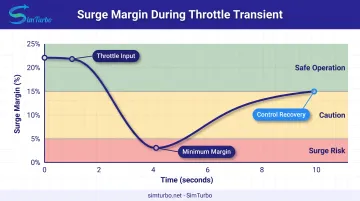
In SimTurbo, engineers can model these throttle bursts and watch turbine inlet temperature, surge margin, and rotor speed evolve together. Documented afterburner cases show surge margin falling from 20–25% to below 5% before adaptive control restores safe operation, underscoring how tightly fuel flow, operability limits, and control response are linked.
Shutdown Transients
After fuel cutoff, rotor speeds decrease while temperatures drop, but not uniformly. Research published in The Aeronautical Journal shows that hot air rises during natural-convection cooling, creating a vertical temperature gradient across the compressor.
That asymmetric cooling causes uneven contraction and bends the rotor, a condition known as thermal bowing. Restarting a bowed rotor can cause blade-tip rubs, bearing damage, or catastrophic failure.
Shutdown transient risks:
- Thermal bowing if engines cool unevenly after high-temperature operation
- Hot restart problems if turnaround time is too short
- Component life reduction from thermal fatigue cycles
Shutdown and coastdown runs in SimTurbo track temperature decay and rotor deceleration. The platform does not offer detailed thermal-bow prediction, but engineers can still compare cooling-rate differences across components and evaluate shutdown control strategies that reduce thermal stress.
Compressor Surge and Stall Transients
Compressor stall is a catastrophic flow breakdown capable of causing power loss, violent inlet pressure transients, and flameout. Rapid throttle movements, inlet distortion, or foreign object damage can push the compressor beyond its stable operating range, triggering surge—violent pressure oscillations and reverse flow.
Surge triggers include:
- Aggressive acceleration without proper fuel limiting
- Inlet flow distortion from aircraft maneuvers or crosswinds
- Foreign object ingestion events
- Rapid deceleration that moves the operating line toward the surge line
Recovery relies on variable geometry: bleed valves open to reduce back-pressure, variable stators adjust to improve flow angles, and fuel flow is modulated to restore operability margin. NASA acceleration and deceleration limiters preserve specified high-pressure-compressor and low-pressure-compressor surge margins during transients by constraining fuel-to-pressure-ratio (Wf/Ps3) within safe bounds.
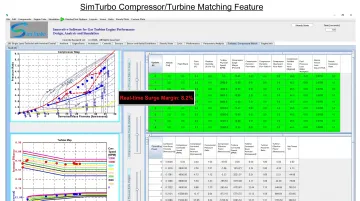
Surge margin appears in real time in SimTurbo, with the compressor operating line overlaid on component maps and margin shown as a percentage. That view lets engineers stress-test limiters, variable geometry, and fuel schedules against aggressive throttle inputs before surge develops.
Environmental Transients
Changes in ambient temperature, pressure, or humidity alter engine performance and operability. NASA identifies exhaust ingestion, aircraft wakes, maneuvers, and airframe-inlet interaction as distortion sources that reduce available power and surge margin.
Inlet flow transients occur during:
- Aircraft maneuvers that create angle-of-attack changes
- Crosswind gusts affecting inlet flow uniformity
- Takeoff and landing in hot, high, or humid conditions
- Rapid altitude or Mach number changes
Altitude, Mach number, and ambient temperature can all be varied in SimTurbo transient runs. Engineers use those cases to see how environmental shifts change compressor matching, turbine performance, and control response. Specific humidity-response features are not documented in the current platform.
Why Transient Conditions Matter in Gas Turbine Engineering
Transient behavior sits at the center of three engineering concerns: keeping the engine intact, meeting response specs, and tuning the control laws that govern both.
Safety Concerns
Uncontrolled transients can cause catastrophic failures. Key hazards include:
- Overtemperature during start: Exceeding turbine-inlet-temperature limits causes metal oxidation and creep damage
- Compressor surge: Flow breakdown leads to power loss, structural vibration, and potential flameout
- Turbine overspeed: Excessive rotor acceleration can cause disk burst or blade liberation
- Thermal stress cracking: Rapid temperature changes create differential expansion and fatigue
These risks shape regulation. The FAA mandates specific thrust-response performance.
EASA allows temporary excursions above steady-state limits during predictable transients: 10 seconds for one-engine-inoperative ratings, 30 seconds for other ratings, and up to 2 minutes for approved temperature transients.
Safety limits alone do not define the job. Many applications also need fast, repeatable response under those same constraints.
Performance Implications
Transients matter most where the duty cycle demands rapid power change:
- Military aircraft: Need maximum thrust within seconds for combat maneuvers and carrier launches
- Marine vessels: Must change speed quickly during port operations and emergency maneuvers
- Power plants: Follow grid load changes as renewable energy fluctuates
The GE LM6000 aeroderivative, for example, takes about 5 minutes from startup to full power. That pace suits power-generation load-following, but it is far slower than the 5-second thrust response aerospace certification often requires.
Meeting those different response targets is a control problem as much as a cycle-design problem.
Control System Design Requirements
NASA's transient optimization research cut thrust-response time by 11.8% and high-pressure-compressor operability stack usage by 31% with optimized transient logic. That result highlights the core performance-versus-margin trade-off in control tuning.
Aggressive fuel schedules deliver fast response but raise surge and overtemperature risk. Conservative schedules protect the engine but give up performance.
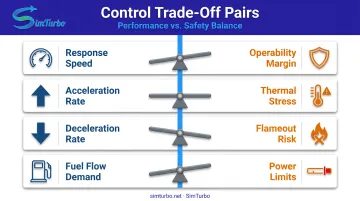
Control designers must balance:
- Response speed vs. operability margin
- Acceleration rate vs. thermal stress
- Deceleration rate vs. flameout risk
- Fuel-flow limits vs. power demand
SimTurbo’s control-system tools (PID controllers, limiters, actuators, and sensors) let engineers test these trade-offs in simulation. Teams can validate control laws against startup sequences, throttle transients, and fault cases before physical testing.
Analyzing Transient Conditions in Gas Turbines
Mathematical Approach
Transient analysis requires solving time-dependent differential equations for mass, momentum, and energy conservation across engine components. Unlike steady-state analysis, which uses algebraic equations at a single operating point, transient simulation introduces:
- Time integration: Advancing system states step-by-step through time
- Volume storage: Tracking mass and energy accumulation in fluid capacitances
- Shaft dynamics: Solving torque balance and rotational acceleration
- Heat transfer: Modeling energy exchange between working fluid and structure
NASA's T-MATS simulation tool uses an outer time loop not required in steady models, plus an inner convergence loop at each time step to match component boundary conditions. ASME-published research validates real-time gas-turbine models that solve ordinary differential equations with initial and boundary conditions. Those models include volume packing and heat transfer between the working fluid and structure.
Experimental Methods
Engine test cells measure transient behavior using high-speed data acquisition. NASA's TF34 facility historically deployed up to 360 pressure channels, 288 thermocouples, 100 thrust/torque/speed channels, 7 fast wall-pressure transducers for stall detection, and 20 vibration pickups. That setup captured analog time histories and digital snapshots during rapid thrust and shaft-load changes.
Key parameters monitored during transient testing:
- Rotor acceleration rates (RPM/second)
- Turbine inlet temperature transients (degrees/second)
- Compressor surge margin variation (percent over time)
- Fuel-to-power response time (seconds)
- Pressure and temperature at each engine station
- Vibration and bearing loads
The Role of Real-Time Simulation Platforms
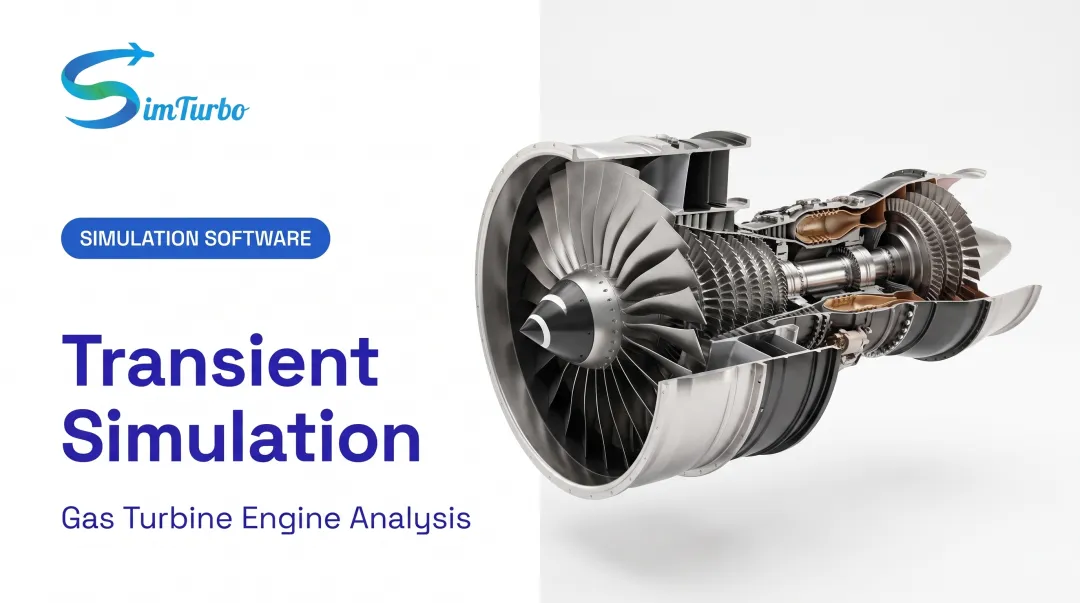
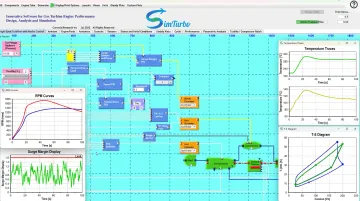
Real-time simulation platforms like SimTurbo let engineers model startup sequences, throttle transients, and off-design operation. Teams can predict system response, validate control laws, and watch temperature, pressure, and speed evolve at each engine station—without the cost and risk of every physical test.
SimTurbo runs on standard Windows PCs, updating performance graphs and thermodynamic cycle diagrams as throttle inputs change. Engineers observe:
- RPM graphs of rotor-speed variation and acceleration rates
- Temperature graphs tracking turbine-inlet temperature against set points
- Surge-margin displays that highlight compressor safety thresholds
- T-S and P-V diagrams of entropy and pressure-volume changes through the cycle
- Component maps showing how operating points shift during transients
Its component-based architecture treats each engine element (compressor, combustor, turbine, nozzle, shaft, sensor, actuator) as a distinct, modifiable block. That structure supports startup, shutdown, throttle changes, compressor stall, sensor failures, and FADEC response. Transient data exports to CSV or Excel for post-processing and control-system tuning.
SimTurbo's J85-GE-21 single-spool turbojet model matched NASA Lewis Research Center test data within ±2% for thrust, flow rate, temperature, and thrust-specific fuel consumption. That figure is an overall engine-simulation benchmark, not a transient-only error metric, and it gives engineers a documented reference for analysis work.
Tuning Control Systems with Transient Data
Transient simulation and test results inform control-system optimization:
- Acceleration schedules limit fuel flow during spool-up to prevent overtemperature and surge
- Deceleration schedules maintain sufficient fuel flow to prevent flameout and compressor stall
- Variable geometry schedules adjust bleed valves and stator vanes to preserve operability margin
- Fuel limiters enforce safe Wf/Ps3 ratios throughout the operating envelope
NASA's transient control research designs thrust-to-setpoint maps, PI gain schedules, acceleration limiters, and lower Wf/Ps3 deceleration limits—using large transient maneuvers specifically to exercise and validate limiter logic under stress.
Managing and Mitigating Transient Effects
Control System Strategies
Effective control strategies limit transient hazards while maintaining performance:
- Fuel limiting during acceleration: Constrains fuel flow to protect high-pressure-compressor surge margin and prevent turbine overtemperature
- Fuel limiting during deceleration: Maintains minimum Wf/Ps3 to preserve low-pressure-compressor surge margin and prevent flameout
- Variable geometry scheduling: Adjusts bleed valves and variable stators to improve flow angles and operability during transients
- Temperature and speed protection: Enforces turbine-inlet-temperature, rotor-speed, and compressor-pressure limits
SimTurbo provides built-in PID and FADEC logic for transient control validation. Engineers can test acceleration schedules, fuel limiters, and protection functions against simulated startup, throttle bursts, and load changes. That validation confirms safe, responsive operation before control laws move to physical hardware.
Mechanical Design Considerations
Transient thermal stresses drive material selection and cooling strategies:
- High thermal-shock resistance materials: Nickel-based superalloys and thermal barrier coatings withstand rapid temperature changes
- Controlled cooling flows: Film cooling and internal passages reduce blade heat transfer and thermal gradients
- Thermal expansion joints: Allow differential expansion between hot-section components and cooler structures
- Clearance control: NASA research models shroud, rotor, and blade deformation from centrifugal and thermal stress, predicting clearance changes during transients
While SimTurbo does not provide detailed structural-stress analysis, it lets engineers examine temperature evolution and thermal lag. Those results inform decisions on cooling flows, material limits, and clearance-management strategies.
Operational Procedures
Pilots and operators follow standardized procedures to minimize harmful transient effects:
- Controlled throttle movement rates: Avoid slam accelerations and decelerations that threaten surge or overtemperature
- Warm-up procedures: Allow components to reach thermal equilibrium before applying full power
- Turnaround management: Monitor shutdown cooling and avoid rapid restarts that could damage thermally bowed rotors
The FAA's 1-second lever movement is a certification test input, not an operational procedure. It proves the engine can handle rapid commands without harm. Normal operations still use gentler rates to extend service life.
Frequently Asked Questions
What is a transient condition?
A transient condition is a temporary, time-dependent state in an engineering system where variables like temperature, pressure, flow rate, and rotor speed change continuously until the system reaches a new steady state.
What causes transient conditions in gas turbine engines?
Transients are caused by changes in operating conditions: throttle movements, startup and shutdown sequences, load changes, environmental shifts, or disturbances such as inlet flow distortion or foreign object ingestion that disrupt steady-state operation.
How long do transient conditions last in a gas turbine?
Duration varies widely by event and engine: 0.05 seconds for a foreign-object-damage impact pulse, 5 seconds for FAA thrust-response tests, 10-30 seconds for typical temperature excursions, and up to 5 minutes for a full aeroderivative power-plant startup.
What is the difference between transient and steady-state operation?
Steady-state operation maintains constant parameters over time at each engine location, while transient operation involves time-varying parameters as the system adjusts from one condition to another—requiring differential equations rather than algebraic equations.
Why are transient conditions dangerous for gas turbines?
Transients can cause thermal stress cracking from rapid temperature changes, compressor surge leading to power loss and flameout, turbine overspeed from excessive acceleration, and rotor-bow restart damage from asymmetric cooling—making transient analysis critical for safe operation.
How do engineers simulate transient conditions?
Engineers use time-domain simulation software that solves differential equations for mass, momentum, and energy conservation. Platforms like SimTurbo couple shaft dynamics, fluid-volume storage, and heat transfer to predict response during startup, shutdown, and load changes.