Today's engineers simulate while they design, catching problems before metal ever gets cut. Add AI-driven generative design into the mix, and the entire product development cycle looks different than it did even five years ago.
But the terminology gets messy. Simulation-driven design, generative design, topology optimization — these terms get used interchangeably, and they shouldn't be. Each means something distinct.
This guide breaks down the differences, the benefits, and how these approaches show up in real engineering work — including specialized platforms built for complex systems like gas turbine engines.
Key Takeaways
- Simulation-driven design puts analysis in every stage so problems surface before late-stage validation
- Generative design uses AI to explore many options against your constraints, not a single baseline concept
- Topology optimization finds the lightest material layout that still meets structural requirements
- Combined, these methods cut physical prototypes and compress development timelines
- Complex systems like gas turbines often need specialized platforms beyond general CAD/CAE tools
What Is Simulation-Driven Design?
Simulation-driven design embeds structural, fluid, thermal, or multiphysics simulation from the concept stage onward. Design and evaluation stay in continuous conversation from the first concept, not a single checkpoint at the end.
Academic literature frames it plainly: simulation becomes the primary means of design evaluation and verification, and this validation happens while the system is being developed, not after (ScienceDirect, 2004).
ASME describes it the same way. Engineers analyze while designing, using immediate feedback to guide decisions, though final expert verification is still required (ASME, 2020).
Traditional Design vs. Simulation-Driven Design
The contrast with old-school trial-and-error design is stark. In traditional workflows, engineers build a physical prototype, test it, find problems, and rebuild. Each cycle costs time and money, and late-stage changes cost the most.
An ASME article cites design-company president Jackson Hedden, who observed that virtual prototyping can shrink what used to require hundreds of prototypes down to an average of just 1-3 (ASME, 2023). The same source still warns against skipping physical prototypes entirely for products with dozens or hundreds of interacting components.
| Factor | Traditional Design | Simulation-Driven Design |
|---|---|---|
| When simulation happens | After design is finalized | Continuously, from concept stage |
| Role of simulation | Validation checkpoint | Core decision-making input |
| Prototyping needs | Multiple physical builds | Minimal — often 1-3 physical builds |
| Cost of late changes | High (retooling, rebuilds) | Lower (caught early, virtually) |
| Engineering risk | Higher — issues surface late | Lower — issues surface early |
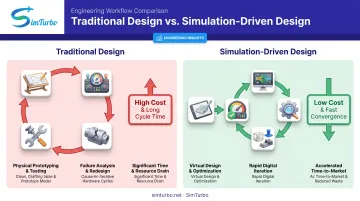
The defining feature of this approach is the simulate-evaluate-optimize loop. Engineers run a simulation, evaluate the results against goals, adjust the design, and repeat. That loop runs dozens of times before a single prototype gets built.
Simulation-Driven Design vs. Generative Design vs. Topology Optimization
These three terms get lumped together constantly. They're related, but they answer different questions.
Generative design is an AI/machine-learning-driven method. Engineers define objectives, parameters, and constraints; algorithms generate multiple valid design options; engineers then evaluate, refine, and select (ASME Journal of Mechanical Design, 2023).
Topology optimization is a mathematical shape-optimization method. It distributes material within a defined design space based on loads, constraints, and an objective function like stiffness or weight reduction.
Here's how they stack against simulation-driven design:
| Dimension | Simulation-Driven Design | Generative Design | Topology Optimization |
|---|---|---|---|
| Scope | Overall design workflow | Multi-solution generation | Material-layout optimization |
| Engineer's input | Models, test cases, validation data | Objectives, parameters, constraints | Design space, loads, constraints |
| Output | Performance evidence guiding decisions | Multiple candidate designs | Optimized material layout |
These aren't silos. In a modern design cycle, the three methods often run in sequence:
- Generative design proposes dozens of candidate geometries
- Topology optimization refines material layout in the strongest options
- Simulation-driven workflows validate each iteration against real-world performance targets
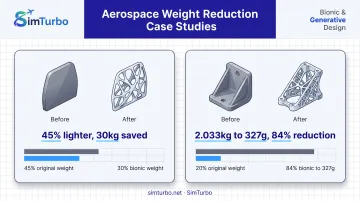
The Airbus "bionic partition" is a clear generative-design case. Airbus produced a micro-lattice partition 45% lighter (about 30 kg less) than the conventional design it replaced (Autodesk, 2015).
GE's aircraft-engine bracket challenge shows topology optimization in the same light. The bracket dropped from 2.033 kg to 327 g—an 84% reduction—and later multiscale research reached an 85.8% weight cut while holding structural safety margins.
Benefits and Key Technologies Behind These Platforms
Modern simulation-driven platforms lean on a few core technologies working together.
CAD, FEA, and CFD integration lets engineers iterate quickly without rebuilding full models from scratch every time a parameter changes. Change a wall thickness, rerun the analysis, and see the result in minutes rather than days.
Optimization algorithms (genetic algorithms, gradient-based methods) automatically explore design spaces too large for manual iteration. They search thousands of variations against defined constraints and surface options a human engineer might never try.
Real Benefits, Not Just Theory
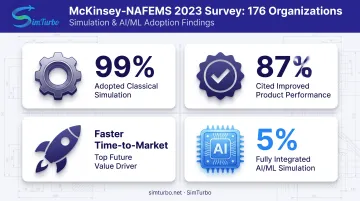
The McKinsey-NAFEMS 2023 survey of 176 organizations found:
- 99% used classical simulation to some degree; more than half used it at scale
- 87% cited improved product performance as a current value driver from simulation
- Faster time-to-market ranked as the top future value driver, ahead of cost reduction
- Only 5% had fully integrated AI/ML simulation into product development — this space is still maturing (McKinsey, 2023)
AI Surrogate Models Are Speeding Things Up
Traditional physics-based solvers are accurate but slow. Surrogate models — statistical approximations of high-fidelity simulations — replace some of that computational burden while retaining reasonable accuracy (PMC review, 2022).
Physics-informed neural networks (PINNs) take this further. They blend physics equations with trained neural networks to handle uncertain or hard-to-model behavior. NASA research describes this approach for systems-health applications, where embedded networks and unknown parameters train together in a single learning stage.
That same idea applies at the control level. SimTurbo’s physics-informed neural network manages turbojet control variables to maximize transient engine response without crossing safety limits:
- Turbine inlet temperature limits
- Compressor surge margin
- Pressure constraints
Real-World Industry Applications
Simulation-driven and generative methods show up across heavy industry:
- Automotive: A 2015 SAE study used FEA modal analysis on a special vehicle's front frame to optimize thickness and improve frequency response
- Mining and heavy equipment: Multibody simulation plus FEA assesses fatigue near welds and joints; continuous real-time fatigue monitoring is still emerging
- Infrastructure: Bridge studies calibrate finite element models with proof-load test data to predict behavior on spans that can't be tested to failure
Gas Turbine Engineering: A Specialized Case
Gas turbines don't fit neatly into general-purpose CAD/CAE workflows. The physics (compressible flow, combustion, and thermal cycling across dozens of interacting components) demands dedicated tools.
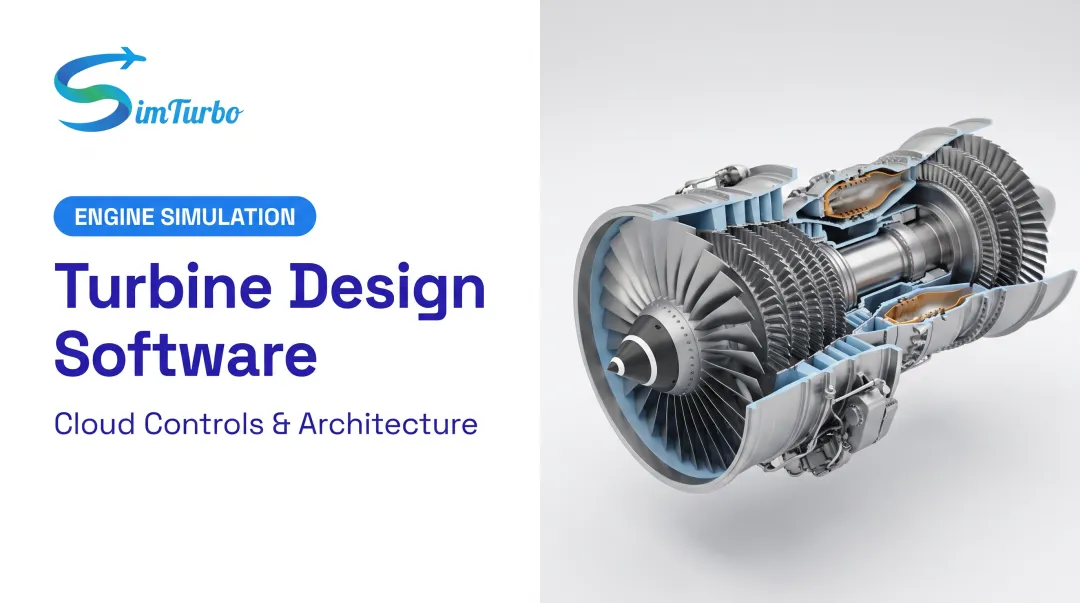
SimTurbo is a purpose-built example. It's a Windows-based, component-driven simulation platform where engineers assemble turbojet architectures from individual pieces: inlets, compressors, combustors, turbines, nozzles, shafts, actuators, and sensors.
The platform runs in real time, so engineers can watch throttle response, startup dynamics, and stall events on live graphs instead of waiting on a batch job.
Its steady-state simulation was validated against NASA Lewis Research Center's J85-GE-21 test data, matching thrust, flow rate, temperature, and thrust-specific fuel consumption within ±2% (NASA Technical Reports, 1980).
It supports both single-spool and dual-spool turbojet configurations. Universities also use it for propulsion coursework, capstone projects, and control-law validation, with students exporting transient data (RPM, EGT, thrust, SFC) to Excel for post-processing.
SimTurbo complements general CAD/CAE tools rather than replacing them. It focuses on domain-specific physics and control-law validation instead of covering every industry's simulation needs.
Choosing the Right Software and Common Challenges
Not all simulation platforms are built the same way. A few questions to ask before committing:
- Component-based or black-box? Component-based architectures (like SimTurbo's drag-and-drop inlets, compressors, and turbines) let you see and modify individual pieces. Black-box tools hide internal logic, which limits flexibility.
- Does it run in real time? Real-time simulation on a standard PC beats waiting hours for batch results, especially during iterative design work.
- What export options exist? Look for Excel/CSV export at minimum, plus MATLAB/Simulink or Python integration if you're validating control laws externally.
- Is there education/university licensing? Academic pricing matters if you're teaching or running capstone projects.
Common Limitations to Expect
- Garbage inputs still produce garbage outputs, no matter how sophisticated the solver.
- Compute time grows with every design variant you explore, even on fast solvers.
- Outputs need domain expertise; a plot alone does not tell you whether a result is valid.
Those limits are why fit matters more than feature checklists. Before you buy an annual or lifetime license, a 30-day free trial lets engineers and students test the tool on real workflows.
SimTurbo turns on full features for 30 days at no cost. Paid options include monthly ($59.99), one-year ($599), and lifetime ($5,999) seats, with discounted licensing for universities and research labs.
Frequently Asked Questions
What are examples of simulation software?
General-purpose CAD/CAE tools like ANSYS and SolidWorks Simulation cover broad structural and thermal analysis. Specialized platforms like SimTurbo focus narrowly on gas turbine engine simulation and control validation.
What is the difference between simulation-driven design and generative design?
Simulation-driven design evaluates a design throughout the entire process, informing decisions at every stage. Generative design uses AI algorithms to automatically create multiple design options from defined constraints, producing alternatives instead of only evaluating an existing design.
How does simulation-driven design reduce engineering costs?
It catches design flaws early, before physical prototypes are built, cutting both prototyping expense and the cost of late-stage changes. Some workflows report shrinking hundreds of required prototypes down to just a few.
Is generative design only useful for large enterprises?
No. Subscription licensing, educational pricing, and free trials make these tools accessible to smaller teams and universities.
What industries benefit most from simulation-driven and generative design software?
Aerospace, automotive, marine propulsion, power generation, and engineering education all rely heavily on these methods. Gas turbine engineering in particular depends on specialized, component-based simulation tools.
Can students and universities access simulation-driven design tools?
Yes. Many platforms, including SimTurbo, offer discounted university licensing, classroom/lab program pricing, and free 30-day trials so students and faculty can evaluate the software before committing to a paid license.