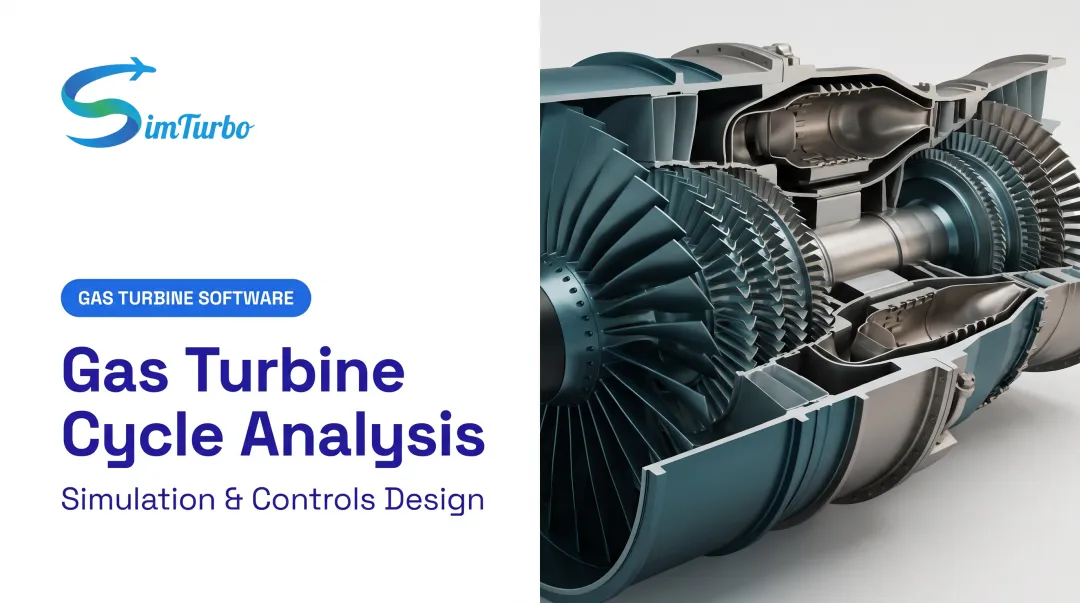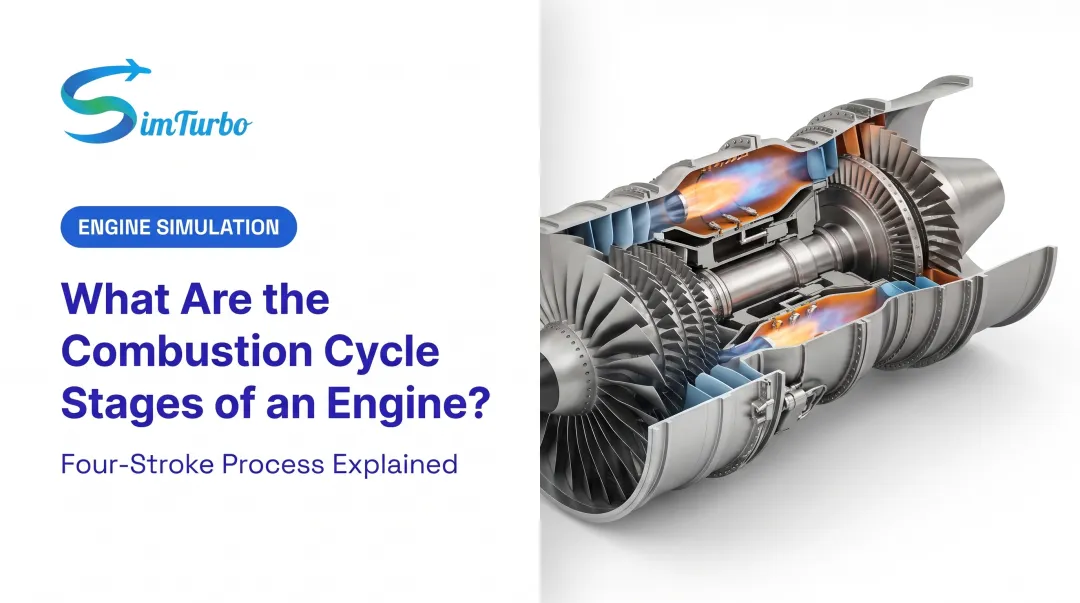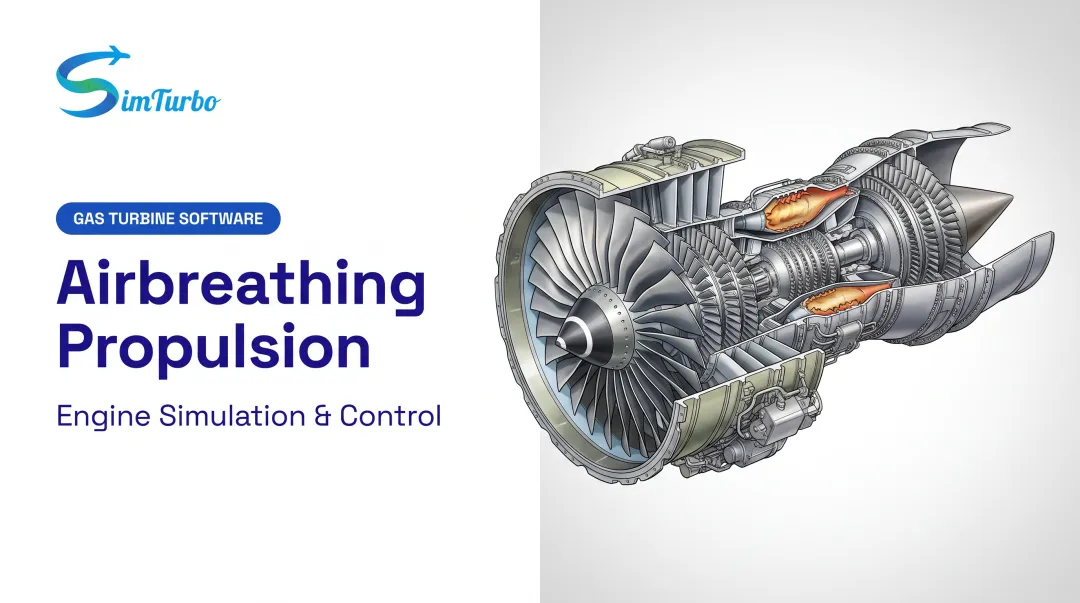
Three-stream adaptive cycle engines represent a breakthrough technology that resolves this tradeoff. By dynamically adjusting airflow distribution in real time, these engines shift between high-bypass fuel-efficient cruise and low-bypass high-performance combat modes as mission requirements change. This adaptive capability delivers strategic advantages: extended range for operations in vast theaters like the Indo-Pacific, superior cooling for next-generation sensors and avionics, and increased thrust for air superiority missions—all within a single propulsion system.
Key Takeaways
- Variable geometry routes air through core, bypass, and third streams to match each mission phase
- GE reports 25% better fuel burn, 30%+ greater range, and 10%+ more thrust vs. fixed-cycle engines
- Third stream doubles thermal-management capacity for high-power electronics and directed-energy weapons
- XA100 and XA101 AETP demonstrators finished ground tests; cost and complexity still block fleet use
What Is a Three-Stream Adaptive Cycle Engine?
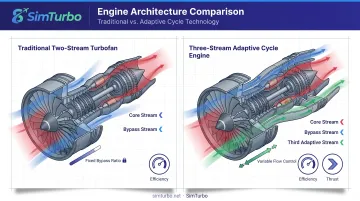
A three-stream adaptive cycle engine is an advanced turbofan with a variable-bypass configuration. It routes airflow through three distinct streams: the core, the fan bypass, and a modulated third adaptive stream.
Unlike traditional fixed-cycle turbofans locked to a single bypass ratio for one flight regime, adaptive engines change their thermodynamic cycle in real time. They respond to pilot input, flight conditions, and mission requirements.
Historical Context and Program Lineage
Research into variable-cycle engines began in the 1960s and 1970s, but early efforts were limited by materials science and control-system capabilities.
NASA's September 1978 Variable Cycle Engine Technology Program study already flagged the critical enablers: variable fan and compressor geometry, variable nozzles, high-temperature components, and integrated digital control. The materials and computing power to run these concepts operationally did not mature until the 2000s.
Modern digital engine controls (FADEC), ceramic matrix composites (CMC), and high-temperature materials have since made adaptive cycle engines viable. The U.S. Air Force and DARPA funded a series of demonstration programs to mature the technology:
- ADVENT (Adaptive Versatile Engine Technology) began in 2007 and showed CMCs, cooled cooling air, and advanced compressor aerodynamics in a four-month, 60-hour core test in 2014
- AETD (Adaptive Engine Technology Development) launched in 2012; Pratt & Whitney's adaptive three-stream fan completed 237 scheduled air-on hours in 2017
- AETP (Adaptive Engine Transition Program) awarded approximately $1 billion each to GE and Pratt & Whitney in 2016 to build full-scale demonstrator engines
Three-Stream vs. Traditional Turbofans
Fixed-cycle turbofans (the standard in current fighters like the F-35, F-22, and F-16) have a single bypass ratio. Engineers must choose one design point: high bypass for fuel efficiency or low bypass for high thrust and speed. The engine cannot change this fundamental architecture in flight.
Two-stream turbofans route air through the core (where combustion occurs) and the bypass stream (which flows around the core). This configuration is efficient for subsonic airliners but still locks the bypass ratio at design time.
Three-stream adaptive cycle engines add a modulated third stream. That tertiary path can boost propulsive efficiency and cooling in cruise, or feed the core and fan streams when combat thrust, acceleration, or afterburner use demands it. One engine covers both high-efficiency and high-performance modes.
How Three-Stream Adaptive Cycle Engines Work
The Role of the Adaptive Fan and Variable Geometry
The adaptive fan system modulates airflow among the three streams with variable-geometry hardware. Public detail on the XA100 and XA101 is limited, but the usual layout uses adjustable vanes and a mode-selection valve to set how much air goes to the core, the bypass, and the third stream.
AIAA work on mode transitions shows those geometry changes must stay smooth enough to hold tight operability limits on thrust, airflow, and surge margin. Many transitions touch only one variable component; across the full envelope, the control system still has to coordinate several at once.
Bypass ratio and fan pressure ratio adjust in real time based on:
- Pilot throttle input
- Flight phase (takeoff, climb, cruise, combat, landing)
- Altitude, speed, and ambient temperature
- Mission requirements (fuel conservation vs. maximum thrust)
Third Stream: The Key Innovation
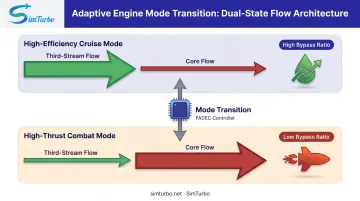
The third stream serves as a heat sink and raises propulsive efficiency. In cruise or loiter, the engine sends more air through that path, which:
- Increases overall bypass ratio for fuel-efficient operation
- Provides additional cooling capacity for avionics, sensors, and electronics
- Improves propulsive efficiency without increasing core size or weight
When the aircraft needs more thrust (intercepts, combat maneuvering, or afterburner use), the engine redirects third-stream air into the core and fan paths. That shift delivers:
- Lower bypass ratio for higher thrust-to-weight
- Increased core airflow for maximum power output
- Faster acceleration and improved combat performance
GE describes this as an automatic switch between high-thrust and high-efficiency states, handled by the engine FADEC rather than direct pilot control of the airflow valves.
Advanced Materials and Thermal Management
Ceramic matrix composites (CMC) are central to adaptive cycle engine design. These lightweight, heat-resistant materials let turbine parts run hotter than nickel-based superalloys, which improves efficiency and power. AFRL’s 2014 ADVENT core test ran CMC hardware with cooled cooling air, using third-stream flow to pre-cool the air that cools the turbine.
GE's XA100 incorporates CMC turbine shrouds, polymer-matrix composites, and additively manufactured parts. Exact turbine-stage details are still limited, but CMCs help the engine take higher thermal loads at lower weight.
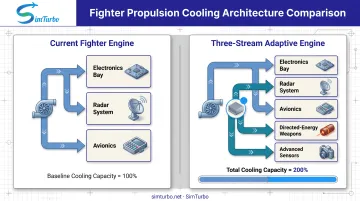
Thermal management matters as much as propulsive efficiency. GE reports the third stream offers about twice the thermal-management capacity of current fighter engines, which supports:
- High-power electronics and mission computers
- Advanced AESA radar and electronic warfare systems
- Future directed-energy weapons (no specific integration has been disclosed publicly)
Sixth-generation fighters will also need far more electrical power for sensor fusion, communications, and possible directed-energy loads than today’s fleets.
Digital Control Systems
A three-stream adaptive engine needs a FADEC that can coordinate airflow, temperature, pressure, and performance across modes in real time. NASA’s 1978 study already treated integrated FADEC as essential: inlet, fan, compressor, fuel, nozzle, bleed, and clearance control all have to move together.
Modern AIAA research checks mode-transition control laws against strict operability limits:
- Thrust and airflow fluctuations below 2%
- Compressor surge margin above 10%
- Turbine-inlet temperature inside material limits
- Smooth fan pressure-ratio changes across transients
Those constraints are why control law design, transient simulation, and hardware-in-the-loop-style validation sit at the center of adaptive-engine development. Public AETP materials still omit software assurance levels, fault-tolerance test detail, update rates, and full acceptance criteria—so most published insight stops at the operability targets above.
Key Benefits of Three-Stream Adaptive Cycle Engines
Fuel Efficiency and Extended Range
Performance improvements reported by GE for the XA100:
- 25% better fuel consumption
- More than 30% greater range
- 20% more acceleration
These are contractor claims based on AETP ground testing, not operational fleet measurements. However, AFRL independently reported a 30% range increase for adaptive engine technology in 2014, supporting the broader performance potential.
Extended range matters for basing and persistence. Concentrated air bases west of the International Date Line face growing air and missile threats. Longer-range fighters can operate from dispersed, less vulnerable bases, cut dependence on aerial refueling, and stay on station longer in contested airspace.
For Indo-Pacific operations that span vast distances, a 30% range increase means more flexible basing options and greater mission persistence.
Enhanced Thrust and Acceleration
GE claims the XA100 delivers more than 10% additional thrust over current engines like the F135, plus faster acceleration. No operational flight trials have validated these figures yet. If they hold, the gains show up where energy and time matter most:
- Higher thrust-to-weight improves turn performance and energy management in air superiority fights
- Quicker acceleration shortens time-to-intercept on air defense runs
- Extra thrust at altitude strengthens both BVR and WVR engagement options
Superior Cooling and Power Generation
The third stream provides twice the cooling capacity of traditional turbofans, enabling:
- High-power AESA radar and electronic warfare suites
- Advanced mission computers and sensor fusion systems
- Future directed-energy weapons (when fielded)
Next-generation avionics demand far more electrical power than legacy systems. GE reports that the XA100's enhanced thermal management supports these high-power electronics and sensors, though specific electrical-output ratings have not been publicly disclosed.
Operational Flexibility
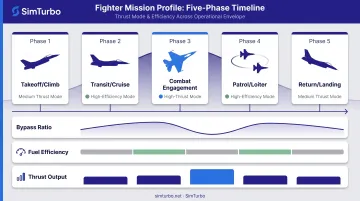
Pilots can optimize the engine for different mission phases:
- High-bypass mode for fuel-efficient cruise on long-range transit or combat air patrol
- Low-bypass configuration when engagement, interception, or evasion demands peak thrust
- Efficient third-stream cooling for extended loiter on ISR or air patrol
One airframe can cover multiple roles without giving up performance in any regime. Fixed-cycle engines cannot make that trade on the fly.
Challenges and Limitations of Adaptive Cycle Engines
Complexity and Maintenance Burden
More moving parts, advanced materials, and sophisticated control systems raise maintenance complexity and add failure points. That complexity shows up in related F-35 thermal-management problems already flagged by the GAO.
GAO found that the existing F-35 cooling system overtasked the engine, increased wear, shortened engine life, and drove about $38 billion in added maintenance costs. That figure reflects baseline F-35 modernization—not measured XA100 or XA101 burden—but it still shows how thermal and mechanical complexity can inflate lifecycle cost.
High Development and Integration Costs
The Congressional Research Service reports that the Air Force estimated $6 billion to integrate either the XA100 or XA101 into the F-35. Despite successful ground testing, the Air Force chose not to fund that integration.
Retrofitting challenges:
- Airframe structural modifications may be required
- Cooling system integration is complex
- Flight control software must be updated
- F-35B (STOVL) compatibility remains constrained by the lift fan
GE has said the XA100 could fit the F-35A and F-35C without major structural changes. For the F-35B, CRS reported that an enhanced power and thermal-management system was the only viable path identified for weight-growth issues. Cost and airframe fit are only part of the adoption barrier.
Reliability and Maturity
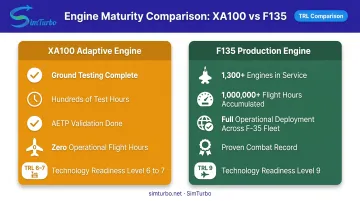
Even with strong test results, adaptive cycle engines remain immature next to fielded turbofans such as the F135, F110, or F414. The operational record is still thin:
- XA100: Completed AETP ground testing and accumulated hundreds of test hours through 2023
- F135: More than 1,300 engines in service with over 1 million flight hours
Ground testing can validate design and performance. Fielded reliability still takes years of operational use across varied missions, maintenance shops, and pilot populations.
Real-World Programs and Applications
US Air Force Adaptive Engine Transition Program (AETP)
AETP is the U.S. Air Force's effort to mature adaptive cycle engines for sixth-generation fighters and potential F-35 re-engining. The program awarded approximately $1 billion each to GE and Pratt & Whitney in 2016, with contracts scheduled through 2021.
GE XA100 milestones:
- First-engine testing began December 22, 2020
- Second-engine phase-one testing concluded in 2021
- All AETP testing completed in 2022
- Additional 2023 testing refined design and validated digital models
Pratt & Whitney XA101 milestones:
The XA101 adaptive three-stream fan completed 237 scheduled air-on hours in 2017 at Arnold Engineering Development Complex, with full-engine testing continuing through AETP program completion.
Both engines demonstrated the core technologies needed for adaptive cycle operation, but neither has been selected for production or aircraft integration.
Next Generation Air Dominance (NGAD) and Future Fighters
Adaptive cycle engines are central to NGAD's vision for a sixth-generation air superiority platform with extended range, persistence, and multi-domain capabilities. The Congressional Research Service notes that sixth-generation fighter technologies may include a variable-cycle engine, though no official selection has been announced.
Potential tactical advantages:
- Longer-range penetration via extended combat radius, cutting dependence on forward basing and tanker support
- Extended loiter in contested airspace using fuel-efficient mode for persistent air patrol and ISR
- Sortie generation from dispersed bases, enabled by range that supports less vulnerable, distributed airfields
GE's 2023 testing indicated that XA100 learning could support the Next Generation Adaptive Propulsion (NGAP) program, but this does not confirm XA100 selection for NGAD.
Potential Applications Beyond Fighter Jets
No authoritative sources document operational or funded three-stream adaptive cycle applications outside fighter propulsion. Potential future uses include:
- UAV propulsion for long-endurance unmanned systems that need adaptive efficiency and onboard power
- Marine gas turbines, where naval systems face the same efficiency-versus-power tradeoffs
- Hybrid-electric propulsion that taps third-stream electrical generation for electric drive
These uses stay speculative until funded programs and primary sources appear.
Engineering Design and Simulation of Adaptive Cycle Engines
Designing and validating three-stream adaptive cycle engines requires simulation tools that model transient behavior, thermal dynamics, control responses, and component interactions before physical prototyping. Simulation accelerates development cycles, reduces risk, and exposes design problems earlier in the process.
Engineers use gas turbine simulation platforms to build component-based engine models, test adaptive fan behavior, and validate control strategies such as PID controllers, limiters, and mode-transition logic. The same tools show real-time performance under varied flight conditions.
Researchers can assemble and re-parameterize inlets, compressors, combustors, turbines, nozzles, shafts, sensors, actuators, and control elements. They then see how those changes affect thermodynamic cycles, surge margins, thrust, and fuel consumption.
Simulation capabilities relevant to adaptive engines include:
- Real-time transient modeling of startup, throttle changes, and mode transitions
- Control-system validation against operability constraints (surge margin, temperature limits, thrust fluctuations)
- Thermal management analysis using recuperators, intercoolers, and advanced cooling configurations
- Off-design performance evaluation across altitude, Mach number, and ambient temperature
- Component map integration for compressors, turbines, and fans
For example, SimTurbo, a cloud-based gas turbine simulation platform from Controls Research LLC, supports component-based engine architecture design, dual-spool turbofan modeling, transient simulation, and PID control validation.
Engineers and university researchers can use platforms like this to explore advanced propulsion concepts hands-on. They connect variable-geometry components, adaptive control logic, and multi-stream airflow configurations to study performance tradeoffs before committing to hardware.
SimTurbo's J85-GE-21 single-spool turbojet model has been validated against NASA Lewis Research Center test data within ±2% for thrust, flow rate, temperature, and thrust-specific fuel consumption.
The platform does not currently offer a dedicated three-stream adaptive cycle engine model. Its component-based architecture, real-time transient solver, and integrated controls framework still support exploration of related modular propulsion concepts.
Universities and research labs working on advanced propulsion can access discounted academic licensing, including reduced-price student licenses and customized class and laboratory arrangements.
Frequently Asked Questions
How does an adaptive cycle engine work?
An adaptive cycle engine uses variable-geometry hardware and a mode-selection valve to route air through core, bypass, and third streams. It shifts bypass ratio in real time for efficient cruise or higher combat thrust as the mission changes.
What are the main advantages of three-stream adaptive cycle engines?
GE reports about 25% better fuel burn, more than 30% greater range, and over 10% more thrust versus fixed-cycle engines. The third stream also doubles cooling capacity for electronics, sensors, and future directed-energy weapons.
What challenges do adaptive cycle engines face in terms of maintenance and complexity?
They add moving parts, complex controls, and materials such as ceramic matrix composites, which raise maintenance burden and failure points. Public man-hour and depot-level data remain limited.
Which aircraft currently use or are planned to use adaptive cycle engines?
None are operational today. The U.S. Air Force is developing the tech for NGAD sixth-generation fighters; it dropped F-35 integration over an estimated $6 billion cost.
How do adaptive cycle engines differ from traditional turbofan engines?
Traditional turbofans lock in one bypass ratio at design time and favor a single flight regime. Adaptive three-stream engines vary bypass in flight, so one engine can run high-efficiency or high-thrust modes as needed.
Can adaptive cycle engines be retrofitted into existing fighter jets?
Retrofit is hard: airframe limits, cooling integration, and cost all stack up. The Air Force put XA100/XA101 F-35 integration at about $6 billion and chose not to proceed.