Real-time simulation changes this. Models run in sync with wall-clock time, so engineers watch a gas turbine, power grid, or vehicle system behave exactly as it would in the physical world, as it happens. No batch queue. No overnight run.
This article breaks down what real-time simulation actually means, how the underlying architecture works, how it stacks up against traditional offline simulation, and where engineers are using it today, including in gas turbine design with platforms like SimTurbo.
Key Takeaways
- Real-time simulation runs a model at the same speed as the physical process, giving live, actionable feedback
- Unlike offline runs, it stays locked to wall-clock time and can take live hardware inputs
- Aerospace, automotive, power systems, and gas turbine teams use it for design validation and control testing
- SimTurbo brings real-time gas turbine simulation to a standard PC so engineers can watch transients unfold instantly
What Is Real-Time Simulation
Engineers often wait hours for a simulation rerun—or risk physical hardware—just to learn how a design change behaves. Real-time simulation removes that lag.
It is a computational model that executes each calculation step within a fixed time window matching actual elapsed time. When one second passes in the real world, the model advances exactly one second.
The technical backbone is determinism. Every simulation step must finish before the next one begins, so cause-and-effect timing stays correct.
According to OPAL-RT, deterministic timing means every step and I/O update happens on schedule with bounded, repeatable delay, and the solver must finish before its hard deadline (OPAL-RT). Miss that deadline even once, and the simulation's timing assumptions fall apart.
Real-time simulation runs in two main forms:
- Standalone software — the model runs entirely in code, no physical connections needed
- Hardware-in-the-loop (HIL) — the model connects to real sensors, controllers, or actuators, closing a physical-virtual loop

Speed alone doesn't make something real-time. A "fast" simulation that finishes well ahead of the wall clock is running in faster-than-real-time mode—useful for sweeps and planning, but not the same thing (arXiv research on faster-than-real-time simulation). Real-time simulation must stay locked to actual elapsed time, not just outrun it.
That lock to wall-clock time is what makes live design decisions possible.
Why Real-Time Matters for Engineering Decisions
Instant feedback changes how engineers work. Swap out a turbine component in the model, and you see the performance impact immediately rather than after a multi-hour rerun. That immediacy shifts design work from "wait and guess" to "test and know."
Hardware-in-the-loop testing shows the same advantage. A real controller runs against a virtual plant, so engineers can test dangerous or expensive scenarios safely and repeatedly (NI's overview of HIL testing).
A 2018 study on an SGT600 industrial gas turbine compared controller sampling times of 53, 75, and 102 milliseconds and found the 53 ms setting delivered the best accuracy of the three. That kind of tuning decision is only practical inside a real-time feedback loop.
How Real-Time Simulation Works
Real-time simulation architecture rests on three pillars:
- A physics-based model representing the system's behavior
- A real-time computing engine that advances calculations on schedule
- I/O interfaces exchanging data with sensors, controllers, or displays
Rather than treating a system as one giant black box, most modern platforms use component-based modeling. A gas turbine, for instance, breaks into interacting parts—compressors, turbines, combustors, controllers—each modeled individually and connected together.
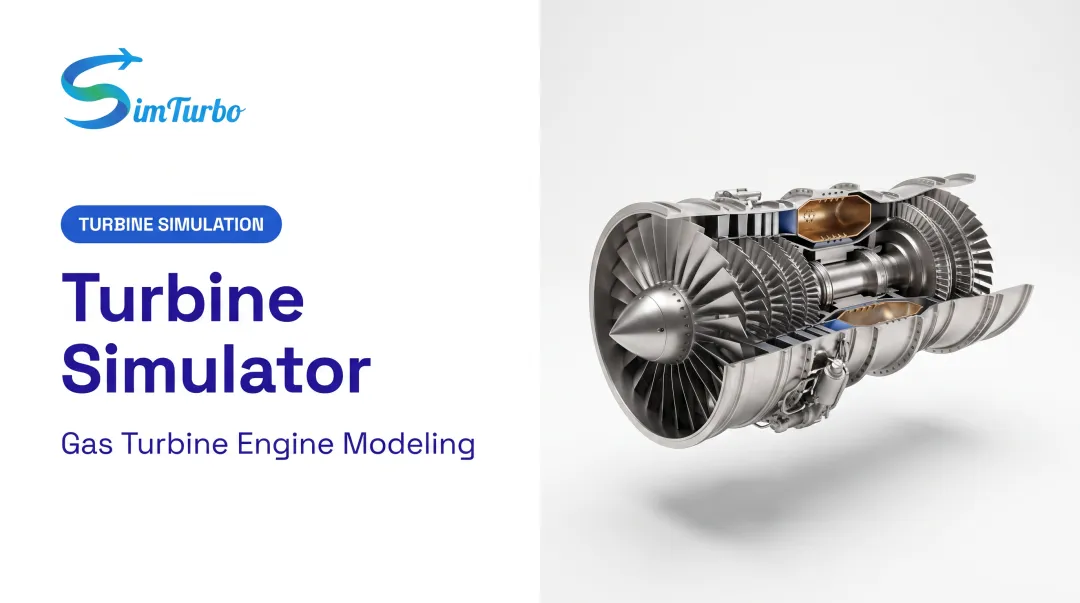
SimTurbo follows this approach. Engineers drag components like compressors, turbines, recuperators, and afterburners onto a design palette and wire them into a working engine model.

Solvers and Timing Precision
The computing hardware matters here. Some platforms lean on CPUs for steps in the tens-of-microseconds range and above; others use FPGAs for sub-20-microsecond, high-determinism work (MathWorks guidance on CPU vs. FPGA for HIL). The right choice depends on fidelity needs, I/O complexity, and how tight the timing tolerance has to be.
Transient vs. Steady-State Behavior
Steady-state simulation shows a system at equilibrium. Useful, but incomplete. Real engines don't sit still. They start up, accelerate, throttle, and sometimes fault. Capturing transient behavior matters because that's where the interesting (and risky) engineering questions live.
SimTurbo's component-based engine supports both. Engineers can watch turbine-inlet temperature, RPM, and surge margin shift in real time as throttle position changes, using models that include startup, slam-acceleration, and sensor-failure scenarios, not just a static design point.
Validating Accuracy
Accuracy only holds if the model reflects reality. SimTurbo validates its single-spool J85-GE-21 gas turbine simulation against NASA Lewis Research Center engine test data, using industry-standard thermodynamic relations, gas-property tables, and compressor/turbine component maps.
The result: thrust, flow rate, temperature, and TSFC all land within ±2% accuracy of NASA's benchmark data.

Real-Time Simulation vs. Traditional (Offline) Simulation
| Factor | Traditional (Offline) | Real-Time |
|---|---|---|
| Timing | No wall-clock sync required | Locked to actual elapsed time |
| Setup | Often hours (meshing, processing) | Feedback in seconds |
| Best for | Deep steady-state/transient studies, calibration | HIL, control validation, live testing |
| Hardware interaction | Typically none | Can connect to physical controllers/sensors |
Traditional simulation still earns its place. It's ideal for detailed, high-fidelity studies where you're not racing a clock: broad parameter sweeps or deep thermodynamic cycle analysis, for example. Real-time simulation doesn't replace that work.
Instead, it complements offline analysis earlier in the design cycle. Catching an unstable control response or a surge condition during a live simulation run—before you commit to expensive offline studies or physical prototypes—saves time and money.
Real-World Examples and Applications
Real-time simulation shows up across many industries:
- Automotive and aerospace HIL testing: Controllers face simulated faults, startups, and edge cases too risky or costly to run on physical hardware
- Power grid and microgrid testing: Teams validate protection relays and control logic before deployment—one RTDS utility case ran a battery storage/DERMS model at ~50 µs and finished 100+ simulations pre-hardware
- CAD-integrated structural/thermal simulation: Designers test material and geometry changes instantly without leaving the design environment
- Gas turbine engine simulation: Platforms like SimTurbo let engineers visualize throttle response and transient behavior on a standard Windows PC
- University classrooms: Students run live system-dynamics simulations without physical test rigs, cutting cost and widening access

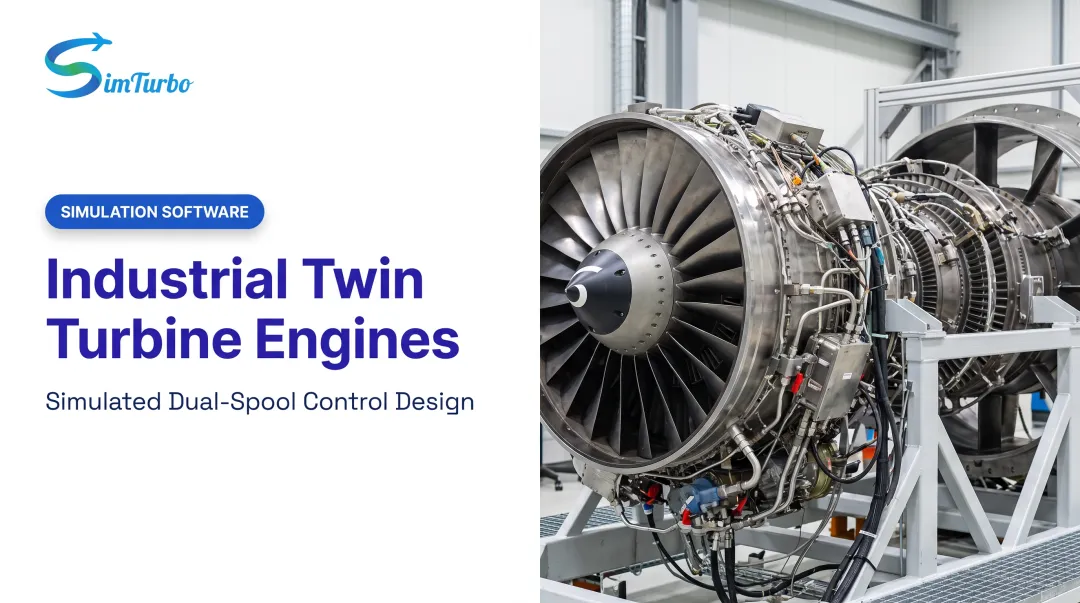
SimTurbo's real-time throttle-response modeling covers both single-spool and dual-spool turbojet configurations. Its "SimTurbo Vision" demo shows a J85 single-spool turbojet with live RPM, temperature, and surge-margin graphs updating as throttle position changes. That kind of visualization used to require a physical test cell.
Key Benefits of Real-Time Simulation
The advantages break down into three practical categories:
- Faster design iteration — Offline runs cost time that compounds across a project. Real-time feedback cuts that loop so teams can adjust and retest in the same session.
- Reduced risk and cost — Catching an unsafe or unstable design in simulation, before physical prototyping or hardware testing, avoids expensive rework and safety incidents.
- Better learning outcomes — Students and engineers see cause-and-effect as it unfolds, not in a static report hours later.
SimTurbo supports that last point by letting users export transient data—RPM, EGT, thrust, and SFC—to Excel, MATLAB/Simulink, or Python. A classroom exercise or control-law validation can move from live simulation into external analysis without rework.
Frequently Asked Questions
What is a real-time simulation?
A real-time simulation is a model that runs synchronized with actual elapsed time, so its outputs reflect current conditions instantly rather than after a delayed computation. It gives engineers live feedback on system behavior as it happens.
Can you give me an example of a real-life simulation?
Hardware-in-the-loop testing of a vehicle controller is one common example, where a real controller runs against a simulated plant. Real-time gas turbine engine simulation, used in engineering and education to visualize transient throttle response, is another.
What is the difference between real-time and traditional simulation?
Traditional simulation runs offline and returns results after the full computation finishes—sometimes minutes or hours later. Real-time simulation stays locked to wall-clock time, so you get live feedback as conditions change.
What industries use real-time simulation the most?
Aerospace, automotive, power systems, and gas turbine engineering are the leading adopters. Each relies on real-time simulation for design validation, control testing, and safe scenario testing before physical deployment.
Is real-time simulation the same as hardware-in-the-loop (HIL) testing?
No. HIL is one application of real-time simulation that involves connecting to physical hardware like sensors or controllers. Real-time simulation can also run entirely in software, with no hardware connection required.
What skills or tools are needed to start using real-time simulation software?
Most modern platforms use graphical, component-based interfaces, so deep coding skill is not required. SimTurbo, for example, lets engineers drag and drop compressors, turbines, and controls on a Windows canvas—no code needed.