Introduction
Nearly half of the fuel energy used in conventional power generation escapes as waste heat instead of useful work.
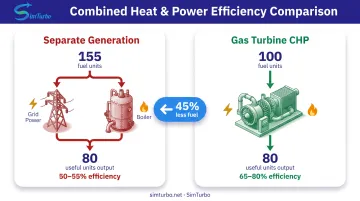
According to the EPA, separate heat and power needs 155 units of fuel to deliver the same 80 useful units that combined heat and power (CHP) supplies from 100 units—about 45% more fuel than an integrated system.
That gap shows up clearly in practice:
- Separate generation: higher fuel use, grid power plus on-site boilers
- Gas turbine CHP: one fuel stream for electricity and recovered heat
- Typical outcome: far more useful energy per unit of fuel
This inefficiency is expensive for industrial plants, power facilities, and large institutions that need both electricity and thermal energy. Running separate boilers and buying grid power means paying for fuel twice, carrying higher emissions, and giving up operational flexibility.
Gas turbine CHP systems recover exhaust heat that would otherwise be wasted, reaching 65–80% total efficiency versus about 50–55% for conventional separate generation. This article covers how gas turbine CHP efficiency is measured, which factors drive performance, and how to improve fuel utilization and cost savings.
Key Takeaways
- Gas turbine CHP systems achieve 65-80% total efficiency by recovering exhaust heat that conventional power plants waste
- Total system efficiency benchmarks CHP against separate heat and power; effective electrical efficiency benchmarks CHP power against the grid
- Turbine firing temperature, pressure ratio, HRSG design, and ambient conditions determine overall performance
- Industrial and aeroderivative turbines offer different power-to-heat ratios so you can match output to site heat and power demand
- Supplementary firing, inlet cooling, and advanced controls raise usable output and stabilize efficiency under real loads
What is Gas Turbine CHP Efficiency?
Combined heat and power (cogeneration) refers to the simultaneous production of electricity and useful thermal energy from a single fuel source. Gas turbines generate electricity by compressing air, mixing it with fuel, combusting the mixture, and expanding the hot gases through a turbine connected to a generator. In a CHP configuration, the turbine's hot exhaust—typically 800°F or higher—is captured by a heat recovery system rather than vented to atmosphere.
Efficiency measures how much useful energy output (electricity plus recovered heat) is extracted from the fuel energy input. Every percentage point of efficiency improvement pays off in concrete ways:
- Cuts fuel spend for the same electrical and thermal output
- Lowers greenhouse gas emissions per unit of useful energy
- Reduces dependence on purchased grid power
Efficiency comparison by generation method:
| Generation Method | Typical Efficiency | Fuel Units Required |
|---|---|---|
| Separate heat + grid power | 50-55% | 155 units |
| Gas turbine CHP | 65-80% | 100 units |
| Advanced CHP configurations | Up to 90% | <95 units |
A facility using separate generation wastes approximately 55% more fuel than an equivalent CHP installation to deliver the same energy services. For a plant consuming $5 million in annual fuel costs, switching to CHP could save $1.75 million per year through efficiency gains alone.
When you compare those figures—or any vendor datasheet—confirm the heating-value basis. Published efficiencies are not always on the same scale.
HHV versus LHV Efficiency Basis
Efficiency may be reported on a Higher Heating Value (HHV) or Lower Heating Value (LHV) basis. HHV includes the latent heat in water vapor from combustion, as if that moisture were condensed and the heat recovered. LHV excludes that latent heat, so the same physical system posts a higher efficiency number on an LHV basis.
U.S. Department of Energy CHP data uses an HHV net-power basis; some manufacturers quote LHV gross values. Always check the basis before comparing specs—the same turbine can look 5–8 percentage points better on LHV.
Calculating Gas Turbine CHP Efficiency
Two primary calculation methods serve different comparison purposes. One measures overall energy performance; the other isolates how CHP electricity compares with grid power.
Total System Efficiency Method
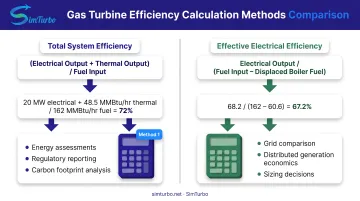
Total system efficiency treats electricity and heat as equally valuable energy outputs and compares the complete CHP system against conventional separate generation:
Formula:
Total System Efficiency = (Net Electrical Output + Net Thermal Output) / Total Fuel Input
This method works best for comparing CHP to the baseline scenario of purchasing grid electricity and operating an on-site boiler. All values must use consistent units (typically Btu or kW) and the same HHV or LHV fuel basis.
Practical calculation example:
A 20 MW gas turbine CHP system operates with:
- Net electrical output: 20,000 kW (68.2 MMBtu/hr)
- Net thermal output (recovered steam): 48.5 MMBtu/hr
- Total fuel input: 162.0 MMBtu/hr (HHV basis)
Total System Efficiency = (68.2 + 48.5) / 162.0 = 72.0%
This calculation shows that 72% of the fuel energy becomes useful output, while the remaining 28% is lost through stack exhaust, radiation, and other losses. Compared to the EPA's 50-55% baseline for separate generation, this represents a 31% reduction in fuel consumption for the same energy services.
Effective Electrical Efficiency Method
Effective electrical efficiency credits the CHP system for displacing boiler fuel that would otherwise produce the recovered heat. That credit supports a fair comparison between CHP-generated electricity and grid power:
Formula:
Effective Electrical Efficiency = Electrical Output / [Total Fuel Input - (Thermal Output / Boiler Efficiency)]
Using the same example with an assumed displaced boiler efficiency of 80%:
Effective Electrical Efficiency = 68.2 MMBtu/hr / [162.0 - (48.5 / 0.80)]
= 68.2 / [162.0 - 60.6]
= 68.2 / 101.4
= 67.2%
This method produces a higher efficiency value (67.2% versus the turbine's standalone ~42% electrical efficiency) because it accounts for the fact that the CHP system eliminates the need to burn additional fuel in a boiler.
When to use each method:
Use total system efficiency for:
- Overall energy efficiency assessments
- Comparisons to conventional separate heat and power
- Regulatory reporting and carbon footprint calculations
Use effective electrical efficiency for:
- Comparing CHP electricity to grid purchases
- Distributed generation economics
- Sizing decisions when heat demand is already met
Both methods are valid; choose the one that answers your business question. When a site already has substantial heat demand, effective electrical efficiency usually clarifies CHP economics by isolating the boiler fuel the recovered heat displaces.
Factors Affecting Gas Turbine CHP Efficiency
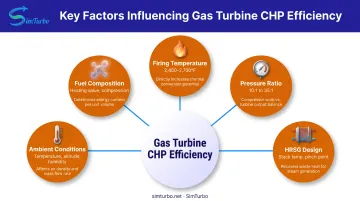
Turbine Firing Temperature
Higher combustion temperatures increase the energy extracted per unit of airflow, improving electrical efficiency. Modern industrial gas turbines operate at firing temperatures exceeding 2,400°F, while advanced aeroderivative units approach 2,700°F.
Higher firing temperatures can cut exhaust temperature available for downstream heat recovery in simple-cycle setups. That electrical-versus-thermal trade-off has to be optimized for each application.
Pressure Ratio
Pressure ratio—the ratio between compressor discharge pressure and inlet pressure—directly impacts both electrical efficiency and exhaust temperature:
- Higher pressure ratios (20:1 to 35:1) improve electrical efficiency but reduce exhaust temperature, leaving less heat available for recovery
- Lower pressure ratios (10:1 to 18:1) produce hotter exhaust with more recoverable energy but sacrifice some electrical efficiency
Current turbine examples:
| Turbine Model | Pressure Ratio | Power Output | Exhaust Temp |
|---|---|---|---|
| Siemens SGT-800 (industrial) | 18.3-22.0:1 | 45.3-62.5 MW | 1,040-1,105°F |
| Siemens SGT-A35 (aeroderivative) | 22.0-24.5:1 | 31.8-38.1 MW | — |
| GE LM6000 (aeroderivative) | 30.7-34.8:1 | 44.7-58 MW | — |
The traditional distinction of 10:1 for industrial turbines and 30:1+ for aeroderivatives no longer holds across all models, as modern industrial designs have adopted higher pressure ratios while some aeroderivative units optimize for CHP applications.
Heat Recovery Steam Generator (HRSG) Design
HRSG performance determines how much waste heat is actually converted to useful thermal output. Key design parameters include:
- Stack temperature: Lower stack temperatures indicate more complete heat recovery but risk acid gas condensation
- Pinch point: The minimum temperature difference between hot gas and steam; tighter pinch points recover more heat but require larger, more expensive heat exchangers
- Steam pressure: Higher pressure steam is more valuable for process applications but requires hotter exhaust temperatures
- Approach temperature: The difference between economizer exit water temperature and evaporator saturation temperature
A 2020 ASME study of a two-pressure HRSG configuration found about 80% exergy efficiency, with roughly 14% exergy destruction and 6% stack loss—values that shift with design and operating conditions.
Ambient Conditions
Gas turbine performance is highly sensitive to inlet air temperature because denser cold air allows higher mass flow through the turbine:
- At 100°F ambient temperature, power output may fall to 90% of ISO rating (59°F standard)
- Inlet air cooling of 40-50°F can increase output by 15-20% on hot days
- High altitude reduces air density and further decreases output
- Humidity affects mass flow and combustion properties
These effects are particularly important for summer-peaking facilities or installations in hot climates, where design-point performance may never be achieved during peak-demand periods without inlet cooling systems.
Fuel Composition
Natural gas heating value, fuel pressure requirements, and fuel gas compression parasitics all influence net efficiency:
- Lower heating value fuels require higher volumetric flow rates for the same power output
- Fuel gas compressors needed to boost pressure consume parasitic power that reduces net electrical output
- Fuel composition affects combustion temperature, emissions, and turbine maintenance intervals
Pipeline natural gas typically provides consistent properties, but facilities using biogas, landfill gas, or process gas must account for composition variability and potentially lower heating values.
Gas Turbine Types and Efficiency Characteristics
CHP results depend on which gas turbine you install. Industrial frame units and aeroderivatives differ in electrical efficiency, exhaust temperature, and power-to-heat balance—so type choice should follow your steam and power loads, not nameplate efficiency alone.
Industrial Gas Turbines
Industrial (or "frame") gas turbines are purpose-built for stationary power generation and process applications:
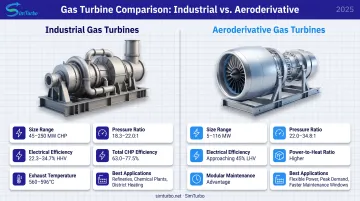
- Current size range: 1 MW to over 350 MW, with CHP applications typically in the 45-250 MW range
- Pressure ratios: Modern units span 18.3:1 to 22.0:1, higher than older designs
- Net electrical efficiency: 22.3-34.7% HHV in CHP configurations (DOE 2-25 MW cases)
- Total CHP efficiency: 63.0-70.9% without duct firing; 72.5-77.5% with supplementary firing
- Exhaust characteristics: 560-596°C exhaust temperature well-suited to steam raising
Industrial turbines excel in applications requiring large amounts of high-pressure steam, such as refineries, chemical plants, large district heating systems, and industrial manufacturing facilities.
Aeroderivative Gas Turbines
Aeroderivative turbines adapt aircraft jet engine designs for ground-based power generation:
- Current size range: Originally 5-50 MW, now extending to 116 MW (GE LMS100)
- Pressure ratios: 22.0-34.8:1, depending on model generation and optimization
- Net electrical efficiency: Approaching 45% LHV for large simple-cycle units (comparable to 42% HHV)
- CHP considerations: Higher electrical efficiency means proportionally less heat available for recovery per unit of fuel input
- Maintenance advantages: Modular construction allows faster component replacement and lower downtime
Power-to-Heat Ratio Comparison
DOE data covering mixed gas turbine CHP installations shows power-to-heat ratios of 0.55-1.01 without duct firing and 0.38-0.64 with supplementary firing. The ratio decreases with duct firing because added fuel goes primarily to steam production rather than electricity generation.
Industrial turbines typically produce more heat relative to electricity (ratios toward the lower end). High-efficiency aeroderivatives produce more balanced or power-favored ratios.
Facilities should match turbine type to their specific heat and power requirements rather than selecting based solely on electrical efficiency or first cost.
Optimizing Gas Turbine CHP Efficiency
Supplementary Firing in HRSG
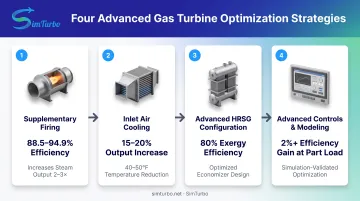
Adding fuel directly to the HRSG (duct firing) increases steam production without requiring a larger gas turbine. DOE's 2024 data shows duct burners operating at 88.5-94.9% efficiency, well above base turbine electrical efficiency.
That gap makes supplementary firing a practical way to raise thermal output when heat demand exceeds what exhaust heat alone can supply.
Example performance increase:
- 2 MW turbine: Steam output increased from 12.3 to 28.1 MMBtu/hr
- 25 MW turbine: Steam output increased from 84.0 to 196.6 MMBtu/hr
The EPA confirms that supplementary firing often exceeds 85% incremental HHV efficiency and can raise steam output while keeping the system flexible. Facilities can match shifting heat-to-power ratios across the day or season without oversized base equipment.
Inlet Air Cooling Techniques
Cooling inlet air before it enters the compressor increases air density, mass flow, and power output:
- Evaporative cooling: Sprays water into inlet airstream; lowest cost but limited by ambient humidity
- Chilled water cooling: Uses mechanical chillers for consistent cooling regardless of humidity
- Inlet fogging: Ultra-fine water droplets provide evaporative cooling with minimal pressure drop
A 40-50°F inlet temperature reduction can increase output by 15-20% during high-ambient-temperature conditions. The economic benefit depends on local electricity prices, the value of increased capacity during peak hours, and the capital and operating costs of the cooling system.
Before committing capital, engineers can model compressor performance, airflow, and power output under different inlet conditions in a simulation platform such as SimTurbo.
Advanced HRSG Configurations
Moving beyond single-pressure designs improves heat recovery and operational flexibility:
- Multi-pressure systems: Produce steam at two or three pressure levels to match different process requirements and maximize energy extraction
- Economizers: Preheat boiler feedwater using lower-temperature exhaust gas that would otherwise be wasted
- Optimized pinch points: Balance heat recovery against capital cost and pressure drop
A 2020 ASME analysis found approximately 80% exergy efficiency in a two-pressure HRSG, with supplementary firing able to reduce stack exergy loss (subject to tube temperature limits). However, the optimal configuration depends on site-specific steam pressure requirements, load profiles, and economic factors rather than a universal "best" design.
Advanced Controls and Modeling
Modern control strategies adjust fuel flow, inlet guide vanes, and steam extraction to maintain optimal efficiency across varying loads and conditions. Testing control logic in a virtual environment before deployment reduces commissioning time and avoids costly field troubleshooting. GE reports that an LM6000 variable inlet guide vane (VIGV) upgrade improved fuel efficiency by more than 2% at 70% power while raising exhaust energy by 3%.
Simulation tools that model compressor-turbine matching, control response, fuel use, and transient behavior let engineers test optimization strategies before hardware changes. SimTurbo supports this kind of virtual evaluation so teams can validate control logic and forecast performance shifts with less field trial-and-error.
Real-World Performance and Efficiency Considerations
Efficiency Degradation Over Time
Gas turbine CHP efficiency declines gradually due to:
- Compressor fouling: Airborne contaminants deposit on compressor blades, reducing airflow, pressure ratio, and surge margin
- Turbine degradation: High-temperature operation causes blade oxidation, coating loss, and tip clearance growth
- Heat exchanger fouling: Particulates and combustion byproducts accumulate on HRSG tube surfaces, reducing heat transfer
No universal annual degradation rate applies across all installations because fouling depends heavily on air quality, filtration, fuel composition, operating hours, and maintenance practices. Sites in dusty or coastal environments experience faster degradation than those with clean inlet air and high-quality fuel gas.
Maintenance Impact on Efficiency
Preventive maintenance programs directly affect sustained performance:
- Compressor washing: Online and offline washing removes deposits and can restore 70-90% of lost performance
- Combustor inspections: Detecting and repairing fuel nozzle wear, liner cracks, and transition piece damage maintains combustion efficiency and prevents unplanned outages
- HRSG tube cleaning: Chemical or mechanical cleaning restores heat transfer and prevents localized overheating
Facilities that implement rigorous maintenance schedules maintain near-design efficiency, while those that defer maintenance experience accelerating performance losses and eventually forced outages.
Part-Load Efficiency
Load profile shapes real-world results as much as fouling and maintenance do. Gas turbines reduce electrical efficiency at part load as firing temperature decreases, but total CHP efficiency often remains relatively stable. As electrical efficiency falls, exhaust temperature and mass flow changes leave a larger share of fuel energy available as recoverable heat. CHP systems therefore hold strong fuel utilization across a wide operating range, unlike simple-cycle plants where part-load efficiency drops significantly.
GE's LMS100 aeroderivative, for example, can run at part load as efficiently as many turbines at full load. That gap is why engineers need model-specific data rather than generic assumptions. Model your specific turbine and HRSG configuration across the expected operating range to see actual part-load performance.
Frequently Asked Questions
What is the average efficiency of a gas turbine?
Simple-cycle gas turbines achieve 25–40% electrical efficiency depending on size and technology. In CHP configurations, total efficiency reaches 65–80% by recovering exhaust heat that would otherwise be wasted.
How do you calculate gas turbine CHP (cogeneration) efficiency?
Use total system efficiency—(electrical output + thermal output) / fuel input—when comparing CHP to separate heat and power. Use effective electrical efficiency—electrical output / (fuel input − thermal output / boiler efficiency)—when comparing CHP power to the grid. Both are valid; pick the one that matches your question.
What's the difference between total system efficiency and effective electrical efficiency?
Total system efficiency treats electricity and heat as equally valuable outputs. Effective electrical efficiency credits CHP for fuel that a boiler would otherwise burn, so the calculated electrical efficiency is higher when useful heat demand already exists.
How does gas turbine CHP efficiency compare to gas engine CHP?
Gas reciprocating engines achieve higher electrical efficiency (28-40% HHV) but produce more low-grade heat suitable primarily for hot water below 200°F. Gas turbines have lower electrical efficiency (22-35% HHV in CHP trim) but generate all high-grade exhaust heat at 800°F+, ideal for high-pressure steam and process applications. Choose based on facility heat requirements.
What factors can reduce gas turbine CHP efficiency over time?
Compressor fouling, combustor degradation, HRSG tube fouling, and control system drift are primary causes. Fouling reduces airflow and pressure ratio; combustor wear affects combustion efficiency and emissions; heat exchanger deposits reduce thermal recovery. Regular compressor washing, combustor inspections, and HRSG cleaning maintain design performance.
Can gas turbine CHP efficiency be improved after installation?
Yes. Inlet cooling, supplementary firing, HRSG optimization, and better controls can restore or raise performance. Variable inlet guide vane upgrades may improve part-load efficiency by 2% or more. Simulation tools help evaluate these options before you implement them.
About SimTurbo: SimTurbo is Windows-based gas turbine simulation software for aerospace, power systems, and marine engineers. It supports steady-state and transient analysis, compressor/turbine matching, heat recovery modeling, and control validation.
Engineers can test efficiency upgrades, inlet cooling, and fuel scheduling in a virtual environment before deployment. SimTurbo offers a free 30-day trial and consulting for advanced CHP simulation projects.