This article explains how hydrogen gas turbine efficiency works in practice. You'll learn the fundamentals of thermal efficiency in hydrogen turbines, how performance compares to natural gas, the technical challenges engineers face, and the optimization strategies—including simulation—that help maximize efficiency before physical testing.
Key Takeaways
- Hydrogen turbines hit 38–42% simple-cycle and 58–63% combined-cycle efficiency, matching optimized natural gas units
- Efficiency hinges on inlet temperature, pressure ratio, combustion design, and purpose-built vs. converted hardware
- 20–30% hydrogen blends ease infrastructure transition, though mixed-fuel runs can briefly cut efficiency
- Simulation platforms validate fuel blends, control strategies, and thermodynamic cycles before hardware prototyping
Understanding Hydrogen Gas Turbine Efficiency Fundamentals
Thermal efficiency in gas turbines is the ratio of useful electrical or mechanical output to the heat energy supplied by fuel. Hydrogen changes this calculation because its combustion properties differ sharply from natural gas.
Hydrogen's flame speed is roughly seven times faster, and its volumetric energy density at atmospheric pressure (approximately 3.0 MJ/m³) is far lower than natural gas (38.3 MJ/m³). Turbines burning hydrogen therefore need nearly three times the volumetric fuel flow, which stresses fuel-delivery systems, injectors, and control logic.
The Brayton Cycle with Hydrogen Fuel
Gas turbines operate on the Brayton cycle: air compression, fuel combustion, expansion through the turbine, and exhaust. In an ideal cycle, efficiency increases with compressor pressure ratio according to:
η = 1 − 1 / PR^((γ−1)/γ)
where PR is the pressure ratio and γ is the heat-capacity ratio. Hydrogen's higher flame speed and reactivity shift the combustion phase, affecting ignition timing, flame stability, and heat release. Engineers must adjust combustor geometry and control parameters to maintain stable, complete combustion across load changes.
Simple Cycle vs. Combined Cycle Configurations
| Configuration | Typical H₂ efficiency | Notes |
|---|---|---|
| Simple cycle | 38–42% | Kawasaki L30A 100% H₂ package: 39.6% electrical |
| Combined cycle (GTCC) | 58–63% | Waste-heat recovery via steam turbine adds ~15–20 points |
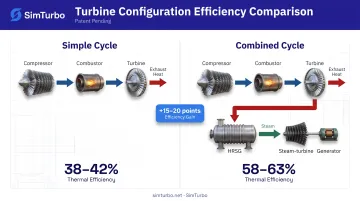
Combined-cycle plants capture exhaust energy to drive a secondary steam turbine, raising overall system efficiency by that recovery margin. Mitsubishi's hydrogen-capable M501J/JAC line is rated at more than 64% combined-cycle efficiency, though that figure reflects design capability rather than field-tested 100% hydrogen operation.
Key Efficiency Metrics Engineers Track
- Net electrical efficiency: Net output divided by fuel energy input (LHV or HHV basis)
- Heat rate: Fuel energy per net kWh; efficiency = 3,412 / heat rate (Btu/kWh)
- Thrust-specific fuel consumption (TSFC): For aero-derivative turbines
- Capacity factor: Actual output versus rated capacity over time
- Part-load efficiency: Performance at reduced power output
Because hydrogen's heating value per unit volume is low, always state whether efficiency uses an LHV or HHV basis, and whether the figure is gross (turbine output only) or net (after parasitic loads).
How Hydrogen Turbine Efficiency Compares to Conventional Fuels
Comparative Efficiency Data
| Fuel Configuration | Simple Cycle Efficiency | Combined Cycle Efficiency |
|---|---|---|
| Natural gas (0% H₂) | 38–40% | 58–62% |
| Hydrogen blend (30% H₂) | 40.6% (Kawasaki GPB300D-H2) | 64–65% (modeled) |
| Pure hydrogen (100% H₂) | 39.6% (Kawasaki GPB300-H2) | 58–63% (various models) |
Kawasaki's product line demonstrates that hydrogen efficiency is not intrinsically lower than natural gas. A 2024 modeling study holding turbine inlet temperature constant showed a 453 MW-class turbine rising from 44.00% on natural gas to 45.55% at 100% hydrogen in simple cycle. Combined-cycle efficiency moved from 64.50% to 65.22% under the same conditions.
These are simulation results, not field measurements. They still confirm that hydrogen's thermodynamic properties can support equal or higher efficiency when combustor design and operating parameters are optimized.
CO₂ Emissions Reduction and Efficiency Trade-Offs
Hydrogen produces zero CO₂ at the point of combustion. Field evidence from two utility-scale demonstrations shows:
- 20.9% hydrogen blend delivered 7% CO₂ reduction at Plant McDonough (265 MW Mitsubishi M501G)
- 38.8% hydrogen blend produced approximately 18% CO₂ reduction at Constellation Hillabee (Siemens SGT6-6000G)
Neither project reported a significant efficiency penalty during blended operation. EPRI's McDonough test observed improved heat rate at constant firing temperature with 20% hydrogen and no turbine-hardware modifications. Efficiency trade-offs depend heavily on whether the combustor was designed for hydrogen or retrofitted.
NOx Emission Trade-Offs
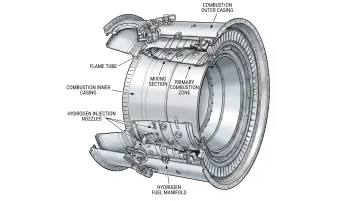
Hydrogen's higher flame temperature (~2,300°C versus ~1,950°C for natural gas) increases nitrogen oxide formation. Mitigation strategies include:
- Dry low-NOx (DLE) combustors use lean premixed combustion to lower flame temperature
- Micromix burners create smaller, distributed flames through many sub-millimeter injection holes
- Water or steam injection cools the combustion zone but consumes energy and needs extra equipment
Siemens' HYFLEXPOWER demonstration achieved below 25 ppm NOx across 0–100% hydrogen blends using dry low-emissions technology. Purpose-built combustors can keep NOx in check, and water injection is not always required. Published project data do not support a universal efficiency penalty for NOx mitigation.
Economic Efficiency Considerations
Hydrogen's current fuel cost still weighs on economic efficiency even when thermal efficiency matches natural gas. The IEA projects $2–9/kg for low-emissions hydrogen by 2030. Additional cost drivers include:
- Roughly three times the volumetric fuel flow versus natural gas
- Fuel-system and control modifications
- Hydrogen-rated combustors and fuel nozzles
- Inspection and maintenance for embrittlement and leaks
- Possible water-system equipment for NOx control
Technical Challenges Affecting Hydrogen Turbine Efficiency
Flashback and Combustion Stability
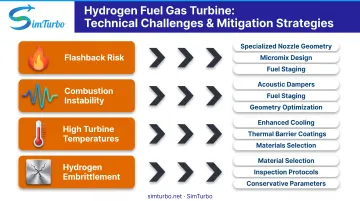
Flashback—upstream flame propagation into the fuel-air premixer—can rapidly damage metal components. Hydrogen's flame speed is up to seven times faster than natural gas, making flashback a primary design concern at hydrogen concentrations of 25% or higher. Common flashback controls include:
- Specialized nozzle geometry with reduced mixing residence time
- Micromix combustor designs using many sub-millimeter injection holes
- Fuel staging to control flame position
Those choices can make combustion optimization harder. No authoritative source pins a universal efficiency penalty, including the often-cited 2–4% range.
Combustion Instability and Pressure Oscillations
Hydrogen's short ignition delay and high reactivity can create destructive acoustic resonance in combustion chambers.
Constellation Hillabee's demonstration used per-basket acoustic sensors and spectral analysis to monitor combustion dynamics. Pressure-oscillation amplitudes stayed muted for tested blends up to 38.8% hydrogen. Typical mitigations include:
- Acoustic dampers
- Fuel staging across multiple injection points
- Combustor geometry optimization
- Real-time control adjustments based on acoustic feedback
Turbine Inlet Temperature and Cooling Requirements
Higher turbine inlet temperatures (TIT) improve thermodynamic efficiency per the Carnot principle, but hydrogen's higher flame temperature stresses turbine materials.
Hydrogen exhaust also carries more moisture, which raises convective heat transfer in the hot gas path. The DOE/NETL safety review flags the need for enhanced cooling, though cooling-air share and maximum TIT still depend on the turbine model and materials.
Mitsubishi's JAC platform raised TIT from 1,600°C to 1,650°C with ultra-thick thermal-barrier coatings and a higher pressure ratio, lifting simple-cycle efficiency from 42% to 44% and combined-cycle efficiency from 62% to 64%.
That gain shows what materials and cooling can unlock. The figures still reflect natural-gas capability, not validated 100% hydrogen operation.
Hydrogen Embrittlement
Hydrogen molecules can penetrate metal crystal structures, causing fatigue cracks and leaks. The NETL review identifies embrittlement-driven fatigue and high-temperature attack (pitting, cracking) as material concerns. Risk controls typically include:
- Material selection for hydrogen compatibility
- Regular inspection protocols
- Conservative operating parameters during initial deployment
These measures add cost and complexity but do not inherently limit peak efficiency if properly managed.
Measuring and Optimizing Hydrogen Gas Turbine Performance
Key Performance Monitoring Parameters
Engineers track multiple parameters to optimize hydrogen turbine operation:
- Turbine inlet and outlet temperatures: Indicate combustion quality and thermal stress
- Pressure ratios: Define compression work and expansion efficiency
- Fuel flow rates: Must account for hydrogen's lower volumetric energy density
- Exhaust gas composition: Monitors combustion completeness and emissions
- Vibration levels: Detect mechanical stress from combustion dynamics
- Real-time efficiency calculations: Net electrical output versus fuel energy input
At Hillabee, the team measured hydrogen flow with a Coriolis meter and verified fuel composition with on-site and off-site gas chromatography. They also tracked NOx, exhaust temperature, fuel-circuit pressures, trip events, and combustor acoustics in real time.
Efficiency Testing Methodologies
These standards keep results consistent and comparable:
- ASME PTC 22-2023: Covers open-cycle gas turbines, specifying corrected power, heat rate, efficiency, exhaust flow, and exhaust energy measurements
- ASME PTC 46: Provides procedures for overall combined-cycle plant performance
- ISO 2314:2009: Acceptance tests for open-cycle gas-turbine plants (legacy standard)
These codes define ambient-condition corrections, instrumentation requirements, and calculation methods to produce defensible efficiency values.
Optimization Strategies for Maximum Efficiency
Ways to raise hydrogen turbine efficiency include:
- Fuel-air ratio tuning: Adjust total fuel flow and injection split for complete combustion and a stable temperature profile
- Combustor staging adjustments: Split fuel across injection points to limit flashback while holding stable combustion
- Turbine inlet temperature management: Hold or adjust TIT to raise cycle efficiency without overstressing materials
- Exhaust heat recovery: In combined-cycle plants, tune HRSG design and operation to capture more exhaust energy
- Control system tuning: Refine PID gains, fuel schedules, and protection logic so efficiency holds through transients
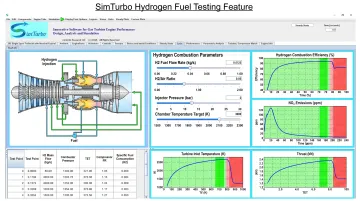
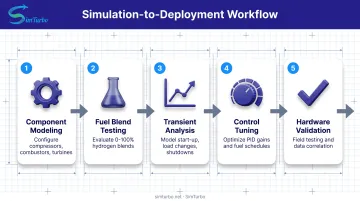
Simulation tools such as SimTurbo let engineers model these optimizations before changing hardware. Teams can configure compressors, combustors, turbines, nozzles, shafts, sensors, actuators, and controls, then compare component performance, cycle behavior, and control response across hydrogen blends, loads, and ambient conditions.
That virtual pass cuts the time and cost of physical prototyping.
Real-World Applications and Efficiency Benchmarks
Current Hydrogen Turbine Installations
| Size Class | Installation | Efficiency / Status | Source |
|---|---|---|---|
| 1–10 MW | Kawasaki 1.786 MW, 100% H₂ | Efficiency not disclosed; 70 ppm NOx at 16% O₂ | Kawasaki, 2023 |
| 10–50 MW | Kawasaki L30A, 34.12 MW, 100% H₂ | 39.6% electrical efficiency | Kawasaki |
| 50–300 MW | Mitsubishi M501G, 265 MW, 20.9% H₂ | Improved heat rate at constant firing temperature | EPRI, 2022 |
| 300+ MW | Mitsubishi M501J/JAC, 330–453 MW | >64% combined cycle (30% H₂ capable, product rating) | Mitsubishi Power |
Siemens Energy's HYFLEXPOWER ran an SGT-400 across 0–100% hydrogen with dry low-emissions combustion. The demo proved fuel flexibility but did not publish a final electrical-efficiency figure.
GE Vernova reports 120+ turbines and more than 10 million operating hours on fuels with 5–100% hydrogen. Capability still varies by turbine model and combustion system.
Transitional Mixed-Fuel Approaches
Until pure-hydrogen supply and hardware catch up, most projects blend fuels so plants can transition in stages:
- Plant McDonough (20.9% H₂): No turbine hardware changes; heat rate improved at constant firing temperature
- Constellation Hillabee (38.8% H₂): NOx held in check with tuning and downstream controls; combustion dynamics stayed muted
Modest blends (20–30%) can run without major efficiency penalties when combustors are tuned well. Higher concentrations need combustor redesigns for flashback, dynamics, and emissions.
Purpose-built packages change that picture: Kawasaki’s 30% and 100% hydrogen designs still post competitive efficiency.
Scalability and Efficiency at Different Power Levels
Efficiency generally increases with turbine size due to:
- Reduced boundary-layer losses relative to flow area
- Higher achievable pressure ratios and turbine inlet temperatures
- Improved heat-recovery economics in combined-cycle configurations
- Lower parasitic losses as a percentage of total output
Size is not the whole story. Pressure ratio, TIT, component efficiency, cycle layout, and auxiliary loads usually matter more.
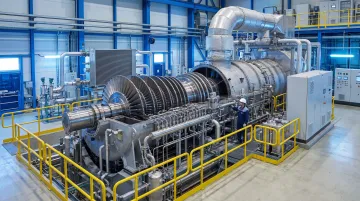
Kawasaki’s 1.786 MW package already runs 100% hydrogen with dry combustion, while the largest published blend (38.8%) ran on a utility-scale Siemens machine. No single efficiency-versus-size curve fits hydrogen turbines apart from those design choices.
The Role of Simulation in Hydrogen Turbine Design
How Simulation Tools Accelerate Hydrogen Turbine Development
Computational modeling lets engineers test hydrogen concentrations, combustor geometries, control strategies, and operating conditions without expensive physical prototypes.
SimTurbo supports component-level simulation so teams can validate designs, optimize thermodynamic cycles, and tune controls before hardware testing:
- Compressors, combustors, turbines, and nozzles
- Shafts, sensors, actuators, and control logic
Engineers can set fuel-blend ratios, adjust fuel-air distribution, and examine transient responses during start-up and load changes. They can also evaluate surge margin, turbine inlet temperature limits, and efficiency trade-offs in real time.
Transient data such as RPM, exhaust gas temperature, thrust, and fuel consumption can be exported to Excel, MATLAB/Simulink, or Python for post-processing and control-law development.
Validation and Accuracy Requirements
Simulation models must be validated against experimental data to ensure reliability. SimTurbo's J85-GE-21 turbojet simulation was validated against NASA Lewis Research Center test data, achieving accuracy within ±2% for thrust, flow rate, temperature, and thrust-specific fuel consumption. That validation gives engineers a solid basis for trusting predicted efficiency, emissions, and operating behavior.
Hydrogen-specific validation requires field data from hydrogen-fueled turbines. As more hydrogen-fueled units log operating hours, models can fold in combustion kinetics, flame stability correlations, and emissions data—and predictive accuracy for hydrogen work improves with each dataset.
Simulation Use Cases for Efficiency Optimization
- Evaluate efficiency, emissions, and operability across 0%, 20%, 30%, 50%, and 100% hydrogen blends
- Model start-up, shutdown, throttle changes, and load steps to find efficiency losses in transients
- Tune PID gains, fuel schedules, and protection logic to hold efficiency without surge or over-temperature
- Compare pressure ratios, turbine inlet temperatures, recuperation, intercooling, and combined-cycle layouts for net efficiency
Virtual studies cut prototype loops and testing cost, so teams lock blend strategies and control settings sooner and field high-efficiency hydrogen turbines faster.
Future Outlook for Hydrogen Gas Turbine Technology
Efficiency Improvement Trajectories
Several technology paths are pushing hydrogen turbine efficiency higher:
- Thermal-barrier coatings and high-temperature alloys targeting 1,700–1,800°C turbine inlet temperatures
- Micromix burners and distributed lean-burn architectures that control flashback and NOx without efficiency penalties
- Film cooling, impingement cooling, and ceramic matrix composites that cut parasitic cooling losses
- Digital twins and AI-driven controls for real-time monitoring and adaptive optimization
Siemens Energy's Zero Emission Hydrogen Turbine Center is aiming for 100% hydrogen capability on its test fleet by 2030. OEMs continue refining combustors and materials to push efficiency higher.
Infrastructure Development Needs
Turbine technology alone will not set the pace of adoption. Widespread high-efficiency deployment also depends on:
- Renewable electrolysis and other low-emissions hydrogen production at scale
- Pipeline networks that move hydrogen from production sites to power plants
- Geological storage, liquefaction, or compressed-gas facilities
These external factors shape timelines regardless of how mature the turbines become. Fuel-blending strategies let utilities start decarbonizing on existing natural-gas infrastructure while hydrogen supply chains scale up.
Frequently Asked Questions
How does hydrogen gas turbine efficiency compare to natural gas turbines?
Properly designed hydrogen turbines match natural gas thermal efficiency: about 38–42% simple cycle and 58–63% combined cycle. Kawasaki reports 40.3% on natural gas, 40.6% on 30% hydrogen, and 39.6% on 100% hydrogen, so fuel type alone does not set efficiency.
What factors most significantly impact hydrogen gas turbine efficiency?
Turbine inlet temperature, pressure ratio (typically 15:1 to 25:1), combustor design, and cooling-air losses have the largest impact. Part-load operation, ambient conditions, and pure-versus-blend optimization also matter.
Can existing natural gas turbines be converted to run on hydrogen without losing efficiency?
Blends of 20–30% hydrogen usually keep efficiency with minimal changes; EPRI's McDonough test needed no hardware changes and saw improved heat rate. At 50–100% hydrogen, combustor and fuel-system upgrades are required, and efficiency may dip 2–5% until the combustor is optimized.
What is the typical efficiency range for hydrogen-fueled gas turbines?
Verified simple-cycle efficiency for 100% hydrogen is 39.6% (Kawasaki L30A); modeled combined-cycle figures range from 54% to 65% by size and layout. Always state gross vs. net, LHV vs. HHV, and whether the number is from a field unit or a simulation.
How do NOx emissions affect hydrogen gas turbine efficiency?
Hydrogen's higher flame temperature can raise NOx, but dry low-NOx and micromix combustors often control it without efficiency penalties (Siemens' HYFLEXPOWER stayed below 25 ppm across 0–100% hydrogen). Water or steam injection also works but adds complexity; design quality matters more than fuel type.
What role does turbine inlet temperature play in hydrogen combustion efficiency?
Higher turbine inlet temperature improves Carnot efficiency; modern hydrogen turbines run near 1,600–1,650°C. Hydrogen's hotter flame (~2,300°C vs. ~1,950°C for natural gas) can help, though advanced cooling partly offsets the gain, and 2024 fixed-TIT modeling still showed efficiency benefits from hydrogen's combustion properties.