What do power generation consultants do?
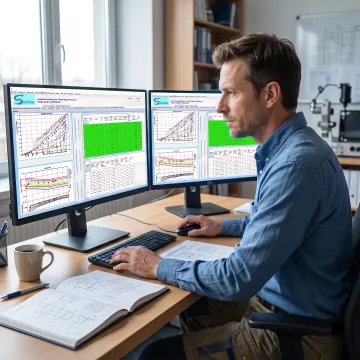
Power generation consultants help organizations assess, design, analyze, and improve power-system equipment and operating strategies. For gas turbine projects, this can include cycle analysis, component matching, performance prediction, fuel-use evaluation, transient studies, control-system development, feasibility work, and validation of proposed changes. SimTurbo supports these activities with component-based simulation and engineering consultation.
Can SimTurbo model industrial gas turbines for power generation?
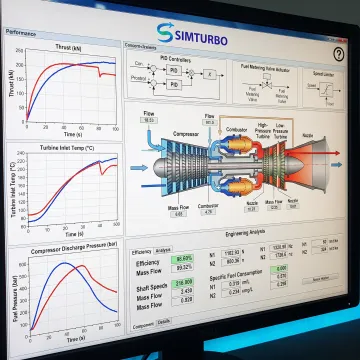
Yes. SimTurbo is positioned for industrial gas turbines as well as aerospace and marine applications. Users can configure engine architectures and evaluate compressors, combustors, turbines, shafts, nozzles, recuperators, and related components. The platform supports thermodynamic cycle development, performance optimization, operating-point studies, off-design analysis, and power-system engineering investigations.
What is steady-state gas turbine performance analysis?
Steady-state analysis evaluates a gas turbine at defined operating conditions where key variables are not changing over time. It can assess power or thrust, efficiency, fuel consumption, pressure ratio, component performance, ambient-condition effects, emissions, and matching. These results establish a baseline for comparing designs, identifying constraints, and selecting more effective operating points.
Why is transient simulation important for gas turbine systems?
Transient simulation examines how a gas turbine responds during changing conditions such as startup, shutdown, load changes, acceleration, deceleration, sensor delays, and faults. It is important because a system that performs well at a single steady operating point may behave differently during actual transitions. The analysis helps teams assess response, stability, protection logic, and control strategies before testing.
Can you help design gas turbine control systems?
SimTurbo supports control-system design and validation for gas turbines, including PID controllers, fuel scheduling, start and shutdown logic, actuator and sensor models, gain scheduling, limiters, and engine-protection functions. Closed-loop simulation allows engineers to assess stability and transient response. This can reduce uncertainty before applying a control approach to a physical system or hardware-in-the-loop environment.
Does SimTurbo support recuperated and regenerated cycles?
Yes. SimTurbo supports studies of recuperated, regenerated, reheated, intercooled, and afterburning gas turbine configurations. These analyses can help teams investigate waste-heat recovery, thermal efficiency, fuel consumption, emissions, component interactions, and alternative cycle architectures. Modeling advanced cycles early provides a structured way to compare potential gains with design complexity and operating constraints.
Can simulation data be exported for additional analysis?
Yes. SimTurbo enables users to export simulation data for post-processing in tools such as Excel, MATLAB/Simulink, and Python. This capability supports custom visualization, comparison with test data, report preparation, optimization workflows, and integration with broader engineering analyses. Teams can retain the interactive model while using familiar tools to evaluate results in greater depth.
Is SimTurbo available for universities and students?
Yes. SimTurbo offers academic simulation solutions for universities, engineering colleges, laboratories, research organizations, and students. Available options include discounted student licenses, classroom and laboratory licenses, research access, and campus-oriented programs. The platform can support propulsion, thermodynamics, gas turbine engineering, capstone projects, demonstrations, and simulation-based practical learning with industry-focused modeling capabilities.