According to AHRQ, simulation modeling is a dynamic method that represents process behavior over time and shows how random variation affects time-based events and resources. Whether you're evaluating a manufacturing layout, testing hospital staffing levels, or analyzing supply chain resilience, simulation enables you to answer "what-if" questions with quantitative evidence rather than gut instinct.
This article explores the core concepts, methodologies, applications, and practical considerations that make simulation modeling a powerful tool for engineering, operations, and strategic decision-making.
Key Takeaways
- Simulation creates risk-free virtual environments to test process changes, designs, and policies before committing resources
- Discrete-event, agent-based, and system dynamics methods each fit different system structures and time horizons
- Proven uses span manufacturing, healthcare, logistics, finance, and engineering, including bottleneck analysis and capacity planning
- Teams test changes without disrupting operations, manage complex systems, and explain decisions more clearly to stakeholders
- Pick a method based on system structure, detail needed, data availability, and operational versus strategic focus
What is Simulation Modeling?
Core Concepts and Definitions
Simulation modeling is a mathematical and computational technique that mimics the operation of real systems over time. Unlike static spreadsheets or optimization models, it represents dynamic behavior: entities moving through processes, competing for resources, forming queues, and responding to variability.
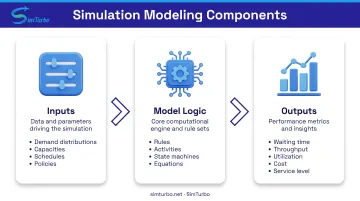
The fundamental components of any simulation model include:
- Inputs: Factors you vary on purpose—demand distributions, capacities, schedules, and policies
- Model logic: Rules and relationships that define system behavior (activities, state machines, or equations)
- Outputs: Metrics such as waiting time, throughput, utilization, cost, and service level
A Winter Simulation Conference paper stresses that models are purpose-specific simplifications, not replicas of reality. Scope, detail, assumptions, and simplifications need to be stated up front. Extra complexity can hurt accuracy when the data or knowledge base cannot support it.
How Simulation Differs from Other Analytical Methods
Simulation is built for systems that change over time, include randomness, and involve interacting parts:
- Versus forecasting: Forecasting predicts future values; simulation models the causal process that produces them and supports scenario comparison
- Versus optimization: Optimization seeks a best decision for an objective; simulation shows how the system actually behaves under each option
- Versus static models: Spreadsheets often skip event order, queues, resource contention, and day-to-day variability
NIST research notes that deterministic network calculations cannot capture the probabilistic treatment of congestion and variability that simulation provides. Use simulation when time, randomness, constrained resources, or feedback make a static calculation a poor fit.
Types of Simulation Modeling Approaches
Discrete-Event Simulation (DES)
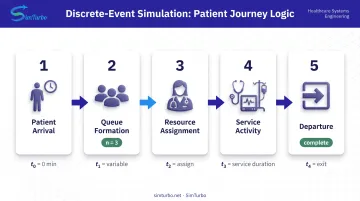
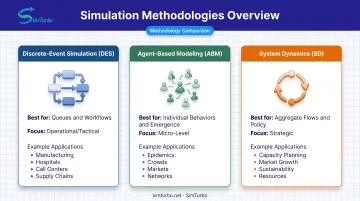
Discrete-event simulation models systems where state changes happen at specific points in time, each triggered by a discrete event. Examples include a patient arriving, a part finishing machining, or a call entering a queue.
Ideal applications include:
- Manufacturing processes with machines, conveyors, and work-in-process inventory
- Service operations such as hospitals, banks, and call centers where entities queue for resources
- Supply chains with order arrivals, shipments, and warehouse operations
- Airport terminals with passengers moving through check-in, security, and boarding
Healthcare DES research confirms that DES is widely used for dynamic, stochastic systems. A 2024 hospital case study using DES to balance clinic and surgery staffing reported a modeled total wait of 94.8 days versus 105.4 days in the baseline scenario. That gap shows how simulation can quantify the impact of resource allocation decisions before you change the real system.
Agent-Based Modeling (ABM)
Agent-based modeling simulates autonomous agents (individuals, organizations, or other entities) with their own behaviors, decision rules, and interactions. System-level patterns emerge from these micro-level behaviors without centralized control.
ABM is most appropriate for:
- Epidemic spread and public-health interventions where individual contact patterns drive disease transmission
- Crowd dynamics, pedestrian flow, and evacuation planning
- Market behaviors, consumer adoption, and competitive dynamics
- Organizational networks and decentralized decision-making
Public health research documents ABM applications in infectious-disease control, health behavior, care access, and policy experiments. ABM excels when heterogeneity, adaptation, and emergent phenomena matter, but parameterization and validation demands can be high.
System Dynamics (SD)
System dynamics models aggregate stocks, flows, feedback loops, nonlinearities, and delays to understand long-term strategic behavior. Rather than tracking individual entities, SD focuses on accumulation processes and causal feedback structures.
Best use cases include:
- Strategic planning and long-horizon policy analysis
- Resource management over time, including capacity growth and workforce planning
- Supply chain dynamics such as the bullwhip effect
- Population growth, market diffusion, and sustainability studies
MIT guidance identifies SD applications in business policy, market growth, forecasting, health, energy, and sustainability. SD is strong for understanding systemic behavior patterns but may hide heterogeneity that operational models require.
Hybrid and Multimethod Simulation
Complex problems often require combining multiple simulation approaches. For example, modeling hospital operations might use DES for patient flow through departments, ABM for individual clinician decisions, and SD for long-term capacity and budget feedback.
Winter Simulation Conference literature reports that hybrid simulation became a full conference track in 2014, with a decade of development combining SD, DES, and ABM methods. Hybrid models add value when problems span multiple levels or mechanisms, but they also increase data requirements, expertise demands, computational burden, and validation complexity.
Applications and Use Cases of Simulation Modeling
Simulation modeling shows up wherever teams need to test decisions before committing capital, staff, or hardware. The same core methods scale from factory floors and hospital wards to engine design labs.
Manufacturing and Production
Plants use simulation to optimize production lines, find bottlenecks, trial layout changes, and stress-test equipment investments before spend. NIST research maps common targets:
- Layout, routing, and labor assignment
- Inventory, batch size, and cycle time
- Schedules, sequencing, and throughput
- Capacity, maintenance, and reliability
A NIST DES study varied machine type, machine count, and material to compare productivity and energy efficiency. Typical shop-floor cases include automotive assembly line balancing, semiconductor fabrication planning, and job shop scheduling.
Supply Chain and Logistics
Warehouses, carriers, and network planners run models to design facilities, set inventory policies, and plan transportation under uncertainty. NIST guidance pairs simulation with optimization for:
- Network design and depot assignment
- Resource investment and control-policy selection
- Routes and probabilistic demand or lead-time variability
Real deployments include e-commerce fulfillment center design, global supply chain risk analysis, and last-mile delivery optimization.
Healthcare Operations
Hospitals and clinics model:
- Patient flow and emergency department staffing
- Operating room scheduling
- Bed capacity and growth policies
A Kentucky long-term care study tested beds, utilization, wait times, and annual capacity-growth rules. A 2025 emergency department DES varied nurse and bed counts to cut waits and raise utilization. Most validation deviations stayed below 5%, though one comparison differed by 14%. Accuracy still hinges on scope, data quality, and assumptions.
Engineering and Product Development
Engineers use simulation to model physical systems, trial designs virtually, validate performance, and shape control systems. Work spans aerospace, automotive, power systems, and related specialties.
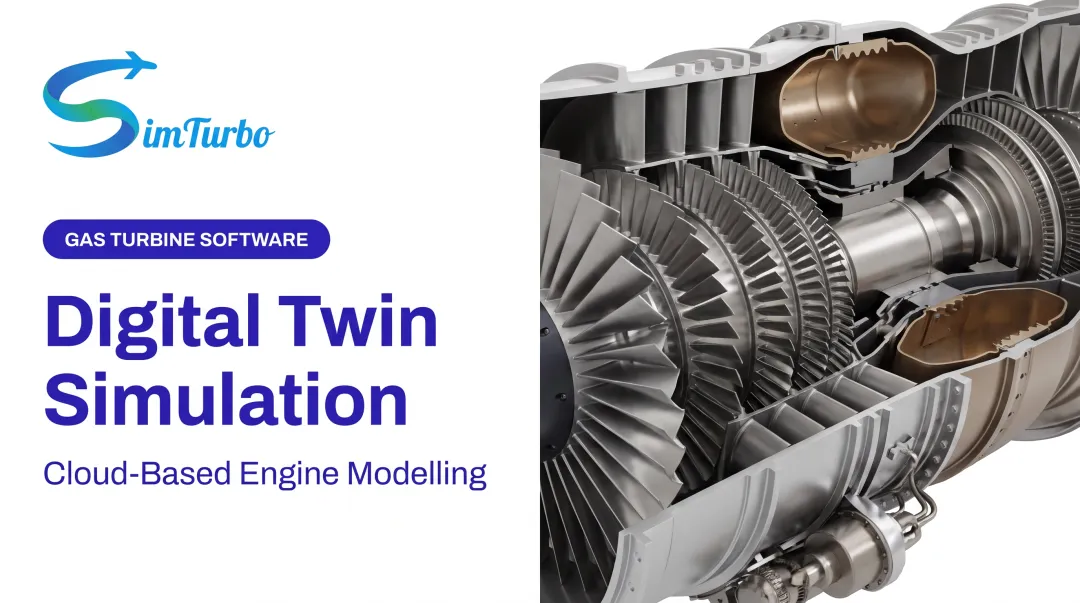
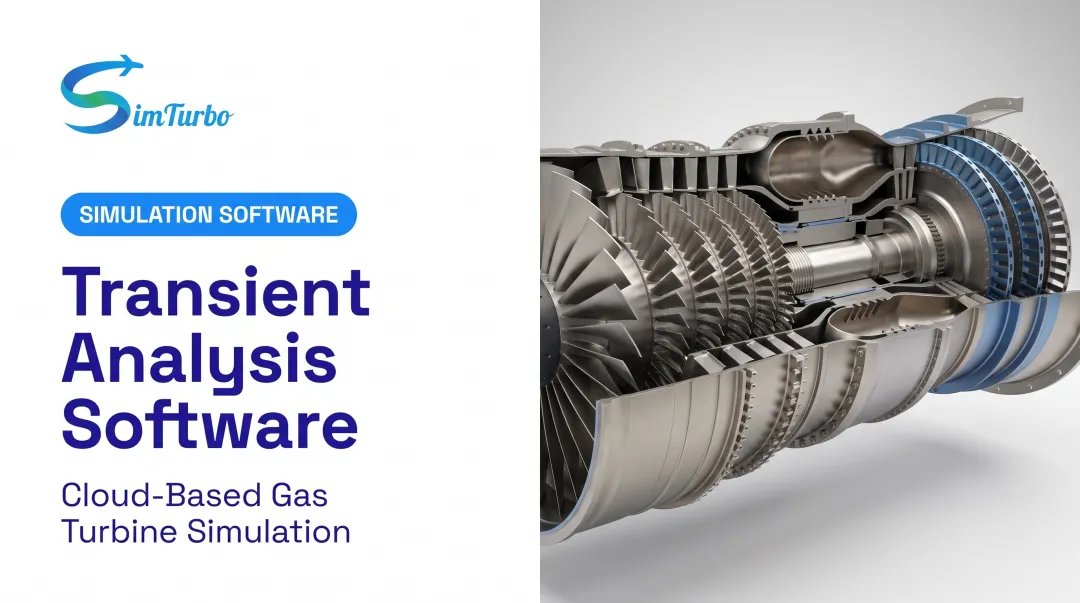
SimTurbo, for example, gives aerospace, marine, and power-generation engineers gas turbine performance analysis and control-system validation on a component-based platform. Teams run steady-state cycle analysis, transient startup dynamics, compressor-turbine matching, and control-law testing before hardware is built.
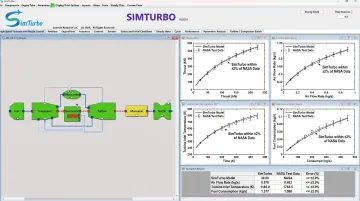
SimTurbo's J85-GE-21 single-spool turbojet model was checked against NASA Lewis Research Center test data within ±2% for thrust, flow rate, temperature, and thrust-specific fuel consumption. That level of agreement supports virtual prototyping and control design ahead of physical rig tests.
Business Process and Service Operations
Service organizations simulate call centers, retail staffing, process redesign, and customer experience changes. Airport terminal DES research compared fixed versus variable check-in and security capacity on waits, queue lengths, and utilization. Variable-capacity scenarios improved nearly every metric reported.
Benefits and Value Proposition of Simulation Modeling
Simulation modeling earns its keep when live trials are too slow, costly, or risky. Teams use it to learn faster before committing hardware, schedule, or budget.
- Test dangerous, expensive, or impractical scenarios (surge conditions, equipment failures, extreme loads) without disrupting live operations
- Cut physical prototyping and untested changeovers; NIST research ties simulation to less trial-and-error disruption
- Compare alternatives with quantitative outputs, surface trade-offs, and watch system behavior over time instead of relying on guesswork
- Represent randomness, queues, resource limits, feedback loops, and non-linear effects that static analytical methods handle poorly
Model development still takes skilled effort, and results need experienced interpretation. Extra complexity does not automatically improve accuracy. Fit for purpose depends on data quality, validation, and a scope matched to the decision you need to make.
The Simulation Modeling Process and Workflow
Building and using a simulation model follows a structured workflow:
- Understand the problem and set modeling objectives
- Define output measures that answer your decision question
- Identify experimental inputs you will vary across scenarios
- Set scope, detail, assumptions, and simplifications explicitly
- Collect and analyze input data, then implement model logic in software
- Verify implementation (was it coded correctly?) and validate fitness for purpose (is accuracy sufficient for this decision?)
- Design experiments and run replications, then analyze output uncertainty
- Communicate results and implement decisions, then document the model and review reusable models periodically
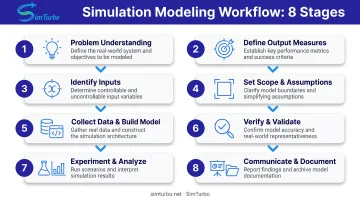
Verification and validation guidance draws a practical line for step 6: verification checks whether the computerized model was built correctly; validation checks whether its accuracy is good enough for the intended decision. No universal test proves validity, and a model can be valid for one use case but not another.
Choosing the Right Simulation Approach
Selecting the best simulation methodology depends on your problem's characteristics:
| Problem Characteristic | Preferred Starting Point | Notes |
|---|---|---|
| Queues, workflows, resources, event sequences | Discrete-Event Simulation (DES) | Best for operational and tactical flow questions |
| Autonomous, heterogeneous, adaptive actors | Agent-Based Modeling (ABM) | Data and validation demands can be high |
| Aggregate feedback, accumulation, long-term policy | System Dynamics (SD) | Strong for strategic behavior patterns |
| Multiple levels or mechanisms | Hybrid | Use only when added methods answer a material question |
ISPOR selection guidance recommends considering individual versus group representation, strategic/tactical/operational level, and stochastic versus deterministic treatment. Also assess these practical factors:
- Objective and required fidelity
- Data availability and validation evidence
- Analyst expertise and computational budget
- Stakeholder interpretability and time horizon
Start with the simplest method capable of representing the material dynamics. Add optimization or a second simulation paradigm only when it changes the decision question.
Frequently Asked Questions
What is the best software for simulation modeling?
The "best" software depends on your application, methodology, expertise, and budget. Options range from general-purpose platforms (AnyLogic, Simio) and industry tools (Arena, FlexSim) to code frameworks (Python SimPy)—weigh learning curve, cost, support, and domain fit.
What are the four types of simulations?
Simulation is commonly categorized as discrete-event, continuous, agent-based, and Monte Carlo. DES and continuous describe state change over time, ABM describes entity representation, and Monte Carlo describes repeated random sampling for risk analysis. Hybrid approaches combining multiple methods are increasingly common.
What are examples of simulation models?
Common examples include manufacturing production lines, hospital emergency departments, supply chain networks, airport terminals, traffic systems, epidemic spread models, financial risk portfolios, and call centers. SimTurbo's gas turbine engine simulation for aerospace and power-generation applications is another specialized example.
When should I use simulation instead of other analytical methods?
Use simulation when systems are too complex for closed-form analytical solutions, involve significant randomness or variability, require understanding behavior over time, include resource contention or queues, or need visual demonstration for stakeholders. Simulation is ideal for safe scenario comparison without disrupting live operations.
How accurate are simulation models?
Accuracy depends on data quality, model validation, appropriate methodology selection, and proper representation of system logic. Models provide conditional insights and scenario comparisons rather than absolute predictions. The goal is fitness for purpose—sufficient accuracy for the intended decision—not perfect replication of reality.
What skills are needed for simulation modeling?
You need domain knowledge of the system, plus probability, statistics, data analysis, and conceptual modeling. Software proficiency, experimental design, verification and validation, output interpretation, and clear stakeholder communication complete the core skill set.