What are turbine technology services?
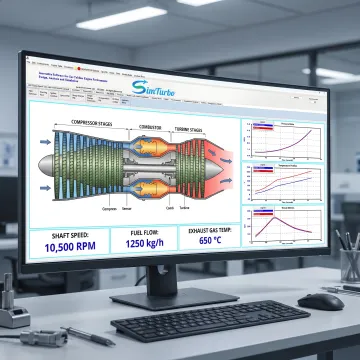
Turbine technology services support the design, analysis, simulation, optimization, and validation of gas turbine systems. SimTurbo focuses on engineering software and consulting for architecture development, thermodynamic-cycle analysis, steady-state and transient performance, and control-system studies. These capabilities can help aerospace, marine, power-generation, research, and academic users evaluate engine behavior before committing to physical testing or hardware changes.
What can SimTurbo simulate?
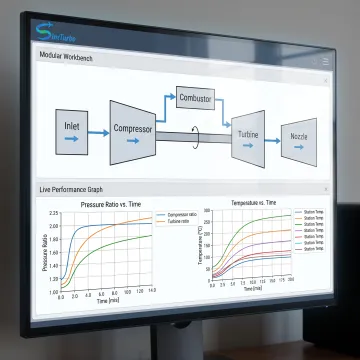
SimTurbo supports component-based gas turbine models that can include inlets, compressors, combustors, turbines, nozzles, shafts, recuperators, and afterburners. Users can investigate turbojet and related configurations, estimate thrust or power, examine fuel consumption, assess component matching, and study steady-state or changing operating conditions. Built-in control components also support PID logic, limiters, fuel scheduling, and control-law validation.
What is the difference between steady-state and transient turbine simulation?
Steady-state simulation evaluates an engine at a defined operating point, such as a selected throttle setting, altitude, ambient condition, or load. It is useful for cycle efficiency, pressure-ratio, thrust, power, and fuel-consumption studies. Transient simulation examines how the system changes over time during startup, shutdown, acceleration, deceleration, throttle movement, load changes, actuator response, or fault scenarios.
Can SimTurbo be used for gas turbine control-system design?
Yes. SimTurbo supports gas turbine control-system development and validation through features for PID controller development, fuel scheduling, start and shutdown logic, gain scheduling, actuator and sensor modeling, engine protection, and FADEC-related logic. Engineers can use closed-loop simulations to assess transient response, system stability, fault detection, and operating constraints before progressing to more advanced validation or hardware-in-the-loop migration.
Is SimTurbo suitable for university classes and research labs?
Yes. SimTurbo offers academic simulation solutions for universities, engineering colleges, technical institutes, research laboratories, and propulsion programs. It can support classroom demonstrations, laboratory experiments, thermodynamics instruction, capstone projects, graduate research, and practical modeling exercises. Custom and discounted licensing options are available for students, faculty, classroom use, lab programs, research organizations, and broader campus deployments.
Can I evaluate SimTurbo before purchasing a license?
SimTurbo offers a free 30-day trial for its gas turbine control-system design capability, with full product features available during that trial period. A free 30-minute online Zoom demonstration of the single-spool turbojet simulation is also available by appointment through the SimTurbo booking calendar. These options help prospective users review the interface, modeling approach, and relevant capabilities before selecting licensing.
Can simulation data be exported for additional analysis?
Yes. SimTurbo can export simulation data for post-processing in commonly used engineering tools, including Excel, MATLAB/Simulink, and Python. This supports custom calculations, reporting, visualization, comparison with test data, and integration into established analysis workflows. Export capability is particularly useful when teams need to share results across disciplines or incorporate turbine-model outputs into broader system studies.
How accurate are SimTurbo turbine models?
Model accuracy depends on the engine configuration, input data, component maps, assumptions, and intended use. SimTurbo reports validation against NASA Lewis Research Center J85-GE-21 engine test data with accuracy within plus or minus 2%. Engineers should still define appropriate validation criteria, compare simulations with available test or reference data, and document assumptions for each specific program.