Key Takeaways
- Propulsion pairs a powerplant with a propulsor, using Newton's third law to accelerate mass rearward
- Gas turbines lead aerospace and marine use; modern turbofans reach 70%–80% propulsive efficiency
- Space propulsion trades thrust for specific impulse: chemical rockets for launch, ion drives for multi-year endurance
- Electric and hybrid propulsion is growing in aviation, shipping, and automotive, limited mainly by battery energy density
- Platforms like SimTurbo help engineers model gas turbines, validate controls, and optimize designs before hardware tests
Understanding Propulsion Systems: Fundamentals
Every propulsion system consists of two parts: a powerplant that converts stored energy into useful work, and a propulsor that generates thrust. A jet engine's combustor and turbine serve as the powerplant, while the accelerated exhaust acts as the propulsor.
An electric vehicle separates the battery (powerplant) from the motor and wheels (propulsor). That split is why different applications favor different architectures.
Newton's Third Law and Thrust Generation
Propulsion relies on Newton's third law: for every action, there is an equal and opposite reaction. When an engine accelerates mass in one direction, the vehicle experiences thrust in the opposite direction. NASA defines thrust using a control-volume equation:
F = (ṁ × v)ₑ − (ṁ × v)₀ + Aₑ(pₑ − p₀)
For a pressure-matched gas turbine, this simplifies to momentum change. The specific thrust (thrust per unit mass flow) becomes Fₛ = vₑ − v₀, where exhaust velocity minus inlet velocity determines thrust per kilogram of air processed per second.
Key Performance Metrics
Engineers evaluate propulsion systems using two primary metrics:
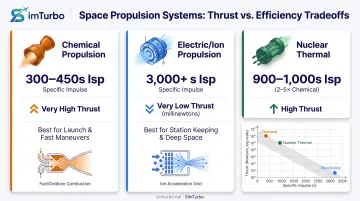
- Specific impulse (Isp) — Thrust per unit propellant weight flow rate, measured in seconds. Higher Isp delivers more total impulse per unit of propellant. Chemical rockets typically achieve 300–450 s; ion drives exceed 3,000 s.
- Propulsive efficiency — Useful propulsive power divided by total power input. In-service turbofans reach 70%–80%; turboprops run about 10% higher.
Energy Density and Fuel Selection
Fuel energy density determines mission range and vehicle mass. U-235 nuclear fuel contains approximately 79,390,000 MJ/kg, while petroleum-based jet fuel holds roughly 42 MJ/kg. That roughly 1.8-million-fold gap is why nuclear propulsion can give naval vessels effectively unlimited range, yet stays impractical for aircraft once radiation shielding mass is counted. Chemical fuels balance energy density, handling safety, and existing infrastructure.
The Mass-Flow Equation
Thrust equals mass flow rate multiplied by velocity change: F = ṁ × Δv. This relationship governs design choices across domains. Launch vehicles need extreme thrust, so NASA's Space Launch System solid boosters burn about 6 tons of propellant per second.
Commercial turbofans prioritize efficiency instead: they accelerate larger air masses at lower velocities and deliver the same thrust with less fuel burn.
Air and Gas Turbine Propulsion
Gas turbines power the majority of commercial and military aircraft because they deliver high thrust-to-weight ratios, operate efficiently at altitude, and scale from small drones to intercontinental transports. Their performance rests on the thermodynamic cycle that converts fuel energy into thrust.
What Makes Gas Turbines Effective for Aviation
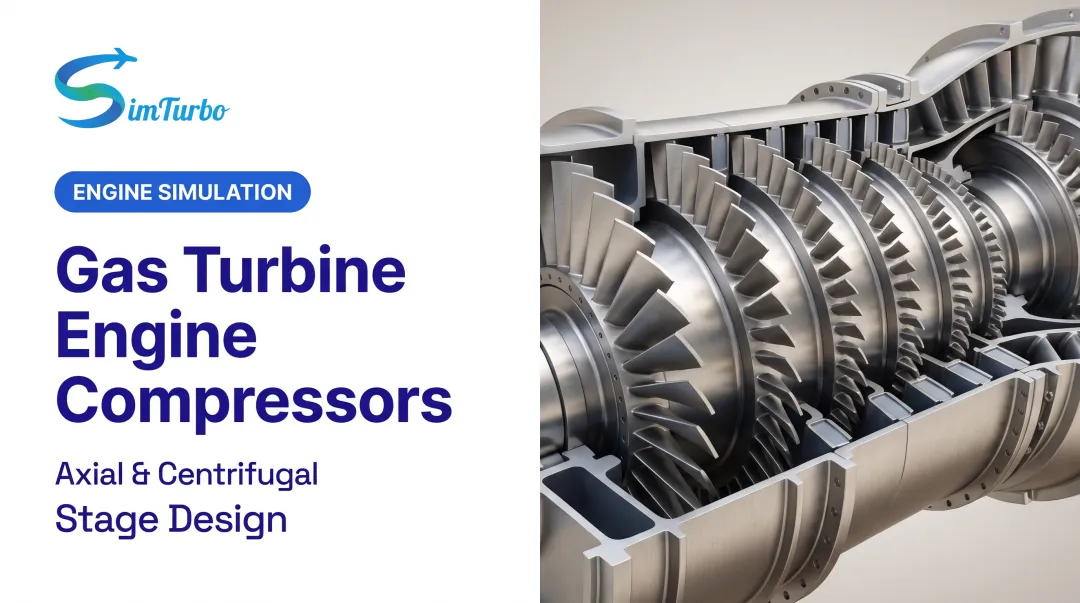
Gas turbines operate on the Brayton cycle: intake air is compressed, heated at constant pressure through combustion, then expanded through a turbine and exhausted at high velocity. The turbine extracts just enough energy to drive the compressor; remaining pressure and temperature produce thrust through the nozzle.
Core components:
- Compressor: Raises air pressure 30:1 to 60:1 in modern engines
- Combustor: Adds heat by burning fuel at constant pressure
- Turbine: Extracts energy to drive the compressor and accessories
- Nozzle: Accelerates exhaust gases to generate thrust
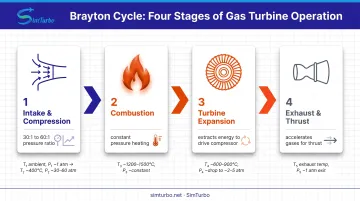
The cycle's efficiency improves with higher pressure ratios and turbine inlet temperatures, but material limits constrain turbine-entry temperature. Advanced single-crystal superalloy blades with ceramic coatings and internal cooling channels allow turbine inlet temperatures above 1,600°C, balancing performance and blade survival.
Types of Air-Breathing Engines
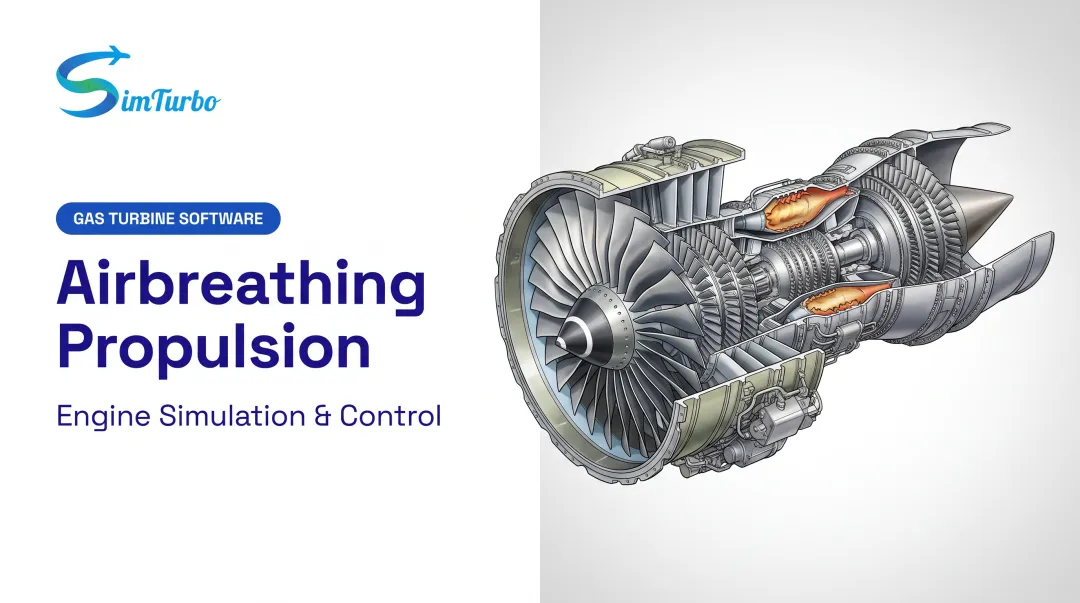
Turbojets compress and combust all incoming air, then exhaust it at high velocity. They deliver high thrust at supersonic speeds but consume more fuel at subsonic cruise. Military fighters and early jet transports used turbojets.
Turbofans split airflow into a core stream (compressed, combusted, and exhausted) and a bypass stream (accelerated around the core by a large fan). The bypass ratio (mass flow through the bypass divided by core flow) determines efficiency.
High-bypass turbofans (about 10:1) dominate commercial aviation because they accelerate more air at lower velocity, cutting fuel burn and noise. GE's GE9X, which powers the Boeing 777X, reaches roughly 10:1 bypass ratio, 60:1 overall pressure ratio, and 105,000 lbf rated thrust.
Turboprops use a gas turbine to drive a propeller, accelerating an even larger mass of air at lower velocity. They excel in fuel efficiency below Mach 0.6 and are common on regional aircraft and military transports.
Gas Turbine Performance and Design
Engineers evaluate gas turbine performance using several parameters:
- Thrust: Total force generated, measured in pounds or newtons
- Specific Fuel Consumption (SFC): Fuel flow per unit thrust or power, measured in lb/hr/lbf or kg/hr/kW
- Pressure Ratio: Compressor exit pressure divided by inlet pressure
- Turbine Inlet Temperature: Maximum temperature before turbine blades, constrained by materials
Design involves balancing efficiency, thrust, weight, and durability. Higher pressure ratios and turbine inlet temperatures improve efficiency but require heavier, more complex cooling systems. Larger bypass ratios reduce fuel burn but increase nacelle drag and weight. Each application, from short-haul narrowbody to long-range widebody to supersonic fighter, demands a different optimization.
Adaptive cycle engines for military applications adjust bypass ratio in flight, combining turbojet performance at supersonic speeds with turbofan efficiency at subsonic cruise. Pratt & Whitney's XA103 engine, in development for the U.S. Air Force Next Generation Adaptive Propulsion program, is one active program advancing this approach.
Modern gas turbine development relies heavily on simulation. Engineers use platforms like SimTurbo to design, analyze, and optimize engine performance across aerospace and marine applications.
The software models compressors, combustors, turbines, and controls at the component level so teams can check steady-state performance, transient behavior, and control laws before hardware testing. Validated against NASA J85-GE-21 test data within ±2%, it supports rapid prototyping, off-design analysis, and real-time transient simulation on standard PCs.
Space Propulsion Technologies
Space propulsion operates in a vacuum, so engines must carry both fuel and oxidizer. The absence of atmospheric drag and gravity (beyond Earth orbit) changes design priorities: missions favor high specific impulse over high thrust, and operation can continue for months or years.
| Type | Thrust | Specific impulse | Best fit |
|---|---|---|---|
| Chemical | Very high | Low to moderate | Launch and fast maneuvers |
| Electric / ion | Very low (mN) | Very high | Station keeping, deep space |
| Nuclear thermal | High | High (2–5× chemical) | Crewed deep space (developmental) |
Chemical Rocket Propulsion
Chemical rockets generate thrust by combusting fuel and oxidizer, then expelling the hot gases through a nozzle. Unlike air-breathing engines, rockets work in space because they carry their own oxidizer supply.
Liquid rocket engines pump fuel (such as liquid hydrogen) and oxidizer (such as liquid oxygen) into a combustion chamber. The RS-25 engine, used on NASA's Space Launch System, achieves 366 s specific impulse at sea level and 452 s in vacuum, with an engine weight of 7,775 lb. Liquid engines can be throttled and restarted, making them suitable for crewed missions and precision maneuvers.
Solid rocket engines use a pre-mixed propellant grain that burns from ignition until depletion. They are simpler, more reliable, and deliver very high thrust, which makes them ideal for launch boosters.
NASA's SLS solid boosters burn about 6 tons of propellant per second, providing the initial acceleration needed to lift the vehicle off the pad. Once ignited, though, they cannot be throttled or shut down.
Chemical rockets excel at launch because they deliver extreme thrust, but their specific impulse limits deep-space missions. The propellant mass required to reach high velocities grows exponentially, making them inefficient for interplanetary travel beyond Mars.
Electric and Ion Propulsion
Electric propulsion systems ionize a propellant (typically xenon) and accelerate the ions electromagnetically to very high exhaust velocities. This delivers high specific impulse but low thrust, typically millinewtons instead of kilonewtons.
Flight heritage is already established:
- JPL's Deep Space 1 ion engine reached about 10 times the specific impulse of conventional chemical propulsion
- Boeing's ABS-3A was the first all-electric satellite to use ion thrusters for orbit raising and station keeping
Electric propulsion suits long-duration missions where thrust can accumulate over weeks or months. Communications satellites use it to extend operational life, and deep-space probes use it to reach asteroids and outer planets with minimal propellant mass. The tradeoff is time: what a chemical rocket accomplishes in hours takes an ion drive weeks.
Nuclear and Advanced Propulsion
Nuclear thermal propulsion (NTP) heats hydrogen propellant using a nuclear reactor, then expels it through a nozzle. DARPA has described NTP as potentially delivering 2–5 times the specific impulse of chemical propulsion and 10,000 times the thrust-to-weight of electric propulsion. That performance band sits between chemical and electric systems.
DARPA's DRACO nuclear propulsion demonstration was canceled in 2025, though NASA's FY2026 budget still lists Nuclear Thermal Propulsion as an active program line. NTP remains developmental, but its energy density advantage makes it attractive for crewed Mars missions, where reducing transit time lowers crew radiation exposure and life-support mass.
Speculative concepts include nuclear-electric propulsion (a reactor powering electric thrusters) and antimatter propulsion. Both still need major materials and engineering breakthroughs before practical use.
Marine and Ground Propulsion Systems
Marine and ground propulsion systems face fewer weight limits than aerospace, so heavier powerplants and a wider range of propulsors are practical. Endurance, fuel availability, and infrastructure integration matter more instead.
Marine Propulsion Overview
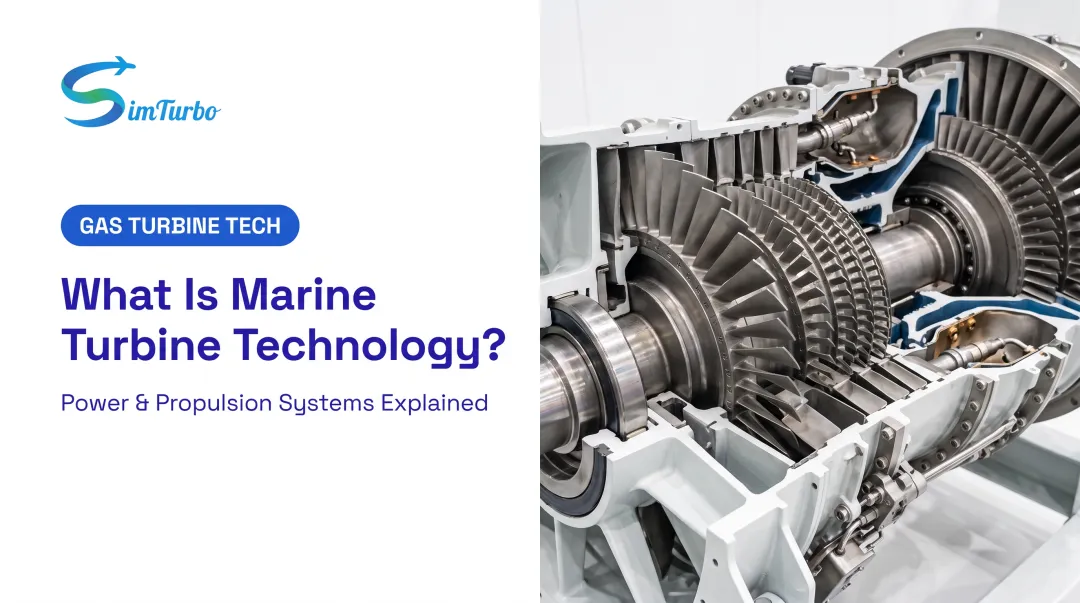
Ships moved from steam to diesel, then to gas turbines and nuclear reactors. The first ocean-going diesel vessel, Selandia, launched in 1911. The Royal Navy's MGB-2009 (1947) was the first naval craft partly propelled by a gas turbine.
Today the split is practical:
- Commercial vessels — diesel engines for fuel economy
- Naval combatants and ferries — gas turbines for high power and rapid response
Nuclear propulsion provides nearly unlimited range for naval vessels. Huntington Ingalls Industries states that a nuclear aircraft carrier is refueled only once during its 50-year service life. Nuclear submarines operate submerged for months without surfacing, limited only by crew provisions and maintenance schedules.
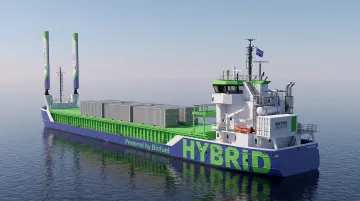
Alternative fuels are expanding in commercial shipping. DNV recorded 275 alternative-fuel vessel orders in 2025, including LNG, hydrogen, and battery-electric designs. Wärtsilä's hybrid systems pair batteries with conventional engines to absorb load fluctuations and improve fuel efficiency. Norled's MF Hydra operates on liquid hydrogen, demonstrating the feasibility of zero-emission ferries.
Ground Transportation Propulsion
The same endurance and fuel pressures show up on land, but ground vehicles depend on tire or rail friction—or magnetic forces in maglev—rather than fluid propulsors. ICE powertrains dominated for a century; electric drivetrains are taking share on efficiency.
Common options include:
- ICE (gasoline/diesel) — Converts chemical energy to shaft power through a transmission; U.S. Department of Energy figures put typical gasoline tank-to-wheels efficiency near 30%
- Battery-electric (BEV) — Reaches 87%–91% drivetrain efficiency with regenerative braking, but battery energy density (~250 Wh/kg vs. ~12,000 Wh/kg for gasoline) still limits range and ties vehicles to charging infrastructure
- Hybrids and PHEVs — Pair ICE with electric motors to recapture braking energy and run the engine nearer its sweet spot; plug-ins add grid-charged batteries for longer electric-only range
- Maglev — Lifts, propels, and guides without contact; Japan's Linimo runs automatically at up to 100 km/h, but high infrastructure cost still limits wider use
Emerging Propulsion Technologies
Decarbonization mandates, performance demands, and energy-security concerns drive propulsion innovation across aviation, marine, and ground use. Electric, hybrid, and sustainable-fuel technologies are moving from research into deployment, though major technical barriers remain.
Regulatory timelines sharpen that pressure. ICAO’s Long-Term Aspirational Goal targets net-zero international-aviation carbon emissions by 2050, and the International Maritime Organization aims for net-zero shipping emissions by or around 2050.
Electric and Hybrid-Electric Systems
Electrification is expanding across aviation, marine, and automotive sectors. In aviation, current batteries deliver approximately 250 Wh/kg, while many applications need more than 500 Wh/kg. NASA studies identify 400 Wh/kg as the threshold for general aviation and 750 Wh/kg for commercial aircraft, both well above today's certified battery packs.
NASA and GE flew a modified Saab 340B partly powered by a hybrid-electric system in July 2026. NASA's High-Efficiency Megawatt Motor (HEMM) program targets 16 kW/kg power density and 99% efficiency, though these are component-level goals, not full propulsion-system metrics.
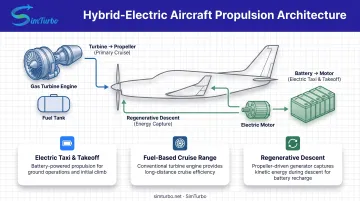
Hybrid-electric architectures pair batteries with gas turbines or fuel cells so aircraft can keep fuel-based cruise range. Near-term gains include:
- Electric taxi and takeoff assistance without full-battery cruise
- Regenerative energy capture during descent
- Lower fuel burn and emissions without breakthrough batteries
That mix makes hybrids practical for commercial use sooner than pure-electric designs.
Sustainable and Alternative Fuels
Where batteries still fall short, fuel pathways carry more of the near-term load. Sustainable aviation fuels (SAF) are drop-in compatible with existing turbofan engines and infrastructure after blending and certification to ASTM D1655. The FAA confirms approved SAF needs no engine modifications, so operators can deploy it immediately. ICAO's 2030 Vision targets a 5% international-aviation CO₂ reduction through SAF, low-carbon aviation fuels, and cleaner energy.
Hydrogen propulsion offers zero-carbon combustion but requires cryogenic storage at -253°C and larger fuel tanks due to lower volumetric energy density. NASA's Hy2PASS study investigates hybrid fuel-cell/gas-turbine aviation power, combining hydrogen fuel cells for electric propulsion with gas turbines for peak power. Norled's MF Hydra demonstrates operational liquid-hydrogen propulsion in marine service.
Advanced Concepts and Future Directions
Scramjets (supersonic combustion ramjets) compress incoming air through shockwaves at hypersonic speeds, enabling flight above Mach 5 without rotating machinery. DARPA's final HAWC flight exceeded Mach 5, 60,000 ft, and 300 nautical miles in 2023, demonstrating sustained hypersonic propulsion. Scramjets remain experimental; thermal management and materials still limit operational use.
AI and machine learning help teams explore design spaces too large for manual analysis. NASA applied genetic algorithms to optimize electric-machine power in an electrified gas turbine. Argonne National Laboratory uses physics-guided machine learning and supercomputing to speed jet-engine cooling design, so engineers can iterate and validate concepts before cutting hardware.
Engineering Applications and Design Considerations
Propulsion system development follows a structured process from concept to validation, balancing performance, weight, cost, reliability, and environmental impact at every stage.
Design Process
NASA's systems engineering framework organizes work into common technical processes covering definition, design, realization, evaluation, and management. Typical stages include:
- Requirements definition: Mission profile, thrust, power, range, efficiency, weight, cost, and certification
- Conceptual design: Thermodynamic cycle selection, propulsor type, fuel, and architecture
- Detailed analysis: Component sizing, materials, cooling, control systems, and integration
- Testing and validation: Bench tests, component tests, full-system tests, and flight certification
Each stage involves iteration. Engineers refine designs based on analysis results, then validate against test data before committing to production.
Balancing Competing Factors
Every propulsion system involves tradeoffs:
- Performance vs. weight: Higher thrust and efficiency often require heavier components
- Cost vs. reliability: Advanced materials and redundancy increase cost but improve durability
- Efficiency vs. complexity: Sophisticated cooling and control systems improve performance but add failure modes
- Environmental impact vs. performance: Low-emission combustors may sacrifice some efficiency
Engineers evaluate these tradeoffs using mission-specific metrics. Launch vehicles prioritize thrust-to-weight, commercial aircraft prioritize fuel burn per seat-mile, and naval vessels prioritize endurance.
Simulation and Modeling Tools
Simulation helps engineers weigh those tradeoffs before committing to hardware. A 1999 NASA review reported one major engine manufacturer's estimate that simulation-enabled reductions in redesign could cut design and development time and cost by 30%-40%.
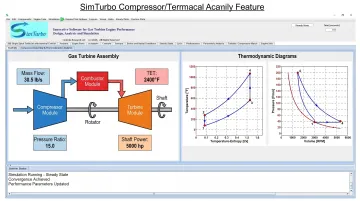
For gas turbine systems, platforms like SimTurbo enable universities and companies to train engineers and validate designs through component-level modeling and real-time simulation. Engineers assemble and re-parameterize inlets, compressors, combustors, turbines, nozzles, and control systems, then analyze:
- Steady-state performance and transient behavior
- Compressor matching and control-law responses
- Real-time thermodynamic diagrams and performance graphs
The software runs on standard PCs and exports data for post-processing in Excel, MATLAB, or Python. Validated against NASA test data within ±2% for the J85-GE-21 engine, it supports aerospace, marine, and power-generation applications, with discounted licensing for university education and research programs.
Frequently Asked Questions
What are the main types of propulsion technology?
Air-breathing engines—turbojets, turbofans, and turboprops—power aircraft. Rockets use chemical, electric (ion), or developmental nuclear thermal systems for space. Marine vessels run on diesel, gas turbine, or nuclear plants; ground transport uses internal combustion, electric, or hybrid drives.
What is the most advanced propulsion technology?
"Advanced" depends on the job. Nuclear thermal propulsion offers the highest energy density for space but is still developmental. Electric drives lead on ground-vehicle efficiency, while adaptive-cycle engines adjust bypass ratio in flight for military aviation.
What does a propulsion technician do?
Propulsion engineers and technicians design, test, maintain, and troubleshoot propulsion systems across aerospace, marine, and automotive industries. NASA describes technicians conducting research tests and experiments to customer requirements and safety standards. Engineers produce hardware and software used to test and operate flight systems.
How do gas turbine engines work?
Gas turbines compress incoming air, mix it with fuel and ignite it at constant pressure, then expand the hot gases through a turbine that drives the compressor. Remaining pressure accelerates exhaust gases through a nozzle, generating thrust by Newton's third law.
What is the difference between rocket and jet propulsion?
Rockets carry their own oxidizer and work in a vacuum, making them suitable for space. Jets use atmospheric oxygen and only function within the atmosphere, limiting them to aircraft and some missile applications.
Why is nuclear propulsion used mainly in naval vessels and not aircraft?
Radiation shielding for nuclear reactors adds substantial mass. Historical aircraft concepts needed about 159,000–204,000 kg of shielding. Ships and submarines can carry that weight; aircraft cannot keep practical thrust-to-weight ratios with it.
Propulsion engineering is how we move people, cargo, and spacecraft under real limits. High-bypass turbofans cut fuel burn on long routes; ion drives support multi-year space missions. Each option trades energy density, efficiency, weight, and cost against the mission.
As net-zero deadlines tighten for aviation and shipping, teams pair proven gas turbine and diesel architectures with electric, hydrogen, and hybrid systems. Simulation and test data keep those trade-offs honest across performance, cost, and emissions.