Introduction
Single-spool turbojets powered the first generation of jet aircraft. They still show up in military trainers, missiles, UAVs, and classroom labs where a simple shaft layout matters more than bypass efficiency.
Commercial aviation largely moved on to turbofans. Engineers still need the single-spool architecture, though: one compressor, one turbine, and one shaft is the clearest way to learn gas-turbine matching, control response, and cycle tradeoffs before you tackle multi-spool designs.
Below you’ll see how a single-spool turbojet is built, how air and energy move through it, and when that simplicity still beats more complex engines.
Key Takeaways
- A single-spool turbojet links all compressor and turbine stages on one shaft at one rotational speed.
- Air is compressed, burned with fuel, expanded through the turbine, and expelled as high-speed thrust.
- Simpler and lighter than multi-spool engines, and well suited to missiles, drones, trainers, and education.
- Historic examples include the Jumo 004, GE J85, and Heinkel HeS 3B.
- SimTurbo’s J85-GE-21 simulation matches NASA test data within ±2%.
What Is a Single-Spool Turbojet Engine?
A single-spool turbojet is a gas turbine engine where one shaft (spool) connects all compressor stages directly to all turbine stages, meaning the entire rotating core operates as one unit at a single speed. That single-speed core is what makes the layout mechanically simpler than multi-spool or bypass designs—and the right place to start if you are learning how turbojets work.
What sets it apart:
- Dual-spool engines: compressor and turbine groups can run at different speeds; a single spool locks everything to one rpm
- Turbofans: add a bypass fan that routes air around the core
- Turboprops: extract shaft power through a gearbox to drive a propeller instead of relying mainly on jet thrust
Why Single-Spool Designs Came First
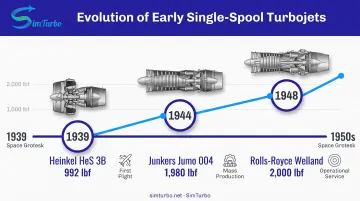
Early pioneers like Frank Whittle and Hans von Ohain used single-spool architectures because they were mechanically simpler to develop with 1930s-1940s materials and manufacturing capabilities. The first turbojet-powered aircraft flight followed on August 27, 1939: the Heinkel HeS 3B, a single-shaft engine producing 992 lbf at 11,000 rpm, powered the He 178.
Notable single-spool turbojets:
- Junkers Jumo 004: Powered the Me 262 and Ar 234; 1,980 lbf at 8,700 rpm; the first mass-produced turbojet, with nearly 6,000 built by WWII’s end
- General Electric J85: Compact military turbojet used in trainers such as the T-38 Talon and in cruise missiles; still in service today
- Rolls-Royce Welland: Britain’s first operational turbojet, derived from Whittle’s work and fielded on the Gloster Meteor
These early engines proved a single shaft could deliver usable thrust and set the mechanical baseline later multi-spool and turbofan designs built on.
How Does a Single-Spool Turbojet Engine Work?
A single-spool turbojet pulls in air, compresses it, burns fuel in that air, extracts energy through a turbine, and expels the rest as high-velocity thrust.
Because the compressor and turbine share one shaft, they must rotate at the same RPM. That constraint simplifies the design but limits operational flexibility.
Air Intake
Air enters through the intake at subsonic speeds, regardless of aircraft velocity. Inlet guide vanes direct smooth airflow into the compressor, reducing turbulence before compression. Many designs feature a nose bullet (center cone) that:
- Diverts air into the compressor annulus
- Houses accessories like starter motors and sensors
- In supersonic applications, helps slow incoming air to subsonic speeds
Compression Stage
The compressor—either axial-flow (multiple rotating blade rows) or centrifugal (single radial impeller)—is driven directly by the turbine via the single shaft. It compresses incoming air to pressure ratios typically between 5:1 and 15:1, depending on design.
Single-spool constraint: Compressor speed cannot be optimized on its own. It is mechanically locked to turbine speed. That can limit efficiency at off-design conditions (low-altitude takeoff versus high-altitude cruise), but it simplifies control systems. No variable-geometry or inter-spool coordination is required.
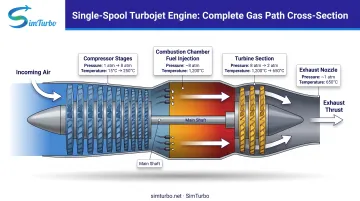
NASA measured a pressure ratio of 8.30 in the single-spool J85-GE-21, with an airflow of 24.05 kg/s.
Combustion Chamber
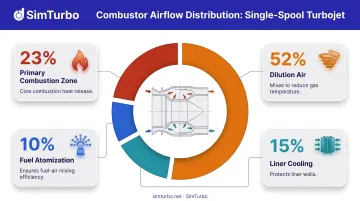
Compressed air enters the combustion chamber, where fuel is injected and continuously burned, raising gas temperature to approximately 1,500-2,000°F (depending on materials and design limits). Only about 23% of airflow participates directly in combustion, according to NASA annular-combustor research:
- 52% for dilution (mixing hot gases with cooler air)
- 15% for liner cooling
- 10% for fuel atomization
This distribution keeps combustor walls from melting while ensuring complete fuel burn.
Turbine Stage
Hot combustion gases expand through the turbine and give up just enough energy to drive the compressor and accessories (fuel pumps, oil pumps, generators). The rest of the energy stays available for thrust.
Critical design challenge: In a single-spool layout, the turbine must be precisely matched to the compressor because they share one speed. There is no independent speed control as in multi-spool designs. The turbine has to deliver the right power across the full operating range, or the engine will stall or overspeed.
Exhaust Nozzle
Gases accelerate through a converging (and sometimes converging-diverging) nozzle to supersonic velocities, generating thrust through momentum change. The nozzle converts thermal and pressure energy into kinetic energy. The faster the exhaust velocity relative to flight speed, the more thrust produced.
Afterburner capability: Single-spool turbojets can use afterburners (reheat) for military applications. Extra fuel is injected into the exhaust downstream of the turbine and ignited, adding short-duration thrust boosts of 30-50%.
The T-38 Talon's J85-GE-5 engines produce 2,050 lbf dry and 2,900 lbf with afterburner.
Single-Spool vs. Dual-Spool Turbojet Engines
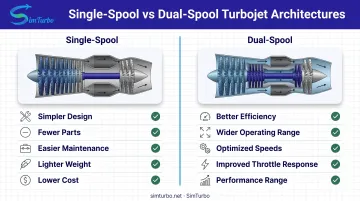
Single-spool designs use one shaft connecting all compressor and turbine stages. Dual-spool engines use two concentric shafts, so the low-pressure and high-pressure sections can rotate independently at optimized speeds.
The Core Trade-Off
- Dual-spool designs: better fuel efficiency and wider operating range, since each spool can run at its optimal speed
- Single-spool engines: mechanically simpler and lighter, with fewer potential failure points
Maintenance Advantage
Single-spool designs offer:
- Fewer rotating assemblies for simpler field maintenance
- Easier troubleshooting with a single rotor system
- Faster full-module swaps for military operations
- Lower parts count and a lighter logistics burden
This simplicity was a key factor in GE's development philosophy for engines like the J85, which prioritized reliability and maintainability for trainer and missile applications.
Performance Characteristics
Single-spool limitations:
- More limited throttle response (all stages accelerate together)
- Less optimal performance across varying flight conditions
- Narrower surge margin at off-design points
Single-spool strengths:
- Strong fit where mechanical reliability matters more than peak efficiency
- Simpler control systems with fewer failure modes
- Proven durability in harsh environments (missiles, target drones)
| Factor | Single-Spool | Dual-Spool |
|---|---|---|
| Shaft systems | One coupled rotor | Two independent rotors |
| Pressure ratio example | J85-GE-21: 8.30 | Hypothetical 1956 study: 12 (split 3×4) |
| Speed optimization | All stages at same RPM | LP and HP sections run at different speeds |
| Complexity | Simpler, fewer parts | More components, more interaction |
Important note: Specific weight, maintenance-interval, and cost comparisons are engine-specific and not universal across all single- versus dual-spool designs.
Where Single-Spool Turbojet Engines Are Used Today
While commercial airliners have moved to high-bypass turbofan engines, single-spool turbojets remain in active use for cruise missiles and unmanned aerial vehicles (UAVs), where simplicity and small size matter more than fuel efficiency.
Military Training Applications
The Northrop T-38 Talon continues to use single-spool J85 engines because their simplicity reduces maintenance burden and operating costs for flight training programs. First entering service in March 1961, the T-38 remains the USAF's primary supersonic trainer.
Why single-spool engines fit training missions:
- Lower parts count reduces downtime
- Field-maintainable with less specialized tooling
- Proven reliability over decades of service
- Lower operating costs per flight hour
Missiles and Drones
Safran's TRI60/TR60 family of single-spool turbojets powers target drones and cruise missiles including Storm Shadow, SCALP EG, Apache, and Sea Eagle. The TR60-30 produces approximately 675 lbf, with more than 2,500 engines manufactured.
Mission-specific advantages:
- Compact size fits in missile airframes
- Long-term storage with little or no maintenance ("wooden round" designs)
- Reliable one-shot operation
- Lower cost for expendable applications
Educational and Research Applications
Universities and aerospace programs use single-spool turbojets for teaching gas turbine fundamentals because their straightforward architecture makes thermodynamic principles easier to understand.
Simulation tools make that architecture practical in the classroom. SimTurbo, for example, validated its J85-GE-21 single-spool model against NASA Lewis Research Center test data to within ±2% for thrust, flow rate, temperature, and TSFC—giving students a benchmark they can use to:
- Build and match compressor-turbine components
- Watch startup, acceleration, and stall in real time
- Test basic control laws without multi-spool complexity
Legacy Military Aircraft
Some older fighters and reconnaissance types still flying with smaller air forces keep single-spool turbojets in service. Proven reliability and existing maintenance infrastructure often outweigh the efficiency gains of a fleet re-engine.
Conclusion
Single-spool turbojets are the foundational jet architecture: one shaft, direct compressor-turbine coupling, and a clear thermodynamic cycle. For aerospace engineers, that simplicity is the point—it teaches core gas turbine principles without multi-spool complexity.
These engines still fit specialized work that values simplicity, maintainability, and reliability over peak efficiency, including missiles, drones, trainer aircraft, and classroom labs.
Platforms like SimTurbo keep single-spool models as educational benchmarks. Validated examples such as the J85-GE-21 support real-time turbine simulation and control-system development, giving students and engineers a direct path into the mechanics behind every jet engine.
Frequently Asked Questions
What is a two-spool engine?
A two-spool (dual-spool) engine uses two concentric shafts. One links the low-pressure compressor and turbine; the other links the high-pressure compressor and turbine. Each spool spins at its own optimized speed, which improves efficiency across flight conditions.
Why are turbojets not used anymore in commercial aviation?
Turbojets burn more fuel at subsonic speeds than high-bypass turbofans, which send most air around the core. NASA notes that even low-bypass turbofans beat basic turbojets on efficiency. Turbojets mainly remain in military, missile, and specialized supersonic roles where speed outweighs economy.
What is the most powerful single-spool turbojet engine ever built?
The Tumansky R-15B-300 (MiG-25) produced about 22,500 lbf with afterburner. The General Electric J79-GE-2 (F-4 Phantom, A-5 Vigilante) made 15,000 lbf. Modern turbofans exceed these levels, but these remain among the highest-thrust turbojets.
How does a single-spool turbojet differ from a turbofan?
A turbojet sends all air through the combustion core. A turbofan uses a large front fan to bypass most air around the core for quieter, more efficient flight. Many turbofans also use dual- or triple-spool layouts so the fan and core sections can run at independent speeds.
What are the main advantages of single-spool turbojet engines?
Main advantages are mechanical simplicity (one shaft, fewer parts, easier maintenance), lighter weight than multi-spool designs, field maintainability in military use, and lower manufacturing cost. That mix suits roles where reliability and simplicity matter more than fuel burn, especially missiles, drones, and trainers.
Can single-spool turbojets be used with afterburners?
Yes. Many single-spool turbojets add an afterburner (reheat) that injects fuel into the exhaust for short thrust boosts. NASA documents the J85-GE-21 as a single-spool afterburning turbojet; the T-38’s J85-GE-5 is rated about 2,050 lbf dry and 2,900 lbf with afterburner.