Engine Architecture Design
Configure complete gas turbine engine architectures with graphical, component-based models for conceptual studies, component matching, shaft arrangements, and aerospace propulsion performance optimization.

Explore SimTurbo’s engineer-friendly environment for modeling gas turbine systems used in aerospace applications. Build component-based engine architectures, examine steady-state and transient behavior, evaluate controls, and visualize performance without treating the model as a black box. From introductory turbojet studies to advanced cycle concepts, the platform helps engineers, researchers, and students turn propulsion ideas into measurable simulation insight.
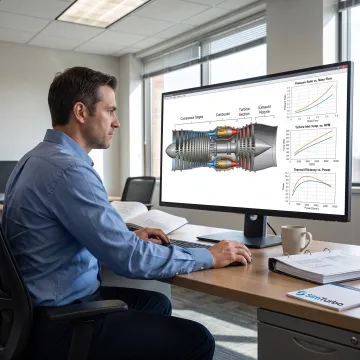
Explore practical modeling, simulation, analysis, and control-design capabilities for aerospace gas turbine systems.
Configure complete gas turbine engine architectures with graphical, component-based models for conceptual studies, component matching, shaft arrangements, and aerospace propulsion performance optimization.
Analyze Brayton-cycle behavior, thrust, power, fuel consumption, pressure ratios, component maps, and off-design operating points to improve aero-thermodynamic performance decisions.
Model single- and dual-spool turbojet systems, including compressors, combustors, turbines, nozzles, spool interactions, thrust prediction, and operating-envelope analysis.
Examine startup, shutdown, throttle changes, acceleration, deceleration, actuator dynamics, sensor response, faults, and other time-dependent engine events in real time.
Develop and validate PID control, fuel scheduling, engine protection, gain scheduling, FADEC logic, and closed-loop response for propulsion-system simulations.
Evaluate recuperated, regenerated, reheated, intercooled, and afterburning configurations for thermal efficiency, waste-heat recovery, emissions studies, and advanced propulsion research.
SimTurbo gives aerospace teams and learners a practical way to translate engine concepts into visible, interactive gas turbine models. Its graphical, component-based approach supports steady-state and transient analysis, real-time throttle-response visualization, and control-law validation on standard PCs. Model key elements such as compressors, combustors, turbines, shafts, nozzles, recuperators, and afterburners, then export results for further work in Excel, MATLAB/Simulink, or Python.
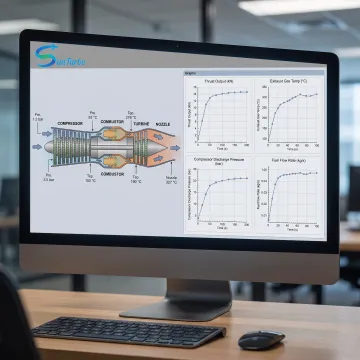
A focused simulation platform for engineers, researchers, and aerospace educators.
Visualize transient behavior and throttle effects interactively on standard PCs during aerospace propulsion studies.
Reported J85-GE-21 validation accuracy within plus or minus 2% supports confident model evaluation.
Build with drag-and-drop components instead of relying on an opaque, black-box engine model.
University programs, laboratories, and students can access specialized licensing for practical propulsion education.
Experienced leaders supporting practical gas turbine simulation.

President, CEO & Founder
Paul J. Hoffman is the President, CEO, and Founder of Controls Research LLC, the company behind SimTurbo. With a BS in Mechanical Engineering from MIT, an MS in Mechanical Engineering from Stanford, and an MBA from the University of Toledo, Paul brings a rare combination of technical depth and business acumen to the company. He has more than 45 years of experience spanning aerospace, automotive, and power systems engineering, giving him a comprehensive understanding of complex gas turbine engine design and simulation challenges. As founder, Paul has guided SimTurbo's development into a specialized, engineer-friendly platform used by aerospace, marine, and power-generation professionals as well as universities. His leadership reflects a deep commitment to advancing engineering education and real-world simulation accuracy, ensuring clients and students alike benefit from decades of hands-on industry expertise.
Vice President of Marketing & Sales
Chris Hoffman serves as Vice President of Marketing & Sales at Controls Research LLC, bringing more than 15 years of experience in the sales and marketing of technical products. Chris plays a key role in communicating the value of SimTurbo's advanced gas turbine simulation platform to aerospace, marine, power systems, and academic audiences across the United States. With a strong understanding of technical sales cycles and engineering-focused markets, Chris works closely with clients and educational institutions to ensure they find the right solutions for their design, analysis, and simulation needs. Chris is dedicated to building lasting relationships with customers, helping engineers and students alike understand how SimTurbo can improve productivity, precision, and outcomes in their gas turbine engineering projects.
GT modeling, or gas turbine modeling, represents an engine’s components and thermodynamic behavior in a simulation environment. In aerospace work, a model can include the inlet, compressor, combustor, turbine, shafts, nozzle, and control logic. Engineers use it to predict thrust, fuel consumption, temperatures, pressures, component matching, and operating limits before or alongside physical testing.
Talk with SimTurbo about your propulsion simulation goals and requirements.

Reported results within plus or minus 2%.
Interactive modeling on standard PCs.
Licensing for university programs and students.
Tell us about your engine architecture, simulation objectives, control requirements, or academic program. The SimTurbo team can help identify a productive starting point.
For immediate assistance, feel free to give us a direct call at 779-390-4786. You can also send us a quick email at pjhoffman@simturbo.net.
For immediate assistance, feel free to give us a direct call at 779-390-4786. You can also send us a quick email at pjhoffman@simturbo.net.