Key Takeaways
- Fouling occurs when airborne particles adhere to compressor blades, roughening surfaces and restricting airflow
- Primary causes: atmospheric dust, coastal salt and moisture, hydrocarbons, and inadequate filtration
- Severe fouling can cut power output by 15-20% and raise fuel consumption by several percentage points
- Prevention centers on high-efficiency inlet filtration, condition-based washing, and protective blade coatings
- Real-time performance monitoring flags early fouling trends so you can intervene before severe losses occur
Common Causes of Compressor Blade Fouling
Compressor fouling results from multiple environmental and operational factors, often acting in combination. Identifying the dominant cause at a specific site—whether it's coastal salt spray, desert dust, or industrial hydrocarbon emissions—is essential for designing targeted prevention strategies.
The particles responsible for most fouling are typically 2–10 microns or smaller, including smoke, oil mist, carbon, and sea salt. These particles bypass many standard filters and deposit on blade surfaces.
Atmospheric Particulate Matter (Dust, Sand, Industrial Pollutants)
Airborne solid particles—dust, sand, ash, and industrial emissions—enter through the turbine inlet and adhere to compressor blade surfaces. Adhesion mechanisms include moisture films, oil contamination, and hygroscopic particles that create sticky surfaces. Particle size matters: smaller particles under 2 microns penetrate filters more easily and deposit on later compressor stages, while larger particles affect front stages.
Typical scenarios include:
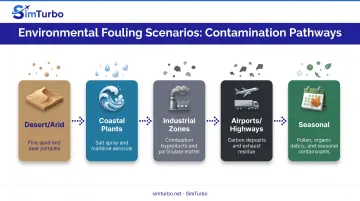
- Desert and arid environments where sandstorms and high ambient dust loads challenge filtration systems
- Coastal power plants exposed to sea spray and salt aerosols, especially within 5-10 km of shoreline
- Industrial zones near quarries, cement plants, refineries, or heavy manufacturing that emit fine particulates
- Airports and highways where combustion emissions from aircraft and vehicles introduce hydrocarbon-laden particles
- Seasonal variations such as spring pollen blooms or agricultural dust during harvest season
Even high-efficiency filtration cannot remove all submicron particles, and any bypass leakage around filter seals admits unfiltered air directly into the compressor.
Salt and Moisture (Coastal and Humid Environments)
Salt particles from sea spray dissolve in humid air, enter the compressor, and crystallize on blade surfaces as water evaporates due to compression heating. The hygroscopic nature of salt deposits attracts additional moisture, creating sticky surfaces that trap other contaminants and accelerate fouling rates.
Sodium and potassium chlorides combined with moisture can also create an acidic environment that promotes compressor-blade pitting and corrosion.
High-risk scenarios:
- Offshore platforms continuously exposed to salt-laden air and relative humidity above 80%
- Coastal power plants within a few kilometers of the ocean, particularly in tropical or humid climates
- Facilities in marine environments where fog, rain, and water mist increase salt-aerosol concentrations
- Regions with seasonal monsoons or extended high-humidity periods that enhance salt adhesion
Research from Gulf of Thailand offshore platforms documented relative humidity consistently above 80% and temperatures of 18-40°C, creating conditions where salt deposits formed rapidly and required frequent intervention.
Hydrocarbon and Oil Contamination
Oil mist, unburned hydrocarbons from nearby combustion sources, and lubricant leaks create thin oily films on compressor blades that act as adhesive layers for particle accumulation. These organic films are particularly problematic because they remain sticky at operating temperatures and resist simple water washing, requiring chemical cleaning agents or detergents to remove effectively.
Common contamination sources:
- Power plants near highways or airports where vehicle and aircraft exhaust introduces hydrocarbon-laden smoke
- Facilities with oil leaks in inlet ducting, bearing seals, or lubrication systems
- Sites with poor air quality from industrial neighbors such as refineries, chemical plants, or manufacturing facilities
- Cooling-tower plumes that carry organic matter and aerosols into the inlet stream
- Stack gas recirculation from nearby combustion sources, including the plant's own exhaust
Hydrocarbon films interact with other contaminants, creating layered deposits that are harder to remove than single-component fouling.
Operational and Design Factors (Inadequate Filtration, Poor Maintenance)
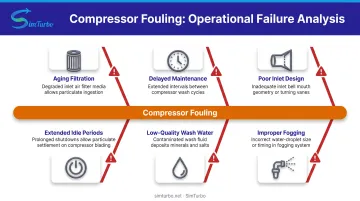
Insufficient or degraded inlet air filters allow higher contaminant ingestion rates, while improper filter maintenance (delayed replacements, poor sealing, or bypass leakage) exacerbates fouling. Operational factors also play a role: extended low-load periods reduce self-cleaning airflow velocity, improper washing schedules allow deposits to harden, and low-quality wash water can introduce dissolved solids and other contaminants.
Key operational and design failures:
- Aging facilities with outdated filtration that lack modern high-efficiency media
- Cost-cutting measures that delay filter changes beyond recommended pressure-drop thresholds
- Poor inlet-house design allowing rain, debris, or unfiltered air to bypass filtration systems
- Extended idle periods during seasonal shutdowns that allow bio-growth, corrosion, or debris accumulation
- Inadequate wash-water quality introducing mineral deposits or contaminants during cleaning
- Improper fogging or evaporative cooling causing water carryover with dissolved solids
Even high-efficiency filters fail if bypass leakage admits unfiltered air. Regular inspections for media degradation, sealing issues, and hardware corrosion remain essential.
What Happens If Compressor Fouling Is Ignored
Ignoring compressor fouling creates immediate performance losses that grow worse the longer they go unaddressed. Moderate fouling typically cuts power output by 2-20%, depending on environmental conditions. Heat rate (fuel consumption per MWh) climbs as the turbine raises firing temperatures to offset lost compressor efficiency.
Pressure ratio drops, compressor discharge pressure falls, and exhaust gas temperature rises. Together, these shifts mark degraded aerodynamic performance.
Long-term consequences include:
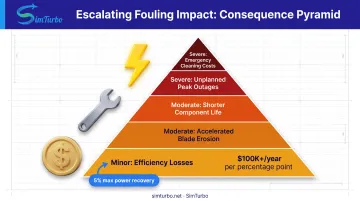
- Accelerated blade erosion and corrosion from abrasive and acidic deposits
- Shorter component life, forcing earlier overhauls or blade replacements
- Higher compressor surge risk from reduced surge margin and unstable airflow
- Efficiency losses of $100,000+ per year for each percentage point of fouling in a 100 MW plant
- Unplanned outages during peak demand, with lost revenue and contract penalties
- Emergency cleaning costs that overrun planned maintenance budgets
Research tracking 51 offline washes documented maximum power recovery of 5%. Even moderate fouling carries economic penalties that justify regular maintenance.
Warning Signs You're About to Experience Serious Fouling
Trending key performance indicators lets operators intervene before severe degradation sets in. Use corrected parameters (adjusted for ambient conditions) so you can separate fouling from normal environmental variation.
Gradual Decrease in Compressor Discharge Pressure
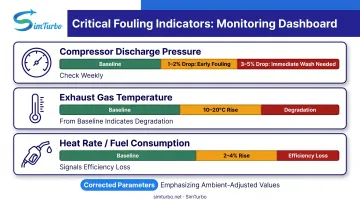
Compressor mass flow and pressure ratio rank among the most sensitive fouling indicators. Check pressure ratio weekly: a 1-2% drop from baseline points to early-stage fouling, while a 3-5% drop calls for immediate offline washing. Corrected discharge pressure strips out ambient temperature and humidity effects so you see true compressor degradation.
Increasing Exhaust Gas Temperature at Constant Load
When EGT rises at steady output, the combustor is firing hotter to make up for lower compressor efficiency and pressure ratio. A 10-20°C increase from baseline often points to fouling or related degradation. Corrected EGT factors in ambient conditions and highlights component-level change.
Rising Heat Rate or Fuel Consumption
Heat rate (fuel energy per unit of electrical output) tracks thermal efficiency directly. A 2-4% rise from baseline signals efficiency loss from fouling, erosion, or other wear. Pair corrected heat rate with power output, pressure ratio, and EGT for a fuller fouling picture.
How to Prevent Compressor Blade Fouling
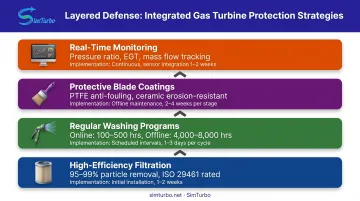
Effective fouling prevention combines engineered solutions (filtration, coatings, and inlet design) with disciplined operational practices such as condition-based washing and continuous performance monitoring. No single measure eliminates fouling entirely; instead, a layered approach reduces ingestion rates, limits deposit adhesion, and removes accumulation before it hardens.
Install and Maintain High-Efficiency Inlet Air Filtration
What to do: Upgrade to multi-stage filtration systems using pre-filters and final filters rated for high efficiency at small particle sizes (such as 0.3–2 microns). Modern filter test standards such as ISO 29461 provide turbomachinery-specific efficiency ratings. Ensure proper filter-housing seals to eliminate bypass leakage, and establish pressure-drop-based replacement schedules rather than fixed time intervals.
How it mitigates causes: High-efficiency filtration removes 95–99% of atmospheric particulates before they reach the compressor, cutting deposition from dust, salt, and industrial contaminants.
An offshore retrofit upgraded from an M6 stage (under 70% efficiency at 0.4 microns) to an F7 prefilter plus E12 final filter (99.5% at most penetrating particle size). After six months, the site saw no pressure-drop increase or turbine performance degradation.
When to implement: During new installations, major overhauls, or when fouling rates exceed acceptable thresholds despite regular cleaning. While no universal ROI figure applies, documented cases show payback within 1–2 years through reduced washing frequency and sustained efficiency. Balance filter efficiency against inlet differential pressure, which affects compressor airflow and plant output.
Establish Regular Online and Offline Washing Programs
What to do: Build a two-tier wash program timed to site fouling rates:
- Online washes: Inject demineralized water or specialized detergents through inlet nozzles during operation. Intervals often run 100–500 operating hours in harsh environments, and longer where air quality is better.
- Offline crank washes: During planned outages, use hot water plus detergent, rinse until conductivity checks confirm residue removal, then run at least 20 minutes to dry the compressor.
How it mitigates causes: Online washing removes soft, water-soluble deposits such as salt and loose dust before they harden, maintaining aerodynamic profiles and delaying severe fouling. Offline washing removes baked-on hydrocarbons and stubborn contaminants that resist online methods, restoring blade surfaces to near-original condition. One documented site extended its offline-wash interval from 22 to 66 days through daily online washing, recovering about 2% capacity.
When to implement: Start immediately if efficiency drops more than 3% between overhauls. Adjust frequency from trended performance: coastal and industrial sites usually need more frequent washing than inland, low-pollution sites.
A 2014 cascade study using demineralized water at a 0.2% liquid-to-air ratio found most cleaning occurred in the first 5 minutes. Wash duration and fluid quality matter as much as frequency.
Apply Protective Blade Coatings and Surface Treatments
What to do: Apply erosion-resistant and fouling-resistant coatings to compressor blades during scheduled overhauls. Smooth, sealed aluminum-ceramic systems and PTFE-bearing coatings (such as SermaLon or TRU Flow 2000) reduce surface roughness and minimize particle adhesion. Hard aluminum-oxide ceramic topcoats target erosion resistance, while PTFE-based systems provide anti-fouling properties. New units commonly coat the first 5–7 wet stages.
How it mitigates causes: Smooth, chemically inert coatings prevent initial particle nucleation sites, reduce surface energy that attracts contaminants, and make deposited material easier to remove during washing. PTFE-bearing systems are temperature-limited to about 500°F, restricting application to forward compressor stages. Chromium-carbide coatings provide erosion protection but have less documented anti-fouling benefit.
When to implement: During scheduled blade refurbishment or replacement. Documented evidence shows coatings can extend wash intervals, though specific extension percentages vary by site. On-site coating requires outage access, with typical compressor-section access durations of 5–7 days. Coatings do not eliminate the need for washing but improve cleaning effectiveness and reduce maintenance frequency.
Optimize Operating Conditions and Monitoring Systems
What to do: Avoid extended low-load operation, which lowers airflow velocity and can raise deposition rates. Install real-time compressor performance monitoring that tracks:
- Pressure ratio and exhaust gas temperature (EGT)
- Power output and corrected mass flow
- Filter differential pressure
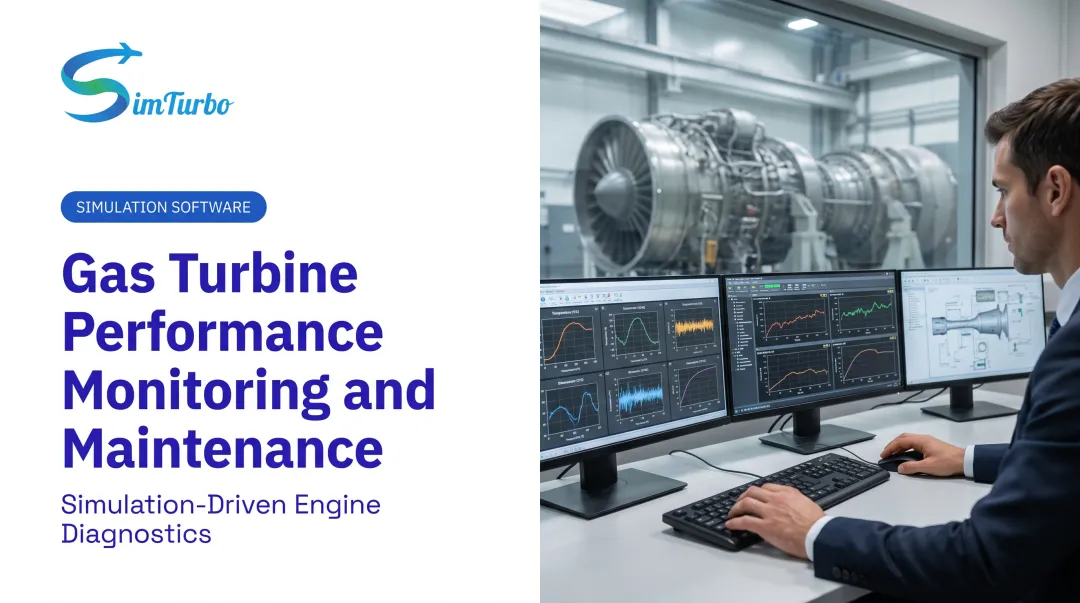
Use predictive models to schedule maintenance before severe degradation sets in. Engineers can use simulation software such as SimTurbo’s gas turbine performance platform to model fouling impacts, test mitigation strategies, and optimize cleaning schedules from site-specific environmental data and operating patterns.
How it mitigates causes: Continuous monitoring detects early fouling trends, allowing intervention before 2–3% efficiency loss. Operational adjustments, such as periodic full-load operation, may promote self-cleaning by increasing airflow velocity, although evidence for this effect varies by engine design. Simulation tools help engineers model compressor degradation, predict performance under different fouling rates, and compare washing-interval trade-offs against cleaning cost, efficiency loss, and lost revenue.
When to implement: Integrate condition monitoring during new installations or major upgrades. Adopt simulation-based scheduling when fouling patterns are inconsistent, when you need a cost-effective wash frequency, or when you are weighing capital spend on filtration or coatings.
A 2022 study using an LSTM deep-learning model optimized wash schedules and reported about $450,000 in savings (3.26 million yuan) versus the plant’s practical schedule, underscoring the payoff from data-driven maintenance planning.
Tips for Long-Term Fouling Prevention and Control
Long-term fouling control comes from steady habits and site-specific adjustments. Put these practices in place:
- Inspect inlet houses for filter wear, seal leaks, and debris bypass; quarterly checks fit most high-risk sites.
- Train operators on early signs such as pressure-ratio drops and EGT rises, with clear wash-escalation steps.
- Log fouling data on wash frequency, percent power recovery, weather, seasons, and nearby industrial activity.
- Automate wash systems to cut labor cost, improve consistency, and support more frequent online washes.
- Use predictive tools such as vibration sensors, blade imaging, and real-time performance trending to time washes.
- Balance filtration vs. pressure drop by tracking inlet differential pressure and replacing filters on condition, not a fixed schedule.
Conclusion
Compressor blade fouling has identifiable root causes: atmospheric contaminants, salt and moisture, hydrocarbons, and operational factors. Each can be addressed with targeted engineering and operational measures.
Proactive prevention delivers measurable ROI through sustained efficiency, lower fuel costs, longer component life, and fewer unplanned outages.
Key strategies include:
- Advanced filtration to remove contaminants before they reach the compressor
- Condition-based washing to clear deposits before they harden
- Protective coatings that reduce adhesion and simplify cleaning
- Real-time monitoring that flags fouling early enough to act
Operators who apply these measures can save hundreds of thousands to millions of dollars annually while keeping gas turbines reliable and efficient.
Frequently Asked Questions
What is turbine fouling?
Compressor fouling is the buildup of airborne contaminants (dust, salt, hydrocarbons, and other fine particles) on compressor blade surfaces. The deposits roughen airfoils, restrict airflow, and cut compression efficiency, which drives power loss and higher fuel use.
What are common causes of turbine engine failure related to fouling?
Severe fouling can trigger compressor surge, salt-driven corrosion, abrasive erosion, and thermal stress from higher firing temperatures used to offset lost efficiency. Prolonged surge can also distort the compressor casing.
How much power loss can fouling cause in a gas turbine?
Moderate fouling typically cuts power output by 2–10%; severe fouling in harsh conditions can reach 15–20%. Industry research on 51 offline washes documented up to 5% power recovery, showing even moderate fouling carries a real performance cost.
How often should gas turbine compressors be washed to prevent fouling?
Frequency is site-specific. Online washes often run every 100–500 operating hours in harsh coastal or industrial sites (longer in clean environments); offline washes are typically every 4,000–8,000 hours during planned outages. Trend local fouling rates to balance cleaning cost against efficiency loss.
Can compressor blade coatings eliminate the need for washing?
No. Erosion-resistant ceramic and PTFE-bearing anti-fouling coatings reduce particle adhesion and can extend wash intervals, but they do not stop fouling entirely. Washing is still required; coatings mainly make cleaning more effective and less frequent.
What is the difference between online and offline compressor washing?
Online washing runs during operation: demineralized water or detergent is injected through inlet nozzles to clear soft, water-soluble deposits (salt, loose dust) and recover part of the lost performance. Offline washing during shutdown uses hot water and detergent on stubborn, baked-on deposits and recovers closer to full output. The two methods work best together, timed from condition monitoring.