This comparison matters because the stakes are high. The wrong modeling approach can delay product launches, miss critical maintenance windows, or force teams to re-engineer their workflow mid-project. Understanding when to use each—and how hybrid approaches combine the best of both—helps engineering teams make informed decisions that align technical capabilities with business goals.
Key Takeaways
- Surrogate models approximate complex physics simulations for rapid design exploration and optimization
- Digital twins pair models with live sensor data to mirror specific assets across their operational life
- Use surrogates for fast design-space exploration; use digital twins for real-time monitoring and predictive maintenance
- Hybrid setups embed surrogates inside digital twins to cut compute cost without losing operational accuracy
- Choose based on project phase, asset existence, data infrastructure, and live updates versus rapid iteration
Surrogate Model vs Digital Twin: Quick Comparison
Side-by-side differences make it clearer which tool fits design exploration versus live asset operation.
| Dimension | Surrogate Model | Digital Twin |
|---|---|---|
| Purpose | Fast approximation of complex simulations for design exploration, optimization, and parametric studies | Mirror and predict a specific physical asset’s behavior using continuous real-world data updates |
| Physical Asset | No physical counterpart required; built from simulation or experimental data | Requires a live physical asset; evolves with that system over time |
| Data Requirements | Upfront training data from high-fidelity simulations or experiments | Continuous sensor and operational data across the asset’s lifecycle |
| Computational Cost | Low after training; thousands of evaluations in minutes (training cost varies) | Moderate to high to stay accurate with real-time or near-real-time updates |
| Primary Applications | Design optimization, sensitivity analysis, uncertainty quantification, virtual prototyping | Predictive maintenance, performance monitoring, anomaly detection, RUL estimation |
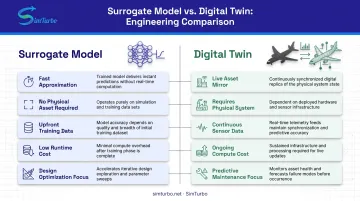
Two dimensions drive most selection decisions: what each tool is for, and whether a physical asset must be in the loop.
Purpose and Intent
Surrogate models are fast approximations. They replace expensive simulations with simplified representations that keep acceptable accuracy.
Engineers use them to explore thousands of design configurations, run Monte Carlo uncertainty studies, or test what-if cases in real time. Waiting hours or days for each full-physics solve is rarely practical in those workflows.
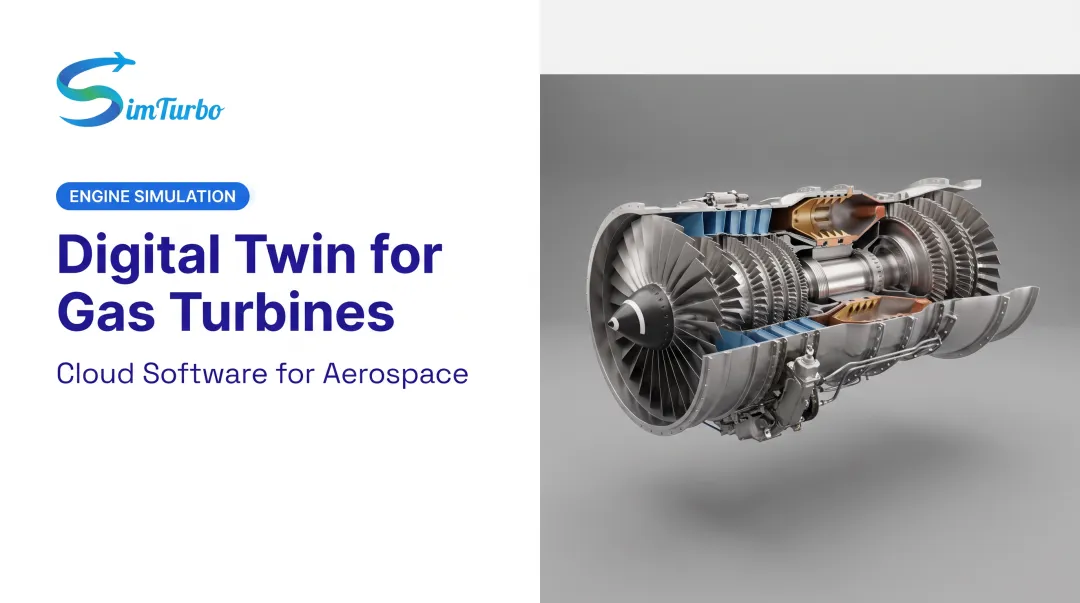
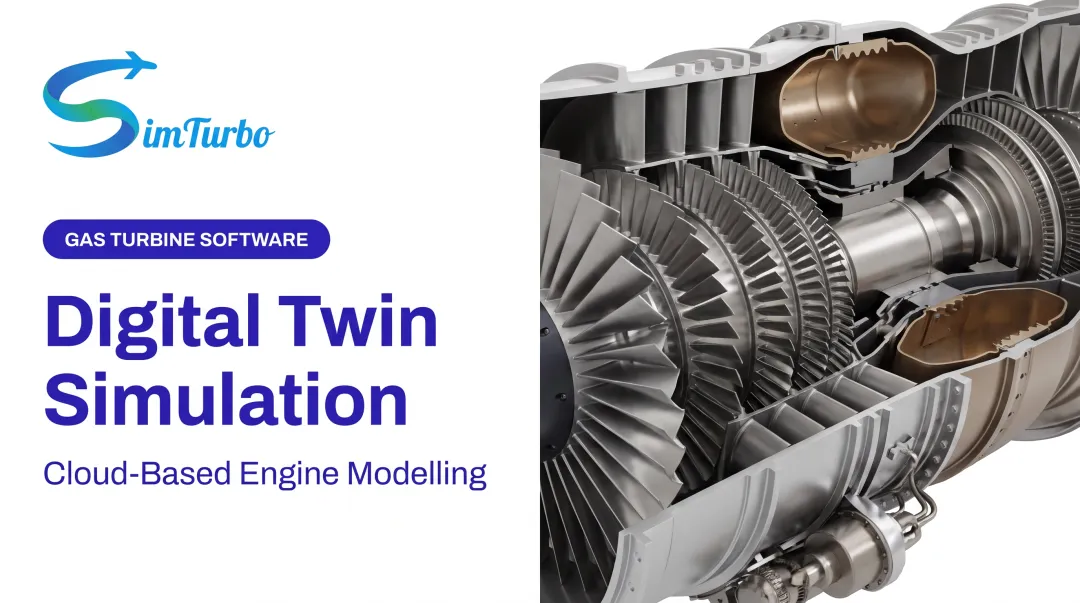
Digital twins work as live operational models. They fuse physics-based models with sensor streams to track a specific engine, turbine, or system as it ages. The twin absorbs wear, maintenance events, and performance drift so teams can act before failures show up.
Relationship to Physical Assets
A surrogate model does not need hardware in the loop. You can build it before any asset exists, train it on simulation data or lab experiments, and use it without connecting to a real system.
A digital twin depends on a physical counterpart—an engine in service, a turbine on the grid, or another asset that generates data. Its value comes from reflecting that asset’s actual state and updating as conditions change.
What is a Surrogate Model?
A surrogate model (also called a metamodel) is a simplified mathematical representation that approximates the input-output behavior of a complex, computationally expensive simulation. Instead of solving full physics equations each time, the surrogate learns patterns from training data and delivers predictions in seconds or milliseconds.
Why Engineers Use Surrogate Models
The core benefit is speed without catastrophic accuracy loss. High-fidelity CFD or FEA simulations can take hours or days per run. When an optimization study requires evaluating 10,000 design candidates, that timeline becomes unworkable. A validated surrogate reduces each evaluation to milliseconds, compressing months of compute time into hours.
Other benefits include:
- Rapid design iteration across thousands of configurations
- Real-time optimization during interactive design sessions
- Reduced hardware requirements compared to running full-scale simulations
- Parametric studies exploring how uncertainties propagate through the system
- Accessible analysis for teams without access to high-performance computing clusters
Main Types of Surrogate Models
Statistical data-fit models learn relationships directly from input-output pairs. Common examples include:
- Gaussian processes (kriging) that provide uncertainty estimates alongside predictions
- Polynomial response surfaces that fit low-order equations to simulation results
Both methods treat the underlying physics as a black box, focusing only on input-output mapping.
Reduced-order models simplify the physics itself rather than ignoring it:
- Proper orthogonal decomposition (POD) identifies dominant modes in the solution and discards less-important dynamics
- Modal analysis captures system behavior using a subset of natural frequencies
Machine learning approaches apply modern data-driven techniques:
- Neural networks approximate nonlinear relationships through layered transformations
- Support vector machines partition the design space for regression or classification
NASA's analysis of an ADEPT trajectory study found that a machine-learning surrogate delivered approximately 10,000x speedup compared to high-fidelity POST2 simulations, while a coarse-timestep model achieved approximately 100x and reduced-physics models reached approximately 4x.
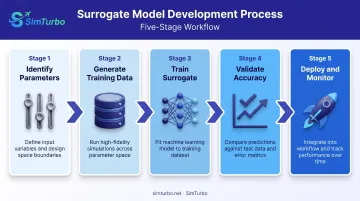
How to Develop a Surrogate Model
- Identify parameters and outputs - Define design variables (geometry, materials, operating conditions) and quantities of interest (efficiency, temperature, pressure ratio)
- Generate training data - Run high-fidelity simulations or experiments using Design of Experiments (DOE) to sample the trade space efficiently
- Select and train the surrogate - Fit the chosen model type to the training data, tuning hyperparameters as needed
- Validate accuracy - Test predictions on separate held-out data; NASA's ACO launch-vehicle study required R² > 0.99 and standard deviation of percent error below 1%
- Deploy and monitor - Use the surrogate for rapid predictions, account for its error in uncertainty quantification, and avoid extrapolating beyond training bounds
Limitations and Trade-offs
Surrogate models sacrifice some accuracy for speed. They work best within their training envelope but can fail when extrapolating to untested regions.
They also require upfront investment. Generating 7,200 training cases for NASA's upper-stage mass surrogate took about 16.5 hours on 8 cores. If system characteristics change significantly, the surrogate needs retraining to maintain validity.
Use Cases for Surrogate Models in Engineering
Design Optimization Workflows
Engineers evaluating thousands of gas turbine component designs need surrogate models to make optimization tractable.
A 2024 study of a 1.5-stage heavy-gas-turbine axial compressor used a surrogate-assisted multiobjective method to achieve 2.42% higher design-point adiabatic efficiency and 9.04% higher surge margin. Full CFD on every candidate would have been computationally prohibitive.
A 2019 ASME supersonic turbine nozzle study used the same class of algorithms to cut cascade loss coefficient by 50% while improving inlet-flow uniformity.
Uncertainty Quantification Studies
Monte Carlo work often needs thousands of runs to show how tolerances, material scatter, or operating-condition uncertainty affect performance.
NASA JPL's 2022 ADEPT trajectory study used multifidelity Monte Carlo with a machine-learning surrogate about 10,000x faster than the high-fidelity model. That speed made landing-state statistics practical to explore.
Gains still depend on the physics fit. When low-fidelity correlation was weak, angle-of-attack improvement was negligible.
Real-Time Control and Operator Training
Fast predictions support work that cannot wait on full CFD or FEA:
- Hardware-in-the-loop testing
- Flight and operator training simulators
- Control algorithm development
SimTurbo, for example, pairs physics-based models of inlets, compressors, combustors, turbines, and nozzles with physics-informed neural networks for real-time control design and virtual prototyping. J85-GE-21 validation stayed within ±2% of NASA test data for thrust, flow rate, temperature, and TSFC.
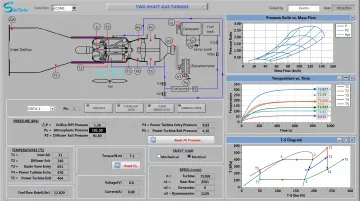
Because it runs on standard PCs with light GPU demand, teams can use it for:
- Interactive exploration of engine behavior
- Classroom and lab demonstrations
- Rapid what-if scenario testing without hour-long CFD runs
What is a Digital Twin?
A digital twin is an integrated virtual representation of a specific physical asset that combines physics-based models with continuously updated data from sensors and operations. The twin mirrors the asset's current state and predicts its future behavior throughout its lifecycle, from commissioning through operation, maintenance, and eventual decommissioning.
Three Essential Components
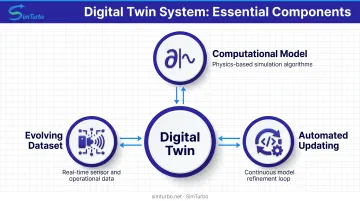
According to the National Academies of Sciences, Engineering, and Medicine (NASEM), a credible digital twin requires:
- Computational model - Physics-based or hybrid models representing the physical system's behavior
- Evolving dataset - Sensors and measurements on the actual physical counterpart that feed the twin
- Automated updating methods - Algorithms for dynamically calibrating the model based on new data, including sensor fusion, parameter estimation, and state tracking
Without all three, the system is simply a model or a monitoring dashboard, not a true digital twin.
The model begins with initial calibration during commissioning, establishing baseline behavior. As the asset operates, continuous sensor data (temperatures, pressures, vibrations, performance metrics) flows into the twin.
Algorithms then update the model to reflect component wear, degradation, and changing efficiency. Maintenance actions and part replacements stay reflected in the virtual representation, so the twin tracks the physical system's actual condition rather than its as-designed state.
Core Benefits for Engineering Operations
Digital twins enable predictive maintenance by identifying potential failures before they occur. Comparing predicted performance against actual sensor readings reveals anomalies that signal developing problems.
Key operational benefits include:
- Accurate performance predictions for better decision-making
- Extended asset life through optimized operating strategies
- Reduced unplanned downtime
- Digital records that support regulatory compliance
Technical Requirements
Building a digital twin demands more than just a model. Required infrastructure includes:
- Reliable sensor networks and data pipelines for continuous observation
- Validated physics-based or hybrid models that capture relevant system behavior
- Data assimilation and parameter estimation algorithms to update the model dynamically
- Computational resources sufficient for regular updates and predictions
- Integration with operational systems to close the decision loop
NASEM notes that large-scale twins require scalable computation, large-scale data handling, federated resource management, and adaptable methods for multiscale, multiphysics, multi-code systems. A twin without serious verification, validation, and uncertainty quantification is not trustworthy.
Use Cases for Digital Twins in Engineering
In engineering practice, digital twins show up most often where live asset data can change a maintenance call, a fleet plan, or an operating setpoint. The cases below are representative—and they also show where published ROI evidence is still thin.
Predictive Maintenance in Aerospace Engines
Twins estimate remaining useful life for parts such as turbine blades by folding in live temperatures, vibration, and performance drift. Rolls-Royce streams in-service engine data in real time and schedules work from each engine’s actual condition instead of fixed intervals. Shops can intervene before failure without tearing down healthy hardware.
A 2023 aeroengine study fused a mechanism model with PSO-XGBoost on 2,700 sensor samples across 9 fault types. Reported results:
- 0.125% MAPE
- 98.6% fault classification accuracy
- 0.0348 s per data point
Validation still relied on simulated degradation, not long-term field failures.
Fleet Management for Gas Turbines
GE Vernova’s Asset Performance Management (A2A) watches 6 sites and 10 gas turbines with customized models. Per-engine twins track degradation, tune inspection intervals across the fleet, and flag anomalous behavior that may signal emerging faults.
Public write-ups stop short of percentage gains in downtime, availability, or maintenance cost. NASEM calls that gap evidence that twin success and added value remain “seriously lacking.”
Performance Optimization During Operations
Twins also test how operating strategies trade fuel burn, emissions, and component life. A 2020 ASME small industrial gas-turbine twin paired a dynamic physics model with Kalman tuning, remote monitoring, and PC/PLC deployment. That setup supported offline commissioning plus online gas-path degradation and fault detection—useful for balancing efficiency, environmental limits, and maintenance cost, even though hard downtime or dollar savings were not published.
NASA Glenn’s 2023 100-kW HyPER electrified-propulsion rig twin used 16 speed, voltage, current, and power outputs with regression and planned Kalman updates. The model matched rig outputs “reasonably well,” which supports twin-based control validation for hybrid-electric systems. Numerical error bounds and availability metrics were not reported.
Surrogate Model vs Digital Twin: Which Should You Choose?
Key Decision Factors
Does a physical asset already exist? Digital twins require a real, operational asset generating sensor data. Surrogate models do not. They can be built purely from simulations or lab tests before any hardware exists.
Do you need real-time operational decisions? For live monitoring, failure prediction, or operations optimized to current conditions, choose a digital twin. For design alternatives or thousands of parametric studies, a surrogate model is faster.
What is your budget for sensors and data infrastructure? Digital twins need reliable sensor networks, data pipelines, continuous computing, and model-update algorithms. Surrogate models need upfront investment in generating training data but minimal operational infrastructure afterward.
What computational resources are available? Surrogate models require significant compute during training but minimal resources during use. Digital twins need moderate to high ongoing capacity for data processing, model updates, and prediction generation.
Design and Development Phase Guidance
During early-stage design, no physical prototype exists. Surrogate models become essential for rapid iteration, design optimization, and exploring the trade space to identify promising configurations before committing to expensive prototyping or testing.
NASA's ACO launch-vehicle study used surrogate models to evaluate 7,200 upper-stage mass cases and 1,206 payload cases, enabling trade-space exploration that would have been impractical with full-fidelity tools. The surrogate development took about 16.5 hours on 8 cores to generate training data, but once built, it enabled months of interactive design work.
Operational Phase Guidance
Once an asset is manufactured and running, digital twins support:
- Monitoring actual performance
- Predicting maintenance needs
- Optimizing operations from real conditions
- Extending asset life with data-driven decisions
Rolls-Royce uses digital twins to schedule maintenance for in-service engines based on each unit's specific condition, avoiding both premature inspections and unexpected failures. The twin evolves with the engine, tracking degradation and updating predictions as new sensor data arrives.
Combining Both Approaches
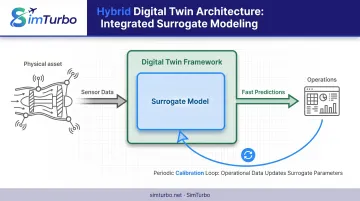
Many teams embed surrogate models inside digital twin frameworks. You get fast predictions for real-time decisions without cutting the link to the physical asset.
The surrounding twin infrastructure keeps those predictions calibrated through periodic updates from operational data. The National Academies (NASEM) treat reduced-order models, surrogates, and multifidelity information as twin enablers—twin models can range from high-fidelity replicas to simplified surrogates. Use a surrogate inside a twin when latency makes the full model impractical, and keep uncertainty quantification plus validation against real-world measurements.
Cost-Benefit Analysis
Surrogate models have high upfront development cost—DOE planning, high-fidelity simulation runs, model training, validation—but low operational cost once deployed. Each subsequent prediction is nearly free.
Digital twins carry ongoing costs for sensors, data management, computing infrastructure, and model maintenance. In return, they can improve operations and cut failures over the asset’s life.
Base ROI on asset value, failure consequences, and optimization upside. NASEM cautions that public evidence of realized ROI remains limited, so require asset-specific baseline and outcome KPIs instead of generic claims.
Real-World Examples in Engineering Simulation
Aerospace Engine Design
Aerospace companies use surrogate models during the design phase to evaluate thousands of turbine blade geometries, optimize compressor configurations, and predict engine performance across flight envelopes. In one documented case, a 2024 compressor-fillet study used a machine-learning surrogate framework to balance structural durability against fillet size during early design trades.
The 2019 ASME supersonic turbine nozzle study went further: surrogate-assisted evolutionary blade-profile optimization achieved a 50% reduction in cascade loss coefficient and improved inlet-flow uniformity. Compressing months of CFD into days lets engineers test far more alternatives than high-fidelity simulation alone would allow.
Power Plant Digital Twins
Gas turbine digital twins in power generation combine physics-based thermodynamic models with real-time operational data to predict component degradation, optimize maintenance schedules, and reduce unplanned outages. GE Vernova's Asset Performance Management system monitors 10 gas turbines at 6 sites using customized models, providing fleet-scale visibility and condition-based decision support.
Public write-ups rarely publish hard availability or maintenance-cost deltas. That gap matches NASEM's finding that published evidence of digital twin value is still "seriously lacking," so teams should judge each deployment on case-specific results rather than generic claims.
Hybrid Approach: SimTurbo for Gas Turbine Simulation
SimTurbo sits between pure surrogates and full operational twins. It pairs physics-based models of inlets, compressors, combustors, turbines, and nozzles with physics-informed neural networks, so engineers get real-time speed without giving up component-level physical insight.
That mix fits control system design, classroom demos, and virtual prototyping: full CFD is too slow, and black-box surrogates alone hide the physics. Its J85-GE-21 single-spool turbojet simulation validated within ±2% of NASA Lewis Research Center data for thrust, flow rate, temperature, and thrust-specific fuel consumption.
The platform runs on standard PCs with light GPU demand and updates transient graphs, component maps, and cycle diagrams as throttle and ambient conditions change. Typical workflows include:
- Building engine architectures and swapping components for parametric studies
- Exporting transient data to MATLAB/Simulink, Python, or Excel for control validation
- Teaching steady-state and transient behavior without a full CFD stack
It does not yet pull live sensor feeds from a specific installed engine. Even so, real-time speed plus physics fidelity place it between design-phase surrogates and fully connected operational digital twins.
The Trend Toward Hybrid Methodologies
Advanced programs increasingly mix both ideas: surrogate speed where exploration matters, and twin-style fidelity where the live asset matters. The right balance still depends on the decision you need to make, the data you can trust, and the compute you can afford.
In practice, teams tend to split the work this way:
- Design optimization: Surrogates lead, because speed opens large design spaces
- Operating assets: Digital twins lead, because sync with the plant supports predictive maintenance and performance tuning
- Both at once: Hybrid setups embed validated surrogates inside twin frameworks for real-time control checks, hardware-in-the-loop tests, or fleet studies, refreshing surrogate parameters from operations data when drift appears
Conclusion
Which tool you need depends on the job. Surrogate models and digital twins solve different problems, and many teams will use both across a product’s life.
Choose the approach that matches the work:
- Surrogate models for design exploration and optimization, when you need to evaluate thousands of configurations, run uncertainty studies, or do real-time what-if analysis that full-physics simulations cannot support at scale
- Digital twins for operational assets, when live accuracy and predictive maintenance matter and the model must track a specific engine, turbine, or system as it ages
Hybrid setups are increasingly practical: surrogate techniques supply speed inside digital twin frameworks, so engineers keep accuracy without waiting on full-physics runs at every step. From early design through operation and maintenance, knowing when to apply each method (and when to combine them) leads to faster development cycles and more reliable in-service decisions.
Frequently Asked Questions
What is the difference between a model and a digital twin?
A model is any mathematical representation of a system. A digital twin pairs that model with real-time data from a specific physical asset and keeps updating from operational measurements, so the virtual copy stays tied to the real system as it changes.
What is surrogate modeling?
Surrogate modeling builds simplified, fast approximations of complex simulations that stay accurate enough for engineering use while running orders of magnitude quicker. That speed supports design optimization, uncertainty quantification, and parametric studies that need thousands of evaluations full-physics models cannot afford.
What are some examples of surrogate models?
Common types include polynomial response surfaces, Gaussian processes (kriging), radial basis functions, reduced-order models, and neural networks. Gaussian processes give uncertainty estimates, polynomials stay interpretable, neural nets handle high-dimensional nonlinearity, and reduced-order models keep more physical structure.
When should you use a surrogate model vs a digital twin?
Use surrogate models in design for fast exploration, optimization across many configurations, and parametric studies before hardware exists. Use digital twins on operating assets when you need continuous monitoring, predictive maintenance, and real-time decisions tied to actual system behavior over the lifecycle.
Can surrogate models and digital twins work together?
Yes. Hybrids embed surrogates inside digital twin frameworks so predictions stay fast enough for real time, while operational data periodically refreshes the surrogate. That mix supports uses such as real-time control validation and fleet optimization.
What are the computational requirements for each approach?
Surrogates cost more up front (often hours or days on multi-core systems to build training data) but need little compute at runtime, often thousands of predictions per second. Digital twins need steady moderate capacity for data processing, sensor fusion, calibration, updates, and predictions across the asset’s operating life.