Physical turbine testing is expensive, slow, and risky. A failed test on a real unit can mean months of delay and six-figure repair bills. That's why simulation software has become essential for engineers, plant operators, and engineering students alike.
This guide covers what steam turbine simulators actually do, how they work under the hood, their real-world benefits, where they're applied across industries, and how to pick the right platform for your needs.
Key Takeaways
- Model, test, and optimize steam turbine performance digitally before hardware is built
- Use real-time simulation for transient analysis, control validation, and operator training
- Prefer component-based platforms over black-box tools when you need flexible system design
- Match simulator choice to fidelity needs, industry use case, and MATLAB/Simulink integration
What Is a Steam Turbine Simulator?
A steam turbine simulator is a digital environment that models the thermodynamic and mechanical behavior of a steam turbine system. Instead of guessing how a design will perform, engineers build a virtual version and run it through real operating scenarios.
Two tool types get lumped together, but they are not the same:
- Offline/static tools calculate steady-state performance at fixed operating points
- Real-time interactive simulators run dynamic models of normal and abnormal scenarios as they unfold
These are not interchangeable. A steady-state model will not show what happens during a load rejection; a real-time simulator will. That dynamic behavior matches the formal definition used for operator training simulators.
Core Components Typically Modeled
Most platforms build their turbine models from a consistent set of building blocks:
- Boiler or steam generator
- Turbine stages (high-pressure, low-pressure, sometimes reheat sections)
- Governor and control valves
- Condenser and feedwater equipment
- Generator
- Shaft dynamics
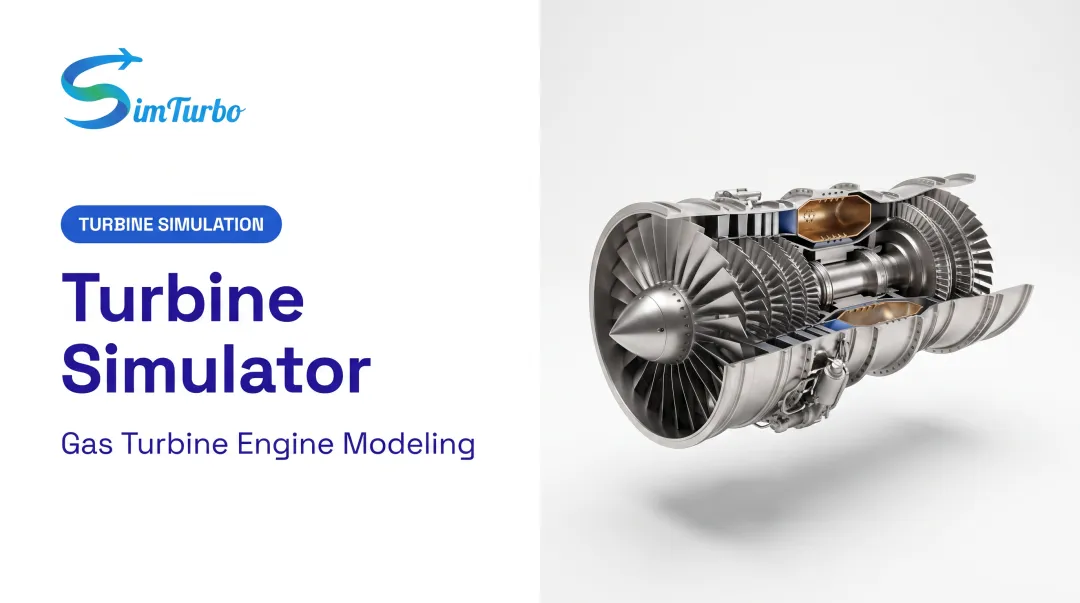
The strongest platforms treat those blocks as configurable pieces, not one opaque model. The same idea shows up in gas-turbine tools such as SimTurbo, where engineers connect inlets, compressors, combustors, turbines, nozzles, and shafts on a design palette and rebuild the flow path as needed. Component-based structure is what keeps a simulator useful for real design work instead of canned demos.

Typical users include:
- Power plant engineers
- Control systems engineers
- University programs running labs or capstone projects
How Steam Turbine Simulators Work
These platforms solve mass and energy balance equations tied to the Rankine cycle, plus rotor dynamics on the mechanical side.
A MathWorks Rankine cycle example shows the layout in practice: high- and low-pressure turbine sections, superheating and reheating, feedwater preheating, and two-phase fluid behavior in the boiler and condenser.
Transient and Control Validation
Real-time simulation lets engineers watch what happens during:
- Startup and shutdown sequences
- Load changes
- Throttle response
- Fault conditions
Governor and control-law testing is where this really pays off. A 2021 study on PID-based steam turbine governors found that peak overshoot during a 15% load change dropped from 44.8% without a controller to just 3.45% with a properly tuned, particle-swarm-optimized controller. That's the kind of tuning work you want to finish in software, not on a live unit.

Data Export and Validation
Most serious platforms let you export simulation data into Excel, MATLAB/Simulink, or Python for deeper post-processing. MathWorks documents this through FMU (Functional Mock-up Unit) export in FMI 2.0 or 3.0 format, letting models plug into broader co-simulation workflows.
Accuracy matters more than marketing claims. A 2016 industrial network study reported mean relative error below 1.18% between field turbine operation and simulation output — but that figure depends on specific boundary conditions and data quality, not a universal guarantee. Always ask vendors for plant-specific validation, not a generic accuracy promise.
A 2025 physics-informed DeepLSTM model for marine steam turbines combined energy conservation principles with machine learning, reporting an R-squared above 0.9676 and a 68.4% lower mean absolute error than a conventional neural network. Hybrid AI-physics methods are still closer to research than to a commercial standard, but the accuracy gains are real.
Key Benefits of Using a Steam Turbine Simulator
Steam turbine simulators cut cost, risk, and development time before hardware ever enters the picture.
Cost avoidance. Finding design flaws in software costs a fraction of catching them after fabrication. Each redesign cycle you skip on the shop floor protects both schedule and budget.
Safety. Engineers can test fault conditions, overspeed events, and emergency shutdowns without putting people or hardware at risk. GE Vernova notes that control system simulators help reduce costly trips and startup failures tied to operator error.
Faster training. Operators and students get hands-on practice with realistic turbine behavior and no operational risk. GSE Systems reports more than 1,100 simulator installations worldwide across nuclear, fossil, and other power sectors.

Iteration speed. Re-parameterizing a design takes minutes in software versus weeks on physical test stands. That speed compounds across a project's lifecycle:
- Accelerate design reviews
- Shorten control tuning cycles
- Compress the path from concept to validated design
Industry Applications of Steam Turbine Simulation
Power generation remains the biggest use case. Engineers model combined-cycle and conventional steam plants to optimize performance and tune control systems before committing to hardware changes.
MIT thermodynamics materials describe how gas turbine exhaust heat feeds a two-phase Rankine bottoming cycle through a heat exchanger. That gas-to-steam interface is exactly what simulation helps validate before a plant change.
Marine and industrial systems use the same approach. A 2025 study built a Modelica-based model of a marine steam turbine generator. Its surrogate stayed under 1.57% absolute error under step-load conditions and cut computation time by 85% versus the full physics model.
Academic and Research Use
Universities use turbine simulators for capstone projects, thermodynamics coursework, and control systems research. A University of Wisconsin-Madison thesis built a transient power-block simulator for operator training, validated against real plant data.
Academic access often comes down to licensing cost. SimTurbo's university program offers seat-based digital licensing with student discounts and classroom or lab specials, so departments can equip a full course without enterprise budgets.
Choosing the Right Steam Turbine Simulator
Selection comes down to a handful of concrete questions:
- Does it run in real time? Not every use case requires it, but transient analysis and operator training do.
- Is it component-based or black-box? Component architecture lets you swap a condenser model or add a reheat stage without starting over.
- What validation evidence exists? Ask for plant-specific or test-data comparisons, not generic accuracy claims.
- Does it integrate with your existing workflow? MATLAB/Simulink compatibility and clean data export matter for downstream analysis.

The IAEA's simulator selection guidance, written for nuclear training but broadly applicable, recommends matching modeling scope to your actual learning or engineering objective rather than buying maximum fidelity by default.
Trial access lowers adoption risk. A free trial lets you test usability before committing budget. SimTurbo, for example, offers a 30-day free trial with full feature access on its gas turbine platform, which is a useful model for how trial periods should work in this software category. Buyers focused on steam applications should still confirm coverage for their exact use case.
On licensing: COMSOL's documented licensing patterns are a good general reference:
- Perpetual licenses never expire
- Term licenses include ongoing updates during the contract
- Floating network licenses support concurrent users
Compare these terms separately from technical fit. A strong simulator with the wrong license structure for your team size is not a good deal.
Frequently Asked Questions
Which is the best software for simulation?
There's no single "best." It depends on gas vs. steam modeling, real-time vs. offline analysis, and how clearly the vendor documents validation accuracy. Weigh component flexibility and your industry use case before choosing.
How much steam is required to generate 1 MW?
Steam requirements vary by turbine efficiency, pressure, and temperature. Case studies report specific steam consumption of roughly 16 to 20 lb per kWh (about 7.3 to 9.1 kg/kWh) depending on turbine type, so a firm answer needs your turbine's actual state points.
What is the difference between a steam turbine simulator and a gas turbine simulator?
Both use similar thermodynamic modeling principles, but steam turbines follow the Rankine cycle while gas turbines use the Brayton cycle. Steam systems model boilers, condensers, and two-phase flow; gas turbines focus on compressor and combustor dynamics.
Can steam turbine simulation software be used for operator training?
Yes. Real-time simulators let trainees practice startup, shutdown, and fault-response scenarios without risking plant equipment or personnel.
Do I need programming skills to use a turbine simulator?
Most modern platforms use drag-and-drop, graphical interfaces that require minimal coding. That said, exporting data to tools like MATLAB or Python for deeper post-processing benefits from basic scripting knowledge.