Key Takeaways
- Compressor stall hits when blade angle of attack exceeds its critical value, separating airflow and driving pressure fluctuations.
- Two types matter: rotating stall (localized cells) and surge (system-wide oscillation that can reverse flow).
- Common triggers include FOD, abrupt throttle inputs, extreme maneuvers, and ice accumulation.
- FADEC, variable geometry, and bleed valves cut stall risk but cannot remove it entirely.
What Is a Compressor Stall?
A compressor stall is a condition where airflow through the compressor becomes disrupted due to aerodynamic stall of the compressor blades, analogous to wing stall but occurring on rotating compressor airfoils. According to NTSB technical documentation, one or more axial-compressor rotor stages fail to pass air smoothly to succeeding stages when the pressure ratio becomes incompatible with engine RPM.
The fundamental principle: Compressor blades are airfoils with an effective angle of attack determined by the vector sum of inlet air velocity and compressor rotational speed. When this angle exceeds a critical threshold, flow separates from the blade surface, interrupting smooth compression and producing turbulence and pressure fluctuations.
Stall occurs when the compressor can no longer push air against the back pressure from downstream combustion. The operating point has moved outside the stable relationship among mass flow, rotational speed, and pressure rise.
Stalls fall into two severity levels:
- Transient stall – A momentary disruption that may self-correct as conditions stabilize
- Full surge – Complete compression breakdown with flow reversal and potential engine damage
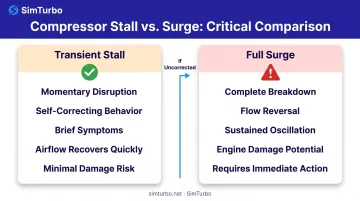
Understanding compressor stalls matters beyond commercial aviation. The GE LM2500 aeroderivative marine gas turbine, used by 39 navies worldwide on frigates, destroyers, and carriers, faces similar aerodynamic challenges.
Industrial power turbines like the Siemens SGT-800, with its 15-stage compressor and up to 62 MW output, must manage surge margins across varying grid demands and ambient conditions.
Types of Compressor Stalls
Rotating Stall
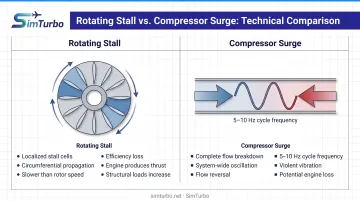
Rotating stall is a localized disruption where stall cells—pockets of separated airflow—rotate around the compressor annulus at a slower speed than the rotor blades themselves. When individual blade sections stall, they block flow and raise the angle of attack on adjacent blades, so the stall cell propagates circumferentially.
An ASME eight-stage-compressor study mapped high- and low-cell-count families from casing pressure and rotor strain data. Cell count and propagation speed still depend on design and operating condition—so treat published numbers as case-specific, not universal.
Rotating stall is a circumferential nonuniformity within the compressor, not a system-wide oscillation. It cuts compressor efficiency and raises structural loads, but the engine still produces some thrust. That is the practical split from surge: different diagnostics, different recovery steps.
Compressor Surge
Compressor surge is a complete, violent breakdown of compression. Airflow reverses and can blast forward out the intake.
The mechanism is straightforward. When blade stall makes the adverse pressure gradient unsustainable, the compressor can no longer push flow against downstream pressure. Flow reverses rapidly and briefly relieves the back pressure.
The cycle is what makes surge so dangerous. Once pressure drops, flow can go forward again, rebuild pressure, and surge once more—a self-sustaining oscillation. A 2018 Cranfield study of industrial gas turbines recorded a 5–10 Hz cycle in that setup; frequency still varies by compressor design.
Severe consequences include:
- Extreme vibration from repeated flow oscillations
- Blade-to-stator clashing and other mechanical damage
- Full engine loss if the surge locks in
- Loud bangs and visible flames at intake or exhaust
- Sharp, unmistakable swings on cockpit or control-room instruments
Surge is a compressor-system oscillation, not just a local blade problem. Prevention and recovery both start from that system-level view—not from treating surge like a single stalled blade row.
Causes of Compressor Stalls
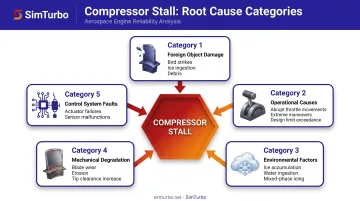
Foreign object damage is a primary initiator. Bird strikes, ice ingestion, or debris can damage compressor blades or disrupt airflow patterns.
US Airways Flight 1549 lost nearly all thrust in both engines after large-bird ingestion and ditched in the Hudson River. The NTSB did not label that event a compressor stall, but it shows how severe FOD-driven thrust loss can be.
A 2026 FAA Airworthiness Directive documents 3 aborted takeoffs and 2 air turn-backs from CFM LEAP-1A high-pressure-compressor stall. Wear in the No. 3 bearing spring-finger housing produced high non-synchronous vibration that triggered the stalls.
The FAA warned the condition could cause power loss during takeoff or climb, loss of thrust control, reduced controllability, and loss of the airplane.
Operational causes:
- Abrupt throttle movements, especially rapid acceleration that over-fuels the engine
- Extreme aircraft maneuvers that distort inlet flow
- Operation outside design limits, such as excessive altitude
- Insufficient fuel flow during abrupt deceleration
Environmental factors:
- Ice on compressor blades that changes their aerodynamic profile
- Water ingestion that raises the operating line and cuts surge margin
- Mixed-phase and ice-crystal icing (FAA AC 20-147A), which can cause rollback, flameout, or core damage
Mechanical degradation:
- Blade wear, sand or dirt erosion, and fouling that distort geometry
- Larger tip clearances that weaken aerodynamic integrity
Recognizing a Compressor Stall
Primary sensory indicators:
- Loud banging sounds – Like backfiring or gunshots, caused by flow reversal
- Visible flames – Unburned fuel igniting at engine intake or exhaust
- Pronounced vibration – Shuddering felt throughout the aircraft
Instrument indications:
- Rapid fluctuations in engine RPM (N1/N2 indicators)
- Sudden spikes in exhaust gas temperature (EGT/ITT/TIT)
- Thrust loss with potential yaw in multi-engine aircraft
These symptoms vary based on stall severity. Transient stalls produce only brief symptoms—a single bang with momentary instrument flutter.
Sustained surges create continuous loud roaring, persistent vibration, and steady instrument abnormalities requiring immediate pilot action.
No single cue proves stall. Operators must correlate sound and visual cues with thrust and engine parameters using the aircraft's approved procedure.
Continued stall may progress to flameout and physical engine damage.
Effects and Consequences
Immediate operational effects
- Significant thrust loss—potentially total in a severe surge
- Handling difficulty from asymmetric thrust on twin-engine aircraft
- Compromised climb performance, especially critical on takeoff
Mechanical damage risks
- Blade and stator vane clash that can fracture compressor hardware
- Liberated blade fragments ingested downstream, damaging the turbine
- Extreme vibration that fatigues engine mounts and airframe structure
Long-term consequences
- Even “minor” stalls still require a maintenance inspection
- Overweight landings when the aircraft cannot climb or dump fuel
- Severe surges that can force a full engine replacement
- 2026 LEAP-1A AD: non-synchronous vibration checks every 50 flight cycles, with bearing-housing replacement within 25 or 5 cycles if limits are exceeded, plus HPT honeycomb inspections
Prevention and Modern Solutions
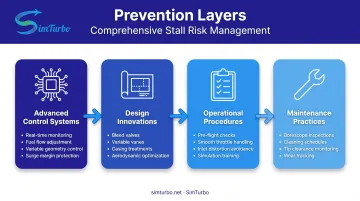
Advanced Engine Control Systems
Full Authority Digital Engine Control (FADEC) systems monitor compressor conditions in real time. They adjust fuel flow and variable geometry to hold safe margins from the surge line. NASA documentation confirms that the maximum fuel limit protects against surge/stall, overtemperature, overspeed, and overpressure.
Modern fuel control units also limit fuel flow during rapid throttle movements, which prevents slam acceleration—a common stall trigger on early jet engines. FADEC still does not remove every risk. FOD, icing, inlet distortion, component wear, and control or actuator faults remain credible initiators.
Design Innovations
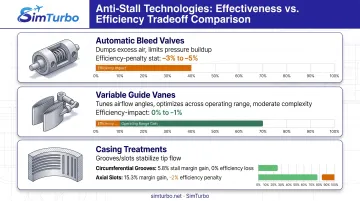
Compressor anti-stall systems include:
- Automatic bleed valves that dump excess air to limit pressure buildup (higher efficiency penalty; the compressor throws away work already done on that air)
- Variable inlet guide vanes and stator blades that tune airflow angles across the map (more mechanically complex than bleed)
- Casing treatments such as grooves or slots that stabilize tip flow
Historical NASA/GE tests found circumferential grooves reduced stalling flow 5.8% with no efficiency loss, while axial-skewed slots achieved 15.3% reduction with a 2.0-point efficiency penalty. These are test-specific results, not fleet-wide performance guarantees.
Aerodynamic design widens surge margin when blade shapes, stage-to-stage diffusion, and compressor matching keep the pressure rise stable. The 2018 Cranfield study notes that Siemens SGT industrial engines combine variable blade geometry with interstage bleed to protect low-speed surge margin.
Operational Procedures and Training
Operational safeguards:
- Pre-flight checks for ice contamination
- Adherence to engine handling procedures (smooth throttle movements)
- Avoiding flight conditions known to cause inlet distortion
Procedures alone are not enough. Engineers and students also need a way to rehearse transients before they show up on the test stand or in flight.
Simulation and training: SimTurbo models compressor behavior, transient response, and stall recovery in a virtual environment. It overlays the compressor operating line on the map so the operating point stays clear of the surge line. In documented examples, surge margin sits near 20–25% in normal operation and can fall below 5% in an afterburner transient before adaptive control restores it.
The platform runs startup, slam acceleration, and stall/surge cases so users can watch control logic react—modulating fuel flow, opening nozzle area, or moving variable stator vanes to avoid choking. Validation on the J85-GE-21 single-spool engine matched NASA Lewis Research Center test data within ±2% for thrust, flow rate, temperature, and TSFC.
Maintenance practices:
- Regular borescope inspections for blade damage
- Timely cleaning to prevent fouling and erosion
- Monitoring tip clearances to maintain aerodynamic integrity
Recovery Procedures
Standard Immediate Response
Smoothly and steadily reduce throttle on the affected engine to lower back pressure and allow compressor airflow to stabilize. At the same time, reduce aircraft angle of attack if operationally feasible.
One NTSB technical memo describes this approach. It is explanatory material only—not a substitute for an approved checklist.
Decision-Making After Stall Recovery
Next, judge whether the stall was transient or recurring:
- Transient: Single occurrence, then normal operation restored
- Recurring: Points to persistent damage or contamination and may require engine shutdown
EASA certification material allows a momentary stall that self-arrests without throttle manipulation. That language is an engine-acceptance provision, not a pilot procedure.
Continued Flight Versus Return
Neither the FAA nor EASA defines a universal continue-or-return rule. Use the aircraft-specific Quick Reference Handbook (QRH) or Aircraft Flight Manual (AFM), and weigh:
- Remaining thrust capability
- Proximity to suitable landing sites
- Potential for stall recurrence
- Manufacturer guidance
Do not rely on a blanket "continue" or "land immediately" rule. Follow the type-specific procedure.
Frequently Asked Questions
What is a compressor stall?
A compressor stall is an aerodynamic disruption where the compressor blade angle of attack exceeds its critical value. Flow separates, pressure fluctuates, and compression efficiency drops, much like an aircraft wing stall.
What are the common causes of compressor stalls?
Common causes include foreign object ingestion (birds, ice, debris), abrupt throttle movements, and inlet distortion from extreme maneuvers. Ice or water ingestion, operation outside design limits, and blade damage or contamination also trigger stalls.
How common are compressor stalls?
Compressor stalls were common in early jet engines but are now extremely rare thanks to FADEC, advanced aerodynamics, and anti-stall protections. They can still occur from bird strikes, severe icing, or component wear. FAA and NTSB sources do not publish a standard per-flight rate.
What does a compressor stall sound like?
A distinctive loud bang or series of bangs, like backfiring or gunshots, caused by airflow reversal. If the surge persists, operators hear a continuous loud roar, often with visible flames from the engine intake or exhaust.
Can a plane recover from a compressor stall?
Yes. Most compressor stalls are recoverable by reducing throttle to allow airflow stabilization. Modern multi-engine aircraft can safely land with one engine experiencing stall or even complete failure, though immediate landing is prudent to allow maintenance inspection and prevent potential engine damage.