Key Takeaways
- Two concentric shafts let the fan/LP compressor and HP compressor spin at independent speeds
- Each spool operates at its aerodynamically optimal speed, improving efficiency and surge margin
- Starting needs less power because only the lighter high-pressure spool is spun up first
- Most modern commercial engines (CFM56, LEAP, GE90, GEnx) use two-spool architecture
- Faster throttle response and stronger off-design performance across the flight envelope
What Is a Two-Spool Jet Engine?
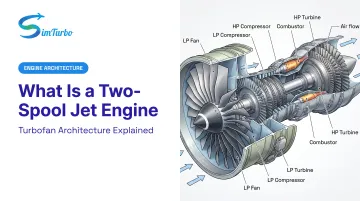
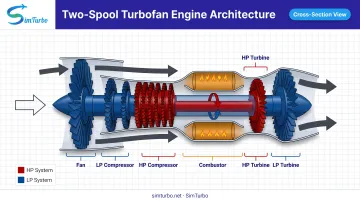
A two-spool jet engine is a gas turbine configuration featuring two concentric shafts. Each shaft connects compressor stages to matching turbine stages so the two assemblies can spin at independent speeds.
The inner high-pressure (HP) shaft runs through the hollow outer low-pressure (LP) shaft. That nested layout mechanically decouples the front and rear compression systems.
This design solves a fundamental problem. In a single-spool engine, every compressor stage must rotate at the same speed, yet large-diameter forward stages naturally want to turn slower than smaller rear stages.
Two-spool architecture fixes that mismatch. The large fan and LP compressor turn slowly while the small-diameter HP compressor spins much faster, so each section runs near its ideal speed.
What a two-spool engine is NOT:
- Not two engines joined together
- Not the same as a twin-engine aircraft (which has two separate engines)
- Not simply two rotors side-by-side: the spools are nested concentrically within one engine case
The configuration emerged in the late 1950s, when engineers pushed for higher pressure ratios and better fuel efficiency. Pratt & Whitney's JT3D, which first flew on June 22, 1960, pioneered the layout by adding a two-stage fan to the existing JT3 gas generator.
The result was a two-spool turbofan with separate LP and HP rotating assemblies—and the higher overall pressure ratios commercial jets needed.
Variations exist today. Some engines add booster stages; others use gearing. The two-shaft principle still dominates commercial aviation engine design.
How Does a Two-Spool Jet Engine Work?
A two-spool engine divides compression and expansion work between two mechanically independent shaft systems, each optimized for its specific pressure ratio and rotational speed requirements.
Spool Initiation and Starting
During engine start, a starter motor (electric or pneumatic) rotates the high-pressure spool. Once it reaches self-sustaining speed and fuel is introduced, combustion produces turbine power that naturally begins spinning the low-pressure turbine and its connected spool.
Key advantages:
- Requires less starter power because only the smaller, lighter HP spool must initially be accelerated
- The larger LP spool is driven by exhaust energy rather than the starter
- During ground start, the LP spool may windmill slowly from intake airflow before turbine power takes over
Low- and High-Pressure Spool Operation
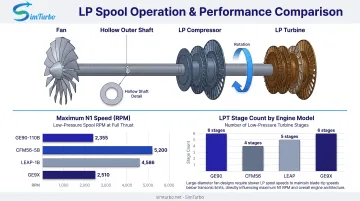
Low-pressure spool. The LP spool connects the fan and low-pressure compressor stages at the front to the low-pressure turbine stages at the rear via a hollow outer shaft. It handles the bulk of airflow, creating the bypass stream that generates most thrust in high-bypass engines while providing the first stage of core compression.
Operational characteristics:
- Rotates at slower speeds because of large-diameter fan blades
- Fan blade tips must stay below excessive tip speeds while moving large air volumes
- The LP turbine needs multiple stages to extract enough energy to drive the fan and LP compressor
| Engine | Max N1 (rpm) | LPT Stages |
|---|---|---|
| GE90-110B | 2,355 | 6 |
| CFM56-5B | 5,200 | 4 |
| LEAP-1B | 4,586 | 5 |
| GE9X | 2,510 | 6 |
LP spool speed is controlled mainly through fuel flow, which sets how much energy reaches the LP turbine in the exhaust gas.
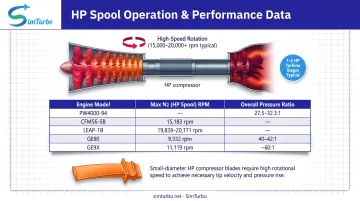
High-pressure spool. The HP spool connects high-pressure compressor stages to high-pressure turbine stages via an inner shaft running through the hollow LP shaft. It takes pre-compressed air from the LP compressor and raises it to combustor pressure.
Operational characteristics:
- Runs much faster than the LP spool (see N2 values below)
- Small-diameter compressor blades need high rpm to reach effective tip speeds
- The HP turbine usually uses only 1–2 stages; smaller diameter and higher speed extract energy efficiently with fewer stages
| Engine | Max N2 (rpm) | Overall Pressure Ratio |
|---|---|---|
| PW4000-94 | — | 27.5-32.3:1 |
| CFM56-5B | 15,183 | — |
| LEAP-1B | 19,828-20,171 | — |
| GE90 | 9,332 | 40-42:1 |
| GE9X | 11,119 | ~60:1 |
Combustion, Energy Distribution, and Independent Speeds
Hot, high-pressure gas from the combustor first expands through the HP turbine, driving the HP compressor, then through the LP turbine, driving the fan and LP compressor. In high-bypass turbofans, the LP turbine extracts far more power than the HP turbine because it drives the large fan.
Gas temperature peaks at the HP turbine inlet; temperature and pressure fall as the gas expands through each stage. That staged extraction lets each spool take the power it needs at its own speed.
Because the spools are not geared together, each runs at an aerodynamically better speed for the current condition. Turbine power on each shaft settles where it matches compressor demand—but at different rpm for LP and HP.
Example: At sea-level takeoff, both spools run fast for max thrust. At high-altitude cruise, the LP spool often slows while the HP spool stays relatively fast, each matching local density and mass flow.
The pilot or FADEC (Full Authority Digital Engine Control) changes only fuel flow. Aerodynamics set the spool-speed ratio. That self-matching is a main reason two-spool layouts work well across the flight envelope.
Operational Benefits, Control, and Thrust
Improved surge margin: Each spool finds its own speed, so compressor stages sit farther from stall during rapid throttle changes.
Faster acceleration: The lighter HP spool spools up first, raising combustion capacity; exhaust energy then accelerates the heavier LP spool, so thrust responds quicker.
Operational flexibility: Independent speeds support efficient running across altitude, airspeed, and throttle without locking both spools to one compromise rpm.
Part-load efficiency: In cruise and other reduced-power settings, each spool can slow toward a more efficient point instead of staying oversped, which cuts fuel burn.
Modern two-spool engines use dual-channel FADEC to manage fuel flow, variable stator vanes, and variable bleed valves, holding safe stall margins in transient operation.
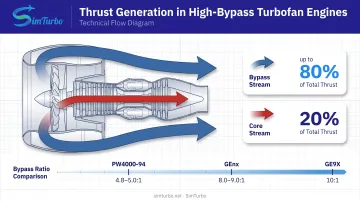
Thrust comes from two streams:
- Hot, high-velocity core exhaust from the engine center
- Cooler, slower bypass air from the fan
In modern high-bypass turbofans, bypass flow can produce up to 80% of total thrust. Bypass ratio (bypass mass flow ÷ core mass flow) varies by design: PW4000-94 about 4.8–5.0:1, GEnx about 8.0–9.0:1, GE9X about 10:1.
Raising fuel flow speeds both spools, moves more air through the fan, and heats the core exhaust—so both streams make more thrust. Most commercial two-spool engines use separate or mixed exhausts tuned to bypass ratio and mission.
Where Two-Spool Engines Are Used
Two-spool architecture dominates commercial aviation. Major engine families power the backbone of global air transport:
Commercial aircraft applications:
| Engine Family | Aircraft Examples |
|---|---|
| CFM56 | Airbus A320ceo, Boeing 737NG |
| CFM LEAP | Airbus A320neo, Boeing 737 MAX |
| GE90 | Boeing 777 family |
| GEnx | Boeing 787, Boeing 747-8 |
| GE9X | Boeing 777X family |
| PW4000 | Boeing 747/767, MD-11, Airbus A300/A310 |
Military transport and tankers: The F108 (military CFM56) powers the KC-135R, RC-135, and E-6B, leveraging two-spool reliability and commonality with commercial maintenance infrastructure.
Business and regional aviation: Smaller two-spool turbofans power business jets and regional aircraft where efficiency and reliability matter most.
Where two-spool is not dominant: Some engines use three-spool configurations. Rolls-Royce adds an intermediate-pressure spool in the RB211 and Trent families to reach higher overall pressure ratios while keeping operability.
Military fighter engines use various architectures tuned to different mission profiles. Even so, two-spool remains the most common commercial choice for its balance of performance, efficiency, and mechanical simplicity.

Engineering simulation and design: Understanding two-spool architecture is core to performance modeling, control design, and validation. Engineers and students use simulation to:
- Model dual-spool configurations and compressor matching
- Study transient operation and throttle response
- Validate control algorithms in real time
Platforms such as SimTurbo let aerospace engineers, researchers, and university programs build component-based two-spool turbojet models, examine high- and low-pressure spool interaction, and export performance data to MATLAB, Python, or Excel.
Conclusion
The two-spool architecture solved a fundamental challenge: allowing different engine sections to operate at aerodynamically optimal speeds while maintaining mechanical simplicity. By decoupling the fan/LP compressor from the HP compressor, engineers created an engine that adapts naturally to varying flight conditions, starts more easily, responds faster to throttle inputs, and operates efficiently across a wide performance envelope.
That balance of efficiency, operability, reliability, and cost explains why two-spool engines dominate commercial aviation, from the CFM56 to the high-bypass GE9X. The layout still underpins most modern air travel because it delivers stable performance across a wide flight envelope with a manageable mechanical design.
For engineers and students who need to go beyond the concept, modeling dual-spool matching, transients, and control response in a tool such as SimTurbo makes those tradeoffs visible in steady-state and real-time simulation.
Frequently Asked Questions
What is a spool engine?
A spool is a rotating assembly in a gas turbine engine consisting of a shaft connecting compressor stage(s) to turbine stage(s). "Spool engine" refers to how many independent shaft assemblies the engine has: single-spool, two-spool, or three-spool.
What is a dual-spool turbine?
"Dual-spool" is another term for two-spool, featuring two concentric, independently rotating shaft assemblies. The design allows different compressor and turbine sections to run at different speeds, improving efficiency and operability.
What is a three-spool engine?
A three-spool engine adds an intermediate-pressure (IP) spool between the LP and HP spools. Rolls-Royce uses this configuration in the RB211 and Trent families to reach higher overall pressure ratios while keeping strong operability and surge margin.
Why do pilots spool up jet engines before takeoff?
"Spooling up" means advancing the throttles to raise engine speed and thrust. Pilots use it to confirm response, check symmetrical thrust, and set stable takeoff power—the term comes from accelerating the rotating spool assemblies.
Why are pure turbojets less common today?
Pure turbojets (all air through the core) have been largely replaced by turbofans, which are more fuel-efficient and quieter at typical subsonic speeds. A bypass fan driven by the spool turbines makes more thrust per unit of fuel, so turbofans dominate commercial and transport use.