Turbine design directly shapes three things project developers care about: energy capture, capital cost, and long-term reliability. As wind technology matures, engineers face more design options than ever, from towering horizontal-axis machines to bladeless experimental concepts.
This article breaks down the major turbine design categories, explains how they differ mechanically and functionally, and gives you a framework for matching design to project conditions.
TL;DR
- Wind turbines split into horizontal-axis (HAWT) and vertical-axis (VAWT) designs, plus emerging bladeless/modular concepts
- HAWTs dominate utility-scale wind farms; VAWTs suit urban, residential, or turbulent-wind settings
- Design choice depends on site conditions, project scale, and maintenance budget
- Innovations like bend-twist blades, floating offshore platforms, and digital twins are reshaping cost and performance
What Is a Wind Turbine?
A wind turbine converts kinetic wind energy into mechanical energy, then electrical energy. That's the whole concept, stripped down.
The core components work together like this:
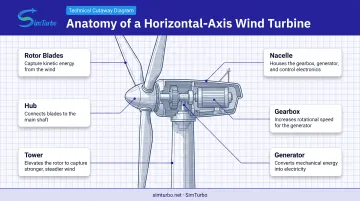
- Rotor blades capture wind and convert it to rotational motion
- Hub connects blades to the main shaft
- Nacelle houses the gearbox, generator, and control electronics
- Gearbox increases rotational speed to match generator requirements
- Generator converts mechanical rotation into electricity
- Tower elevates the entire system to access stronger, steadier wind
Turbine design is a practical engineering discipline: aerodynamics, structural loads, and manufacturing cost all have to balance at once. A blade that looks excellent in a wind tunnel but costs too much to build at scale—or fails after five years of fatigue loading—is still a bad design, no matter how efficient it looks on paper.
Why Does Wind Turbine Design Matter?
Design choices ripple through a project's entire economics. According to NREL's 2024 Cost of Wind Energy Review, land-based wind reference projects had an LCOE of $39/MWh in 2022 dollars, while fixed-bottom offshore projects hit $95/MWh. Floating offshore came in at $181/MWh using 2023 figures. That's roughly a 4.6x cost spread driven largely by design and site conditions.
Poor design choices show up as:
- Excess blade wear from mismatched aerodynamic loads
- Downtime from mechanical failures or gearbox issues
- Low output during variable or turbulent wind
- Higher-than-expected maintenance costs over the turbine's lifetime
Maintenance costs alone vary dramatically by turbine vintage. Berkeley Lab's 2024 report found capacity-weighted O&M averages ranging from $80/kW-year for 1980s-era projects down to $20/kW-year for turbines installed since 2020. Newer designs simply cost less to keep running.
That cost gap is why simulation-driven engineering matters. Instead of waiting months of field testing to find flaws in a physical prototype, teams validate designs virtually first.
Engineers can stress-test control logic, load response, and operating envelopes before locking a design for manufacturing. Model it before you build it—and you catch expensive mistakes early.
Types of Wind Turbine Designs
Wind turbines aren't one-size-fits-all. A rural utility-scale wind farm has almost nothing in common, design-wise, with a rooftop installation on a downtown commercial building. The types below address different wind conditions, space constraints, and power needs.
Horizontal-Axis Wind Turbines (HAWT)
HAWTs are what most people picture when they think "wind turbine." The rotor and generator sit atop a tall tower, with blades facing directly into the wind.
How they work:
- A yaw system rotates the entire nacelle so the rotor keeps facing the wind as direction shifts
- Blade pitch mechanisms adjust blade angle to optimize energy capture and prevent damage in high winds
- An anemometer continuously feeds wind-speed data to the controller, which manages rotor speed
Because blades sit perpendicular to airflow, HAWTs maximize swept area and output. The DOE states that the majority of installed wind turbines use this horizontal-axis design, and the fleet-wide performance data backs up why: US turbines averaged a 33.5% capacity factor in 2023, with turbines built in 2022 hitting 38.2%.
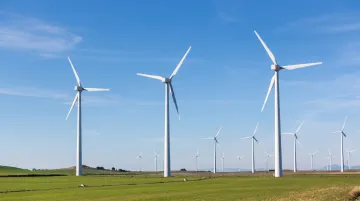
Best suited for: Utility-scale wind farms, open rural sites, offshore locations with steady, high wind speeds.
Strengths:
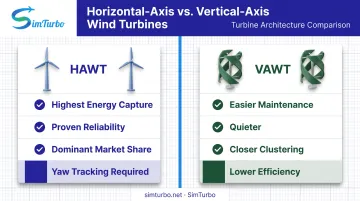
- Highest energy capture among mainstream designs
- Proven, well-documented reliability
- Dominant share of installed capacity worldwide
Limitations:
- Higher maintenance complexity (nacelle sits high off the ground)
- Noise generation from rotating blades
- Wildlife collision risk requiring environmental screening
- Must actively track wind direction
Vertical-Axis Wind Turbines (VAWT)
VAWTs rotate around a vertical shaft, perpendicular to the ground. Common variants include Darrieus, Savonius, and giromill designs.
How they work:
- Capture wind from any direction without a yaw system
- Vertical shaft keeps working as wind direction shifts
- Generator sits at the base, simplifying maintenance access
Best suited for: Urban rooftops, residential installations, turbulent or variable-direction wind environments where a HAWT's yaw system would constantly hunt for alignment.
Strengths:
- Easier maintenance access (no climbing to a nacelle)
- Quieter operation
- Can be clustered more closely together than HAWTs
Limitations:
- Generally lower efficiency and output than HAWTs, largely due to shorter height and increased air drag
The efficiency gap isn't fixed across the category. A 2020 peer-reviewed study found that a tested Darrieus rotor achieved a higher power coefficient than a tested Savonius rotor at every wind speed evaluated.
That spread means VAWT performance depends on the specific rotor. Use independently measured data for the design you're evaluating—not a single category-wide efficiency number.
Emerging & Niche Turbine Designs
Beyond the classic HAWT/VAWT split, bladeless, modular, and hybrid designs rethink the mechanical structure.
Notable directions:
- Bladeless oscillating turbines capture wind through vortex-induced vibration rather than a rotating blade. Vortex Bladeless describes this as small-wind, on-site technology, though independently verified rated output data remains limited.
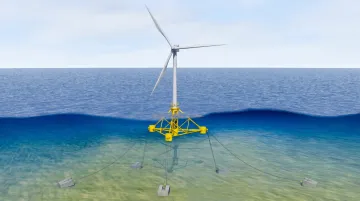
- Floating offshore platforms open deep-water wind resources. DOE notes that roughly two-thirds of US offshore wind potential sits in water too deep for fixed-bottom foundations, with a Floating Offshore Wind Shot target of 70%+ LCOE reduction to $45/MWh by 2035.
- Bend-twist blade airfoils (flatback designs) let engineers build longer, lighter blades at lower cost, an improvement within traditional turbine architecture rather than a replacement for it.
Best suited for: Microgrids, commercial rooftops, remote or off-grid locations, and research/pilot projects rather than utility-scale deployment.
Strengths:
- Lower installation footprint
- Reduced noise and environmental impact
- Potential cost savings at scale
Limitations:
- Unproven at grid scale
- Thin manufacturing and maintenance ecosystem
- Generally lower power density than HAWT or established VAWT designs
How to Choose the Right Wind Turbine Design
The right design depends on site conditions and project goals, not on which turbine sounds most advanced on a spec sheet.
Factors to weigh:
- Wind resource — average speed and turbulence at hub height, measured on-site, not estimated
- Available space — utility, commercial, or residential scale changes everything
- Budget — installation cost plus ongoing maintenance and part availability
- Local regulations — noise limits and wildlife/environmental review requirements
- Long-term scalability — how the design integrates with grid connection or storage systems
On sound specifically, DOE reports land-based utility turbines typically produce 35-45 dB at 300 meters. Most modern residential turbines add less than 6 dB above ambient wind noise.
What to Check Before Finalizing a Turbine Design
- Size the machine to the real power need; a smaller, simpler design often beats the largest option on the sheet
- Confirm maintenance access, noise ordinances, and wildlife impact studies before you commit
- Factor in long-term costs: part replacement, downtime, and grid interconnection
Conclusion
Turbine design sits at the center of how efficiently and affordably wind energy gets captured. HAWT, VAWT, and emerging designs each serve different needs based on site conditions and project scale. There's no universal "best" option.
Matching design to site conditions, backed by solid engineering analysis and simulation before physical build, cuts project risk and improves performance. That applies whether you're planning a utility-scale wind farm or validating turbine performance before manufacturing.
Frequently Asked Questions
What are the main types of turbine designs?
The two primary categories are horizontal-axis (HAWT) and vertical-axis (VAWT) turbines. A growing third category includes bladeless and modular designs, though these remain less proven at commercial scale.
What are the latest turbine designs?
Recent innovations include floating offshore platforms for deep-water sites, bend-twist blade airfoils for longer and cheaper blades, bladeless vortex turbines, and digital-twin simulation tools for predictive maintenance and design validation.
How tall are modern wind turbines?
In 2023, average US utility-scale hub height reached about 103.4 meters (339 feet), with rotor diameters exceeding 133.8 meters on new installations. Taller towers access stronger, steadier wind, boosting energy capture.
Are vertical-axis turbines better than horizontal-axis turbines?
Neither is universally better. It depends on space constraints, wind turbulence, and project scale. HAWTs win on raw output for open sites; VAWTs work better in turbulent, directionally variable urban settings.
How is wind turbine performance tested before installation?
Engineers use computational modeling, wind tunnel testing, and simulation software to validate designs before manufacturing. IEC standards govern formal power-performance measurement and structural blade testing for certification.
What factors most affect a wind turbine's efficiency?
Blade design, tower height, wind speed consistency, and maintenance quality are the leading efficiency factors. Site-specific wind resource data matters more than any single design spec.