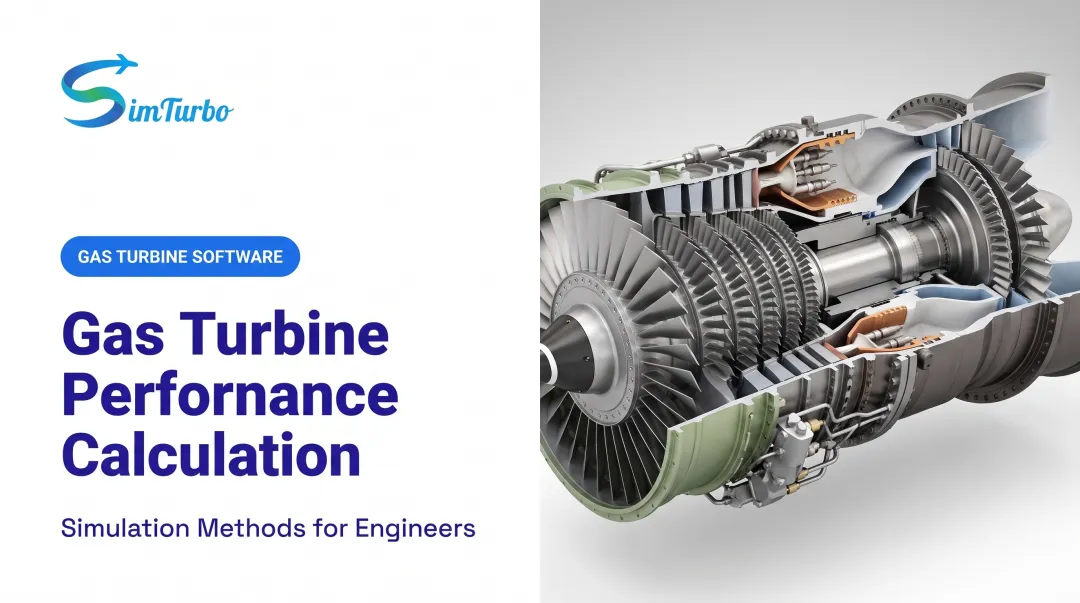
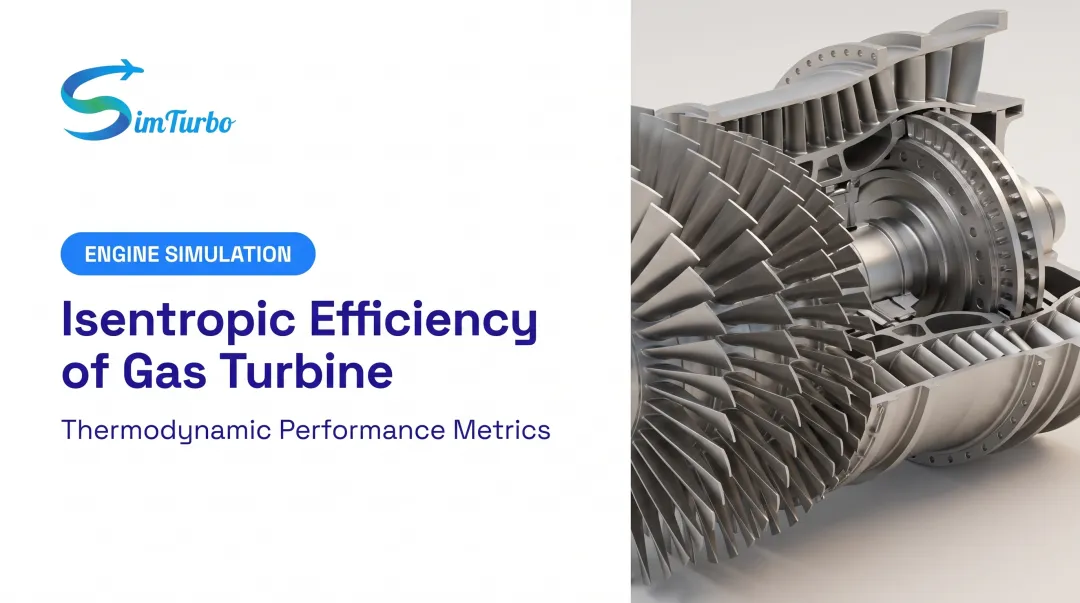
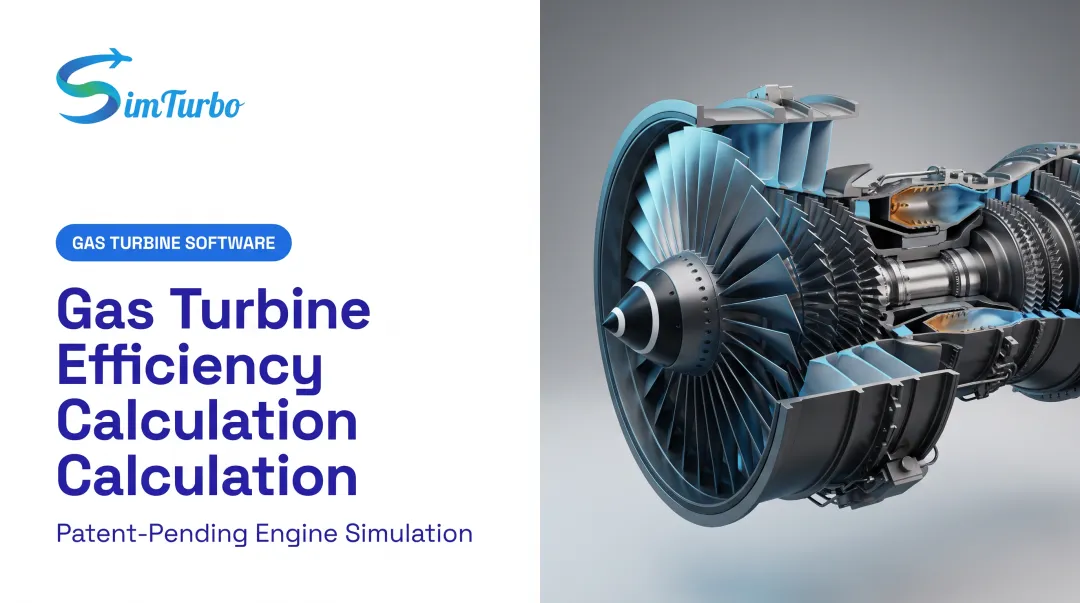
This guide breaks down what "efficiency" actually means for a gas turbine, how to calculate it, what typical numbers look like across configurations, and how engineers push those numbers higher. Whether you're designing systems, studying for an exam, or building a simulation model, these fundamentals matter.
Key Takeaways
- Gas turbine efficiency ranges from 20-40% in simple cycle to 60%+ in combined cycle configurations
- Ideal Brayton-cycle efficiency rises directly with pressure ratio and specific-heat ratio
- Pressure ratio, turbine inlet temperature, and ambient conditions drive most real-world efficiency swings
- Simulation software lets engineers vary these drivers virtually and compare efficiency before hardware tests
What Does "Efficiency" Mean for a Gas Turbine Engine?
Before comparing numbers, you need to define the boundary you're measuring. Thermal efficiency is a system-level ratio: net power output divided by the heat added through combustion. Combustion efficiency is narrower: it measures how completely the fuel burns inside the combustor, based on emission indices like unburned hydrocarbons and CO.
These are not interchangeable. A combustor can burn cleanly (high combustion efficiency) while the overall plant still loses significant work to compressor losses, cooling air, and mechanical friction (lower thermal efficiency).
Three components drive the outcome:
- Compressor — consumes shaft work to pressurize incoming air
- Combustor — adds heat by burning fuel at roughly constant pressure
- Turbine — extracts work from the hot, expanding gas, powering both the compressor and the output shaft
Efficiency isn't fixed. It shifts with load, ambient temperature, and altitude. A turbine running at part-load on a hot day performs differently than the same machine at full load in cold, dense air. Simple-cycle versus combined-cycle configuration is the single biggest efficiency variable, since it determines whether exhaust heat gets wasted or recaptured.
How Do You Calculate the Efficiency of a Gas Turbine Engine?
Engineers use the Brayton cycle as the standard idealized model. It has four stages:
- Adiabatic compression
- Isobaric combustion (constant-pressure heat addition)
- Adiabatic expansion through the turbine
- Isobaric heat rejection

The ideal thermal efficiency formula, per MIT's gas turbine notes, is:
η = 1 − 1/rp^((γ−1)/γ)
Where:
- rp = compressor pressure ratio
- γ (gamma) = specific-heat ratio of the working gas (roughly 1.4 for air)
Higher pressure ratios push efficiency up. Real engines fall short of that ideal because of:
- Non-isentropic (imperfect) compression and expansion
- Combustor pressure drop
- Cooling air diverted away from doing useful work
- Mechanical friction in bearings and seals
The Utility Metric: Heat Rate
Power plant operators rarely quote "efficiency" directly. They use heat rate, measured in Btu per kWh. The conversion is: efficiency = 3,412 / heat rate. A heat rate of 10,500 Btu/kWh works out to about 33% efficiency; 7,500 Btu/kWh translates to roughly 45%.
Validating the Math Against Real Engines
Ideal formulas only start the work. Engineers validate models against real test data. At SimTurbo, that validation was run against the J85-GE-21 single-spool turbojet, benchmarking simulated thrust, flow rate, temperature, and thrust-specific fuel consumption against NASA Lewis Research Center test data, landing within ±2% across those parameters.
With that confidence, engineers can adjust pressure ratio, inlet temperature, altitude, and Mach number in a GUI and watch calculated efficiency update in real time.
What Is the Typical Thermal Efficiency of a Gas Turbine Engine?
Typical thermal efficiency depends on configuration—and it has moved a long way from the first commercial machines.
| Configuration | Efficiency | Era/Source |
|---|---|---|
| Early simple-cycle turbines | ~17-18% | 1939 literature |
| Modern aeroderivative simple-cycle | 30-40% (LHV) | IEA review |
| Modern H-class simple-cycle (Siemens SGT5-8000H) | 41.2% (gross) | Manufacturer data, 2024 |
| Combined-cycle (typical) | 50-55% | Industry standard |
| Combined-cycle record (GE, French plant) | 62.22% (net) | GE, 2016 |
| CHP with heat recovery | ~70% total efficiency | DOE example, 2022 |

The jump from 18% to over 60% is not incremental tinkering. It reflects decades of materials science, aerodynamics, and cycle innovation.
Simple cycle vs. combined cycle, in short:
- Simple cycle: Exhaust leaves as hot gas after the turbine extracts work—one conversion stage, lower electrical efficiency, faster response.
- Combined cycle: That same exhaust feeds a heat recovery steam generator (HRSG) that drives a second steam turbine, so one fuel input yields two power stages.
- CHP / heat recovery: Add district heating or industrial process heat and total energy utilization can approach 80%, counting useful heat as well as electricity.
You're still measuring electrical efficiency separately from total energy use. Combined-cycle figures above describe power output; CHP totals fold in recovered heat.
How Can the Efficiency of a Gas Turbine Engine Be Improved?
Four levers dominate real-world efficiency gains.
Inlet Air Cooling
Cooler, denser air at the compressor inlet raises effective pressure ratio and power output. A 2011 peer-reviewed study quantified the tradeoffs:
- Chillers: +15-20% power, +1-2% efficiency
- Overspray/fogging: +10-20% power, +1.5-3% efficiency
- Evaporative media coolers: +5-10% power, +1.5-2.5% efficiency
Dry, hot climates see the biggest benefit. Humid regions see less, since evaporative cooling depends on a dry bulb-wet bulb temperature gap.
Heat Recovery Systems
Heat recovery puts exhaust energy back to work instead of venting it to atmosphere. Two common paths:
- HRSG (combined cycle): Captures turbine exhaust heat to generate steam for a bottoming cycle
- Recuperator: Preheats compressor discharge air before it enters the combustor
Recuperator effectiveness and airflow rate determine how much of that benefit actually shows up on the heat rate.
Raising Turbine Inlet Temperature
Once exhaust heat is in play, the next lever is how hot the gas path can run. Higher firing temperature drives higher cycle efficiency. The Department of Energy's Advanced Turbine Systems program linked combined-cycle designs exceeding 60% LHV to a 2,600°F turbine inlet temperature, enabled by improved alloys, thermal barrier coatings, and advanced cooling schemes. Coatings alone can lower component metal temperature by 56-83°C. That margin is what lets the gas path run hotter without melting the hardware.
Maintenance and Fuel Quality
Hotter hardware only pays off if the engine stays clean in service. Efficiency degrades quietly over time. Fouled compressor blades from a mere 5% airflow loss can cut output 13% and raise heat rate 5.5%, according to ASME research on compressor washing. Fuel composition—especially hydrogen-to-carbon ratio—also shifts shaft power, thermal efficiency, and emissions.
Engineers can pressure-test these levers before touching hardware. SimTurbo's component-based architecture lets users add and reconfigure recuperators, afterburners, intercoolers, compressors, and turbines, then run steady-state and transient simulations to quantify effects on thermal efficiency and fuel consumption before a physical build.

Are Gas Turbines More Efficient Than Steam Turbines?
Neither wins outright. It depends on what you're comparing and how you're using the machine.
| System | Typical Efficiency | Best Suited For |
|---|---|---|
| Simple-cycle gas turbine | 30-41% (LHV/gross) | Peaking, fast response |
| Steam turbine | 20-40% (up to ~47% in top ultra-supercritical plants) | Baseload, steady heat source |
| Combined-cycle (both paired) | 50-62%+ | Sustained base/intermediate generation |
Combined-cycle plants pair the two technologies deliberately. The gas turbine's hot exhaust, which would otherwise go to waste, drives a heat-recovery boiler feeding a steam turbine generator. You get compounded efficiency from a single fuel input.
The operational tradeoff comes down to timing:
- Gas turbines start in as little as 20 minutes, making them ideal for peaking demand and grid flexibility
- Steam turbines need longer warm-up but excel at continuous, steady baseload output
- Combined-cycle plants hit the highest efficiency when held on sustained intermediate or baseload duty
They're tools for different jobs. EIA heat-rate data backs that up: combined-cycle plants average about 7,146 Btu/kWh, well below simple-cycle units at roughly 10,000 Btu/kWh—an efficiency gap that also shows up in how each unit is typically dispatched.

Frequently Asked Questions
How do you calculate the efficiency of a gas turbine engine?
The Brayton cycle formula, η = 1 − 1/rp^((γ−1)/γ), gives ideal efficiency based on pressure ratio and specific heat ratio. Real-world efficiency runs lower due to mechanical losses, pressure drops, and cooling air diversion.
What is the typical thermal efficiency of a gas turbine engine?
Simple-cycle turbines typically run 20-40%, while combined-cycle systems routinely exceed 50% and can exceed 60% in record installations.
How can the efficiency of a gas turbine engine be improved?
The main levers are inlet air cooling, exhaust heat recovery, and raising turbine inlet temperature through better materials and coatings. Regular maintenance and fuel quality also prevent efficiency from degrading over time.
Are gas turbines more efficient than steam turbines?
Standalone gas and steam turbines fall in similar efficiency ranges, but combined-cycle configurations that pair both technologies consistently outperform either one alone.
What factors cause gas turbine efficiency to drop in real-world operation?
Ambient temperature swings, part-load operation, and mechanical losses from compressor fouling or wear all pull real-world efficiency below ideal calculations.
Why is simulation useful for studying gas turbine efficiency?
Simulation lets engineers and students change pressure ratios, temperatures, and component layouts and see efficiency effects instantly—without the cost or delay of physical testing. Platforms such as SimTurbo run those trade-offs in real time on a standard PC.