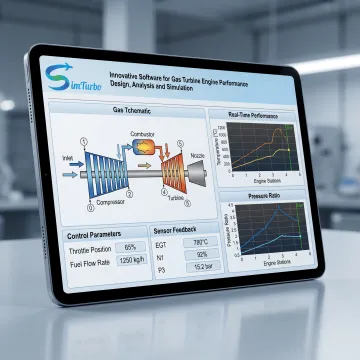
SimTurbo models gas turbine engine systems and their individual components, including inlets, compressors, combustors, turbines, nozzles, shafts, recuperators, and afterburners. Users can configure turbojet and related engine architectures, then study thermodynamic cycles, component matching, thrust or power, fuel consumption, operating points, and control behavior. It supports aerospace, marine, power-generation, research, and educational applications.
Can SimTurbo perform both steady-state and transient analysis?
Yes. Steady-state tools support cycle analysis, off-design performance evaluation, ambient and altitude studies, efficiency calculations, and component performance mapping. Transient simulation addresses time-dependent events such as startup, shutdown, throttle changes, acceleration, deceleration, load changes, actuator dynamics, sensor response, and fault conditions. This combination helps users evaluate how an engine performs at a point and how it responds during operation.
Is SimTurbo suitable for gas turbine control-system design?
Yes. SimTurbo supports control-system development and validation through built-in components such as PID controllers and limiters. Users can model fuel scheduling, engine start and shutdown logic, acceleration and deceleration control, gain scheduling, protection systems, actuator and sensor behavior, and FADEC concepts. Closed-loop transient studies help engineers assess stability, response quality, and control-law behavior before implementation.
Which turbojet configurations can SimTurbo simulate?
SimTurbo supports single-spool and dual-spool turbojet simulation. Single-spool studies can include compressor, combustor, turbine, nozzle, thrust, fuel-consumption, and operating-envelope analysis. Dual-spool models add high- and low-pressure spool interaction, matching, subsystem integration, transient behavior, and control strategies. The component-based approach also supports architecture exploration for related gas turbine configurations.
Can universities and students access SimTurbo?
Yes. SimTurbo offers academic simulation solutions for universities, engineering colleges, laboratories, research groups, and technical institutes. The platform can support propulsion and thermodynamics courses, classroom demonstrations, laboratory experiments, capstone projects, faculty research, and graduate or undergraduate learning. Discounted student licensing and customized class or lab programs are available for eligible academic users.
Can simulation data be exported for additional analysis?
Yes. SimTurbo supports exporting simulation data for post-processing in tools such as Excel, MATLAB/Simulink, and Python. This allows users to compare cases, create custom plots, perform further calculations, connect results to established analysis workflows, or document findings for design reviews, research reports, and academic projects. Export capability helps preserve flexibility beyond the platform’s interactive graphs and diagrams.
How can I evaluate SimTurbo before purchasing?
A free 30-day trial is available for gas turbine control-system design, with full product features included during the trial period. SimTurbo also offers a free, 30-minute online demonstration of single-spool turbojet simulation by appointment through its booking calendar. A demonstration can help users review the interface, modeling approach, and relevant capabilities before selecting a licensing option.
What licensing options are available for SimTurbo?
Available options include a one-seat monthly subscription for gas turbine engine architecture design, annual access for steady-state performance and cycle analysis, and a lifetime-access option for transient system operation simulation. Free upgrades are included for the stated license duration or lifetime-access offering. Student, university, classroom, laboratory, and research licensing can be customized or discounted based on academic requirements.