Key Takeaways
- Surge is system-wide flow reversal; stall is localized blade flow separation that can trigger surge
- Most events stem from near-surge operation, rapid transients, fouling, or control failures
- Antisurge controls, variable geometry, monitoring, and trained operators keep units clear of the surge line
- Pressure, vibration, and acoustic signatures flag trouble early—before hardware damage
- Simulation validates control strategies and safe operating envelopes before you run the machine
Common Causes of Surge and Stall
What Are Surge and Stall?
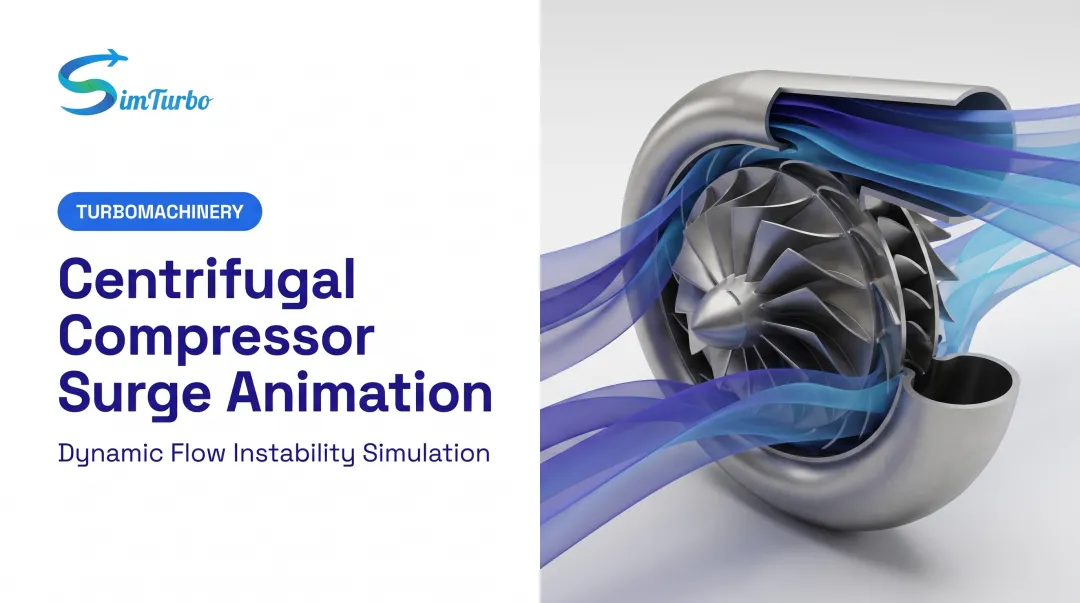
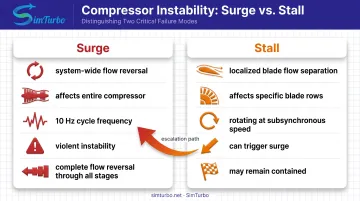
Surge is a violent system-level instability where the compressor cannot overcome discharge pressure, causing complete flow reversal through the machine. DLR reports typical surge-cycle frequency around 10 Hz, with accumulated air discharging backward through the compressor. This phenomenon affects the entire compression system: all stages, ducting, and connected components experience pulsating or reversed flow.
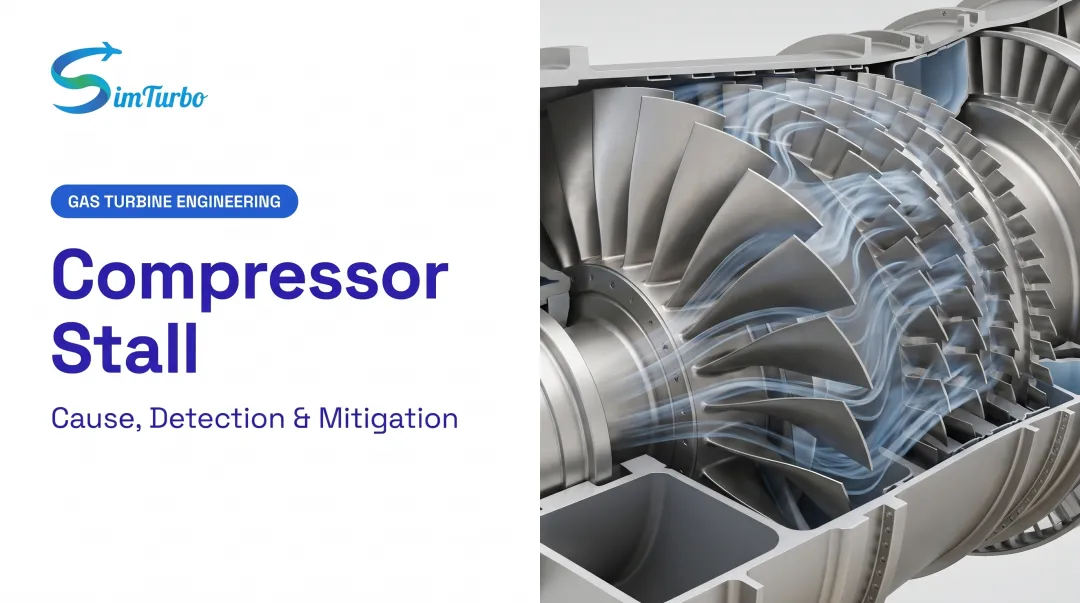
Stall is aerodynamic flow separation on compressor blades or vanes due to excessive flow angles. It can remain localized to specific blade rows (rotating stall) or spread to trigger system-wide surge. In rotating stall, separated flow in certain blade passages rotates around the compressor annulus at subsynchronous speed.
NASA testing on an axial compressor documented one stalled cell rotating at 50.6% rotor speed, affecting about 15% of the circumference (a compressor-specific result, not a universal constant).
The critical distinction: Surge affects the entire compressor system and its connected piping; stall affects specific blade rows or passages and may or may not escalate.
Cause 1: Operating Too Close to the Surge Line
Compressor performance maps plot pressure ratio against mass flow, with the surge line defining the left-side stability boundary. When flow rates drop—pushing the operating point toward this line—the compressor's ability to sustain pressure rise diminishes.
Typical scenarios include:
- Startup and shutdown sequences with reduced throughput demand
- Partial load operation in power-generation turbines
- Downstream blockages or valve closures restricting flow
- Process upsets reducing gas demand in industrial applications
Manufacturers build in surge control margins to keep normal operation safely away from the surge line. NASA engine-cycle studies have used controlled margins as low as 5% for specific test conditions, though operational systems typically keep wider buffers.
The exact margin depends on application, control-system capability, and acceptable risk.
Cause 2: Rapid Load Changes and Transient Events
Sudden changes in discharge pressure or flow demand can push the operating point across the surge line faster than protection systems respond. Surge develops in milliseconds, while mechanical control elements and digital logic require finite response time.
Common triggers:
- Emergency shutdowns of downstream equipment
- Rapid valve closures in pipeline or process systems
- Sudden increases in system backpressure
- Starting compressors against pressurized discharge systems
- Rapid fuel addition in engine applications, which can temporarily back-pressure the compressor past surge
NASA's YF-102 mixed-flow engine control addressed transient risk by opening interstage bleed valves during low-power operation and rapid acceleration/deceleration, while fuel limits balanced throttle response against stall margins. The exact time constants depend on actuator technology, control architecture, and system inertia.
Cause 3: Compressor Fouling and Degradation
Dirt, scale, corrosion, and erosion on blades alter their aerodynamic characteristics, reducing surge margin by changing flow angles and pressure-rise capability. ASME research defines fouling as airborne contaminant deposition on compressor blades, degrading blade aerodynamics and engine performance.
Typical scenarios:
- Inlet filter degradation allowing contaminants into the gas path
- Salt water ingestion in marine and coastal power applications
- Process gas contaminants in industrial compression
- Inadequate or infrequent compressor washing schedules
Fouling disproportionately affects front stages, where deposits accumulate more readily. Those stages often carry the highest pressure rise and the smallest relative surge margins, so contamination shifts the surge line right on the map and shrinks the stable operating range.
One ASME gas-turbine washing study reported that a demineralized-water online wash recovered 30% of lost power in a specific simulation, a measurable but case-dependent improvement.
Cause 4: Control System Issues and Inadequate Antisurge Protection
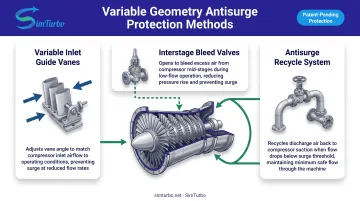
Modern compressors rely on antisurge valves, recycle systems, variable inlet guide vanes (VIGVs), and variable stators to maintain safe operation. When these systems fail or are improperly configured, protection disappears.
Common failure modes:
- Stuck or slow-responding antisurge valves
- Failed position transmitters providing incorrect feedback
- Control logic errors or inadequate tuning
- Disabled protection during maintenance or testing
- Insufficient recycle capacity for transient events
NASA guidance on engine control emphasizes smooth, stable, stall-free operation as a core objective. Variable geometry (inlet preswirl or variable stators) can shift the surge line, but effectiveness varies with speed and pressure ratio.
Research on gas-turbine compressors found that 40 degrees of inlet preswirl produced significant surge-line movement over much of the operating range, with diminished effect at 60% speed—so control strategies have to match geometry schedules to those speed and pressure-ratio limits.
What Happens If Surge and Stall Are Ignored
Surge subjects compressors to severe mechanical and operational damage. Industry guidance for gas turbines points to seals, thrust bearings, and blades as common casualties in axial-compressor surge.
Repeated flow reversals slam the rotor with violent axial thrust changes that stress bearings. High-cycle fatigue loading hits blades and other rotating parts at the same time.
Operational and economic impacts include:
- Forced outages and lost production
- High repair costs from blade and bearing replacement
- Reduced equipment life from cumulative fatigue
- Safety hazards from violent pressure pulsations
- Combustor flameouts or fires from reverse flow in engine applications
- Risk of catastrophic compressor failure with debris damage throughout the gas path
Rotating stall is usually less violent than full surge, but it still creates localized reversed flow and uneven blade loading. That nonuniform loading accelerates wear and can crack blades over time.
Those failures are avoidable when instability is caught early. Several measurable signs show up before full surge or a fully developed rotating stall.
Warning Signs You're About to Experience Surge or Stall
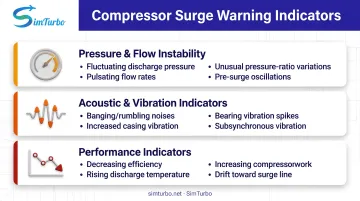
Pressure and flow instability:
- Fluctuating discharge pressure readings
- Pulsating or erratic flow rates
- Unusual pressure-ratio variations across the compressor
- Pre-surge pressure oscillations detectable by fast-response sensors
Acoustic and vibration indicators:
- Loud banging, rumbling, or whooshing noises
- Increased casing vibration, especially at low frequencies
- Unusual bearing vibration patterns or amplitude spikes
- Subsynchronous vibration components indicating rotating stall
Performance indicators:
- Rapidly decreasing efficiency
- Rising discharge temperature relative to normal operation
- Increasing compressor work for the same pressure ratio
- Drift of the operating point toward the surge line on performance maps
Circumferentially resolved fast pressure measurements can tell a rotating stall cell apart from whole-system surge. NASA instrumentation for stall detection used wall static-pressure probes, miniature total/static-pressure transducers, and thermoanemometric fiber probes for flow direction and density. That kind of sensing gives operators a chance to act before ignored instability turns into bearing damage, blade failure, or a forced outage.
How to Prevent Surge and Stall
Preventing surge and stall requires proper system design, active control strategies, and disciplined operating practices across all compressor types.
Install and Maintain Antisurge Control Systems
What to do:
- Size antisurge valves correctly and pair them with fast-acting actuators
- Provide reliable position feedback and well-tuned controllers
- Monitor the real-time operating point against the surge control line
- Ensure controllers react to transients before the machine enters unstable territory
How it works:
Antisurge valves automatically recycle flow from discharge back to suction when the operating point approaches the surge line. This maintains minimum safe flow through the compressor even during sudden load drops, valve closures, or equipment trips, preventing the low-flow conditions that trigger surge.
When to implement:
Essential for all centrifugal and axial compressors in critical service. Verify proper operation during commissioning, after any control system changes, and during periodic testing. While testing intervals depend on criticality and regulatory requirements, annual verification is a common industry baseline.
Use Variable Geometry and Bleed Systems
What to do:
For axial compressors, use variable inlet guide vanes (VIGVs) and variable stator vanes to adjust flow angles across the operating range. Use compressor bleeds to reduce pressure ratio during startup, shutdown, and other low-power transients.
How it works:
Variable geometry optimizes blade incidence angles, preventing stall inception across a wide operating envelope. Bleeds reduce pressure buildup in intermediate stages that could otherwise drive the compressor into surge during transient operation or at off-design conditions.
When to implement:
Most critical during the design phase for compressors expecting wide operating ranges or frequent transients. Retrofit options exist for machines experiencing surge issues. Variable geometry is standard in aircraft engines and many industrial gas turbines with frequent load changes.
Implement Rigorous Monitoring and Predictive Analysis
What to do:
- Install fast-response pressure and temperature sensors to catch pre-surge oscillations
- Monitor vibration for rotating-stall signatures
- Track performance against baseline maps to spot fouling or wear shifts
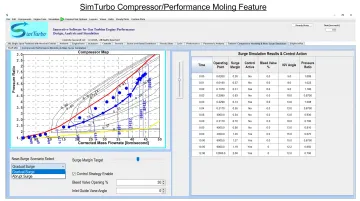
- Use simulation to validate the safe envelope and test what-if scenarios
How it works:
Early detection of degradation allows intervention before surge margin erodes completely. Performance monitoring reveals shifted operating characteristics, such as reduced flow capacity or altered pressure rise, that indicate fouling, erosion, or seal wear. Simulation enables engineers to test control responses, evaluate new operating modes, and train operators without risking actual equipment.
When to implement:
Continuous monitoring for critical compressors; detailed performance analysis during scheduled outages; simulation analysis during the design phase, before operational changes, and for operator training programs.
Platforms like SimTurbo allow engineers to model compressor behavior across the full operating envelope, including near-surge conditions, so teams can spot risks and validate control strategies before field implementation.
Maintain Proper Operating Procedures and Operator Training
What to do:
- Write startup and shutdown procedures that keep the machine out of surge zones
- Set minimum flow requirements and load-change rate limits
- Train operators to spot pre-surge signs (pressure swings, unusual noise, erratic readings) and act immediately
How it works:
Disciplined procedures keep operation within the safe envelope defined by the compressor map and control system. Trained operators recognize warning signs early and respond appropriately: throttle back, open recycle valves, or activate bleed systems. Clear minimum-flow limits prevent inadvertent operation in dangerous zones.
When to implement:
Establish procedures during commissioning and update them whenever equipment or process changes occur. Conduct operator training initially, with annual refreshers and additional sessions whenever new personnel join the operations team or after any surge event.
Tips for Long-Term Prevention and Control
Sustained surge-free operation depends on consistent maintenance, monitoring, and organizational discipline:
- Schedule regular compressor washing (online and offline) to keep the gas path clean and preserve surge margin
- Run periodic performance tests to confirm the surge line has not shifted from fouling, wear, or seal leakage
- Log surge and near-surge events to spot patterns, triggers, and root causes
- Use condition-based maintenance so blade erosion, seal wear, and similar degradation get fixed before surge margin erodes
- Keep antisurge software and logic current with manufacturer guidance and fleet operating experience
- Train and validate with simulation tools such as SimTurbo for operator scenarios and protection-system checks as conditions change
- Set clear protocols across operations, engineering, and maintenance on limits, operating windows, and performance trends
Conclusion
Surge and stall have identifiable causes tied to operating conditions, equipment condition, and control-system performance. Prevention is achievable through proper design (including antisurge controls and variable geometry), active monitoring with fast-response instrumentation, and well-trained operators who understand compressor operating limits and warning signs.
Proactive measures such as regular washing, performance trending, simulation-based planning, and disciplined procedures protect equipment and prevent costly failures. These practices support reliable long-term operation across aerospace, marine, and power-generation applications.
Frequently Asked Questions
What is a compressor stall and surge?
Stall is localized flow separation on compressor blades when incidence angles get too large. Surge is a system-wide instability in which flow through the compressor reverses because it cannot overcome discharge pressure. Uncorrected stall can progress to surge, or stay localized as rotating stall.
What causes surge in a centrifugal compressor?
Surge occurs when flow drops too low (too far left on the map) and the compressor can no longer raise pressure enough to beat system backpressure. Common triggers are reduced demand, fouling that shifts the surge line, fast transients that outrun controls, or antisurge-system failures.
What is the difference between rotating stall and surge?
Rotating stall affects only some blade passages; the stalled zone rotates around the annulus at subsynchronous speed. Surge is full flow reversal through the compressor and connected system. Stall can cause fatigue and performance loss; surge should always be avoided.
How can you tell if a compressor is about to surge?
Warning signs include pressure pulsations, flow swings, unusual vibration, rumbling or banging, and erratic discharge pressure. Fast-response sensors can catch pre-surge oscillations milliseconds before full surge, giving automated controls time to intervene.
Can surge damage a compressor?
Yes. Surge drives violent axial thrust reversals, high-cycle fatigue on blades and rotors, bearing damage, and blade failures that can cascade through the gas path. Keeping the machine out of surge protects both hardware life and safe operation.
What is the difference between surge in axial vs. centrifugal compressors?
Both surge as flow reversal when they cannot overcome discharge pressure. Axials usually have narrower stable ranges and more inlet-distortion sensitivity, while centrifugals typically offer wider flow ranges. Severity tracks system volume, pressure ratio, and conditions more than machine type alone.