Understanding marine turbine technology is essential for engineers, naval architects, and maritime professionals evaluating propulsion options for modern vessels. Whether you're designing a new frigate, optimizing a fast ferry, or researching hybrid propulsion systems, a solid grasp of turbine fundamentals—how they work, their configurations, and their trade-offs—enables informed decisions that balance power, efficiency, and mission requirements.
Key Takeaways
- Marine turbines adapt aviation gas turbines to deliver shaft power or electricity for ship propulsion
- Marine turbines run on the Brayton cycle: compress air, burn fuel, expand hot gas, and exhaust
- Two main types: aeroderivative units (e.g., LM2500) and industrial turbines built for marine duty
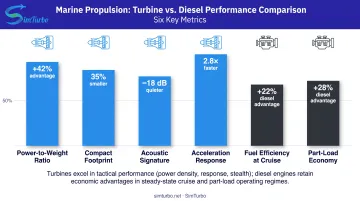
- Advantages: high power-to-weight ratio, rapid acceleration, compact footprint, and low acoustic signature
- Primary applications are naval warships, fast ferries, patrol vessels, and hybrid electric propulsion systems
What Is Marine Turbine Technology?
Marine turbine technology refers to gas turbine engines specifically designed or adapted for marine propulsion. These engines generate mechanical shaft power or electricity to drive ship propellers, waterjets, or integrated electric drive systems. Unlike diesel engines, marine turbines use a full gas generator core (compressor, combustor, and turbine) as the ship's primary prime mover, not as auxiliary support.
Traditional marine diesels are heavy, slow to answer the throttle, and limited in power density. Marine turbines close that gap with high power-to-weight ratios, quicker acceleration, and the flexibility naval vessels and high-speed craft need under changing load.
That role is easy to confuse with turbochargers or other exhaust-driven accessories on reciprocating engines. A marine turbine is different: it is the standalone engine producing the ship's main propulsive force.
They still burn more fuel than diesel at cruise. Shipyards and fleets keep specifying them anyway when power density, lower acoustic and infrared signatures, and fast start/stop matter more than fuel economy—especially on military and specialized commercial hulls.
Two Main Categories
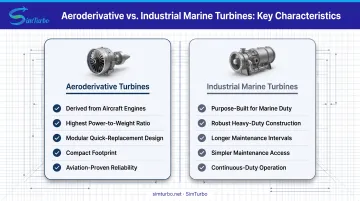
Aeroderivative turbines begin as aircraft engines and are marinized for saltwater service. Common examples include the GE LM2500 (from the CF6) and the Rolls-Royce MT30 (from the Trent family), fitted with corrosion-resistant materials, marine accessories, and adapted fuel systems.
Industrial marine turbines are purpose-built heavy-duty units for continuous marine duty. They favor robust construction, simpler maintenance access, and longer inspection intervals.
How Does Marine Turbine Technology Work?
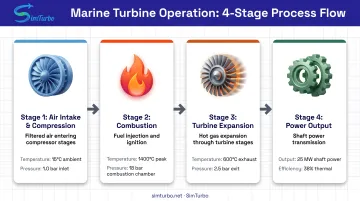
Marine gas turbines operate on the Brayton thermodynamic cycle, where air is continuously compressed, mixed with fuel and combusted, then expanded through turbine stages to generate rotational shaft power for propulsion.
Air Intake and Compression
Ambient air enters through intake filters designed for marine environments, removing salt spray and moisture before passing through axial or centrifugal compressor stages. The LM2500 uses a 16-stage high-pressure compressor, while the upgraded LM2500+ adds a seventeenth zero-stage blisk.
Marine installations need robust filtration to prevent corrosion and erosion from salt-laden air. Salt ingestion can foul compressor blades and drive hot-section corrosion—a critical difference from land-based or aircraft applications.
Regular compressor washing and inlet coalescing filters are essential maintenance practices.
Combustion Process
Compressed air enters combustion chambers where fuel is injected and ignited. Naval vessels typically burn NATO F-76 naval distillate, a diesel-like fuel meeting MIL-DTL-16884 standards.
Some installations can run marine diesel (DFM), kerosene, or natural gas, though fuel quality directly affects maintenance intervals and component life. Fuel sulfur and ingested sodium also feed fouling and hot-section corrosion, so fuel conditioning remains critical to long-term reliability.
Turbine Expansion and Power Extraction
Hot combustion gases expand through multiple turbine stages, where turbine blades extract energy to drive both the compressor and the output shaft. Modern marine turbines use split-shaft designs:
- Gas generator turbine powers the compressor
- Free power turbine drives the propeller shaft independently
The LM2500 uses a 2-stage high-pressure turbine plus 6-stage free power turbine running at 3,600 RPM. The MT30 operates at 2,800-3,600 RPM mechanically, or 3,000/3,600 RPM for 50/60 Hz alternator drive. Independent speed control lets operators optimize both engine efficiency and propeller performance.
Power Transmission and Propulsion Integration
Extracted shaft power passes through reduction gearboxes to match high turbine speeds with optimal propeller speeds. Alternative configurations include:
- Direct mechanical drive through gearboxes to propeller shafts
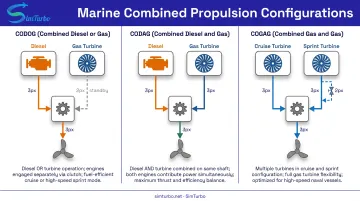
- CODOG (Combined Diesel or Gas): one diesel and one turbine per shaft, engaged separately
- CODAG (Combined Diesel and Gas): diesel and turbine power combined on the same shaft
- COGAG (Combined Gas and Gas): multiple turbines on shared shafts
- Electric drive: turbines power generators for integrated electric propulsion
The Independence-class littoral combat ship uses CODAG with two turbines and two diesels driving waterjet trains. The Queen Elizabeth-class carrier employs two 36 MW MT30 alternators in an integrated full-electric propulsion (IFEP) system.
Control and Operational Management
Modern marine turbines use Full Authority Digital Engine Control (FADEC) systems that automatically regulate:
- Fuel flow and combustion efficiency
- Compressor variable geometry (where present)
- Speed and power output under changing loads
- Protection limits for temperature, surge margin, and overspeed
The MT30 includes integrated alarm systems, health-data logging, redundant control-bus interfaces, and unmanned-operation support. Control responsiveness is a tactical advantage: marine turbines can go from idle to full power far faster than diesels, which matters in combat and emergency maneuvering.
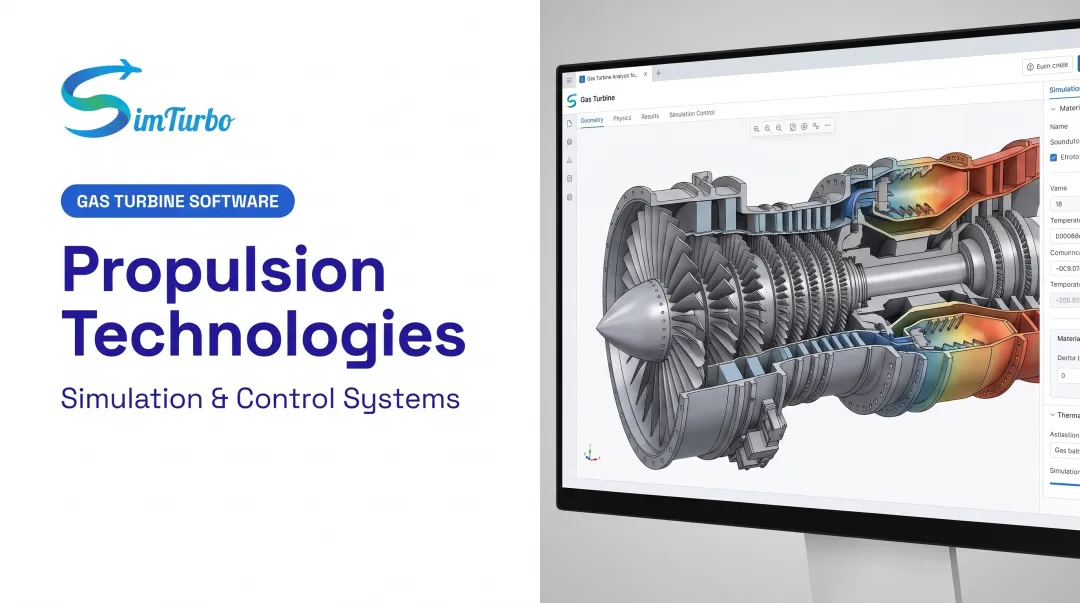
Engineers often validate these responses in simulation before sea trials. SimTurbo helps marine engineers model turbine performance, test control systems, and optimize propulsion integration, including startup sequences, throttle response, load changes, and fault conditions in real time.
Types of Marine Turbines
Most modern marine gas turbines are aeroderivative designs—aircraft engines adapted for shipboard use. How those engines are arranged with diesels or electric drives is what shapes real-world performance across cruise, sprint, and hotel loads.
Aeroderivative Marine Gas Turbines
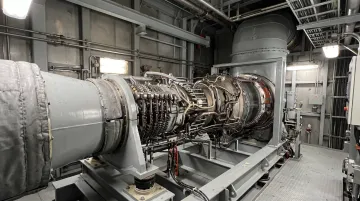
Aeroderivatives are gas turbines derived from proven aircraft jet engines, modified with marinized components, corrosion-resistant materials, and adapted fuel systems for shipboard operation.
Key advantages:
- Highest power-to-weight ratio in the marine propulsion category
- Compact footprint ideal for space-constrained naval vessels
- Modular design enabling quick engine replacement at sea or in port
- Established reliability from aviation heritage
Performance benchmarks:
- GE LM2500: 25.06 MW ISO, 226.9 g/kWh ISO fuel consumption, 3,600 RPM
- GE LM2500+G4: 36.98 MW ISO, 213 g/kWh ISO, 19.9 metric tons dry weight
- Rolls-Royce MT30: 36–40 MW, over 40% thermal efficiency, 6,500 kg unpackaged weight
These engines typically power naval combatants, fast attack craft, and high-speed ferries where space and weight are at a premium.
The LM2500 alone serves 39 navies worldwide. The MT30 powers the US Freedom-class littoral combat ships, UK Type 26 frigates, South Korean Daegu-class frigates, and Japan’s Mogami-class frigates.
Heavy-Duty Marine Gas Turbines
Heavy-duty (industrial) marine gas turbines trade some power-to-weight advantage for longer maintenance intervals and rugged continuous-duty operation. They show up more often in larger commercial or auxiliary roles than on weight-critical combatants, and they pair well with steady load profiles where compact naval packaging matters less than durability.
Combined Propulsion Configurations
Turbine choice is only half the story. Most warships combine diesels and gas turbines so the plant stays efficient at cruise without giving up sprint speed:
- CODOG (Combined Diesel Or Gas): Diesels handle efficient cruising; the gas turbine engages separately for high-speed transit. Example: South Korea’s Incheon-class frigate.
- CODAG (Combined Diesel And Gas): Diesel and turbine power share the same shaft and can run together for maximum output. Example: US Coast Guard National Security Cutters and Independence-class littoral combat ships.
- COGAG (Combined Gas And Gas): Multiple turbines split cruise and sprint roles for flexible speed bands. Example: US Arleigh Burke-class destroyers producing about 100,000 shaft horsepower and exceeding 30 knots.
Combined plants keep prime movers nearer their efficient ranges on routine patrols while preserving high-speed capability when needed.
Hybrid and Electric Integration
Beyond geared mechanical plants, integrated electric propulsion uses marine turbines as generator sets, with electric motors driving the ship. Power can shift between propulsion and ship systems as loads change.
The Queen Elizabeth-class aircraft carrier uses two 36 MW MT30 alternators in its IFEP system. The Zumwalt-class destroyer (DDG-1000) takes the idea further with an Integrated Power System (IPS) that generates, distributes, and converts electrical power for both propulsion and ship services.
The MT30 is configurable for mechanical, electrical, or hybrid drive, so the same core engine family can fit different naval architecture choices.
Applications and Use Cases
Marine turbines dominate naval surface combatant propulsion. Frigates, destroyers, cruisers, and aircraft carriers use turbines (often in CODAG or COGAG configurations) for rapid acceleration, a low acoustic signature, and clear tactical advantages in combat.
Naval applications:
- Arleigh Burke-class destroyers (DDG-51): 100,000 shp, 30+ knots
- Queen Elizabeth-class carriers: two 36 MW MT30 alternators
- Frigates: Type 26, Daegu/Ulsan, Mogami, and FREMM classes
- Littoral combat ships: Freedom and Independence classes
- Coast Guard National Security Cutters: 28 knots, 12,000 nmi range
Commercial applications:
High-speed passenger ferries leverage turbine power density for exceptional speed. The MDV 3000 ferry class (Capricorn, Scorpio, Aries, and Taurus) carries 1,800 passengers and 460 vehicles at speeds above 40 knots.
Some cruise ships use turbines in Combined Gas turbine and Electric Steam (COGES) or other combined plants for operational flexibility. GE reports 20 LM2500+ and five LM2500 units operating or planned in cruise vessels.
Fast attack craft and patrol boats rely on the same traits—high speed, quick response, and low installed weight—when the mission leaves little margin for slower, heavier plants.
Advantages and Considerations
Key Advantages
- Exceptional power-to-weight ratio: The MT30 delivers 36-40 MW at just 6,500 kg unpackaged weight, far superior to equivalent diesel plants
- Compact installation footprint: Saves valuable ship space for weapons, sensors, or cargo
- Low vibration and acoustic signature: Beneficial for naval stealth and anti-submarine warfare operations
- Modular maintenance: Aeroderivatives support quick engine swaps, minimizing vessel downtime
- Operational flexibility: Configurable for mechanical, electrical, or hybrid drive
- Proven reliability: GE reports more than 16 million operating hours and 99+% reliability across the LM2500 naval family
Fuel Efficiency Considerations
Marine turbines consume more fuel than equivalent diesel engines at cruising speeds. Published fuel-consumption benchmarks include 226.9 g/kWh ISO for the LM2500 and 213 g/kWh ISO for the LM2500+G4.
Gas turbines also suffer from poor part-load efficiency, so they are less economical for long-distance commercial shipping. This is why combined diesel-gas configurations are popular: efficient diesels handle cruise speeds, while turbines provide sprint capability when needed.
Maintenance and Operational Factors
Marine turbines require less frequent but more specialized maintenance compared to diesels. The US Navy does not service LM2500 engines on a fixed planned maintenance interval; maintenance is condition-based instead.
Fleet data shows mean time between removal exceeding 16,000 hours, with some engines surpassing 30,000 hours.
Critical maintenance considerations:
- Salt ingestion causes compressor fouling and hot-section corrosion
- Regular compressor washing and robust inlet filtration are essential
- Hot-section inspections monitor turbine blade condition
- Major overhauls require approximately 3,000 man-hours per engine
Marine engineers increasingly rely on simulation tools during design to predict turbine performance, validate fuel efficiency across operational profiles, and optimize integration.
SimTurbo supports virtual testing of turbine configurations, control strategies, and transient responses before costly sea trials. Engineers can model startup dynamics, throttle responses, load changes, compressor matching, and control-system behavior. Results validate against NASA test data within ±2% for thrust, flow rate, temperature, and fuel consumption.
Conclusion
Marine turbine technology is a proven, mature propulsion option. High power density, operational flexibility, and strong performance still justify its use on naval and specialized commercial vessels, even with higher fuel costs. Rapid acceleration, compact installation, low acoustic signature, and tactical maneuverability keep turbines central to modern warship propulsion.
Understanding operational principles, configuration types, and application trade-offs helps maritime professionals run clearer propulsion trade studies. Whether you are specifying a CODAG plant for a patrol vessel or optimizing an integrated electric system for a carrier, that foundation keeps the choice aligned with the mission profile.
Engineers who need to pressure-test those choices can model steady-state and transient behavior in specialized tools such as SimTurbo before locking a plant design.
Frequently Asked Questions
What is the main difference between marine turbines and aircraft jet engines?
Marine turbines start from aircraft engine designs but use corrosion-resistant materials, marinized accessories, and fuel systems built for heavier marine fuels. They deliver shaft power instead of jet thrust and add heavy inlet filtration for salt spray and moisture.
Are marine gas turbines more efficient than diesel engines at cruise?
No. Marine turbines typically consume more fuel than equivalent diesel engines at part-load cruise conditions. Combined diesel-gas configurations address this by running efficient diesels for economical cruising and engaging turbines only for high-speed operations when power density matters most.
Why do navies prefer gas turbines for warships?
Navies value rapid acceleration, low acoustic signature, and high power density that frees hull space for weapons and systems. Combat reliability and fleet-proven engines such as the LM2500, which serves 39 navies, also drive the preference.
What maintenance do marine turbines require?
Turbines need condition-based inspections and regular compressor washing to manage salt ingestion. US Navy data shows mean time between removal exceeding 16,000 hours, with some engines surpassing 30,000 hours. Aeroderivatives require more frequent but faster modular replacements compared to industrial units.
Can marine turbines run on different types of fuel?
Yes, marine turbines are designed for multi-fuel capability. Verified fuels include NATO F-76 naval distillate and marine diesel (DFM). Some installations can accommodate kerosene or natural gas, though fuel quality affects maintenance intervals and hot-section component life.
What is a CODAG or COGAG propulsion system?
CODAG (Combined Diesel And Gas) uses diesel engines and gas turbines together on the same shaft for maximum power. COGAG (Combined Gas And Gas) uses multiple turbines, typically one set for cruise and another for sprint, for tactical flexibility and better fuel use across speeds.