But redundancy isn't automatic safety. The FAA is explicit about this: multiengine performance only improves outcomes when the operator is trained to manage an engine-out scenario, since losing one engine still means reduced performance and asymmetric-thrust control challenges.
Twin-engine design work has gotten more complex as a result. Engineers now need to validate control synchronization, thermal behavior, and load-sharing logic long before any hardware exists. This article covers the four turbine types used in twin systems, where these configurations show up across industries, the real engineering tradeoffs involved, and how simulation software fits into de-risking the design process.
Key Takeaways
- Twin systems pair two full gas turbines for fault tolerance, combined power, or maintenance continuity.
- Turbojet, turboprop, turbofan, and turboshaft engines all support twin layouts by mission needs.
- Gains bring real costs: control sync, thermal management, and duplicated maintenance streams.
- Tools like SimTurbo let engineers validate engine control logic before building physical prototypes.
What Are Industrial Twin Turbine Engines?
An industrial twin turbine engine system uses two complete gas turbine units working together for propulsion, mechanical drive, or power generation. This is a distinct concept from a "twin-spool" or multi-shaft architecture, which describes separate rotating shaft systems inside a single engine. NASA's two-spool turbofan, for example, has a fan shaft passing through the core shaft: one engine, two internal spools, not two engines.
Keeping these terms straight matters for design work:
- Twin-engine = two full engines (aircraft, vessel, or power package)
- Twin-spool/multi-shaft = one engine with separate internal rotating systems
Real-World Example: The FT4000 SWIFTPAC
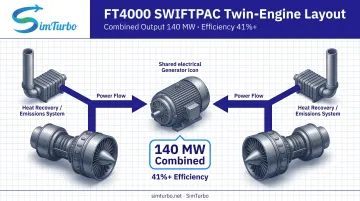
Mitsubishi Power's FT4000 SWIFTPAC 140 shows the industrial setup in practice. It uses two gas turbines driving one shared electrical generator, rated at 140 MW combined output, with simple-cycle efficiency above 41%.
The package uses a free-turbine arrangement that skips reduction gearing. Mitsubishi recommends a separate heat-recovery/emissions system for each engine, so the turbines share a generator but not their supporting infrastructure.
Common industrial use cases for twin configurations include:
- Aeroderivative gas turbine packages for peaking or baseload power plants
- Marine propulsion twins for redundancy and maneuverability
- Dual-engine drive trains in industrial mechanical applications
Engineers choose twin over single-engine designs for three practical reasons:
- Redundancy if one unit fails
- Higher combined package output
- Continued operation while one unit is offline for maintenance
The Four Types of Turbine Engines Used in Twin Systems
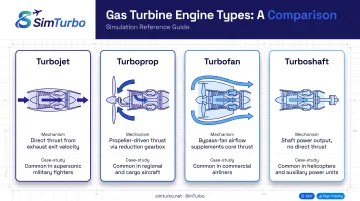
Turbine type describes how the engine delivers useful output, not how many engines are installed. Any of these four can be built singly or paired.
Turbojet Engines
Turbojets compress incoming air, add fuel and burn it, then expand the hot gas through a turbine and exhaust nozzle to generate thrust directly. This is the simplest thermodynamic cycle among the four types. Twin turbojet setups still appear in legacy military and industrial applications where direct thrust, rather than fan-driven bypass air, is the design priority.
Turboprop Engines
A turboprop's gas-turbine core drives a shaft connected to a gearbox, which turns a propeller. Twin turboprops are common in regional and industrial aviation because they deliver strong fuel efficiency at lower cruise speeds compared to jets. The tradeoff: two propellers need matched RPM control to avoid vibration and thrust imbalance.
Turbofan Engines
Turbofans use a large front fan to move air, most of which bypasses the engine core rather than passing through combustion. This design runs quieter and produces thrust more efficiently at typical airliner speeds. Twin turbofan configurations dominate commercial and cargo aviation, where noise regulations and fuel costs both favor the bypass approach.
Turboshaft Engines
Turboshafts work thermodynamically like turboprops but deliver shaft power instead of driving a propeller directly, most commonly to a helicopter rotor. Twin turboshaft setups add critical redundancy for helicopters and industrial generators, since a single engine failure in a rotorcraft is a much more immediate problem than in fixed-wing flight.
The common thread: all four types share the same intake-compression-combustion-exhaust logic. That shared foundation is exactly why component-based simulation tools can model any of them using the same building blocks (compressors, combustors, turbines, and shafts), just arranged differently.
Where Industrial Twin Turbine Engines Are Used
Aerospace and Defense
Twin-turbine aircraft and UAV propulsion systems exist largely for engine-out safety margins. The FAA defines a "critical engine" as whichever engine's failure most severely affects directional control. That concept only applies because twin configurations create asymmetric-thrust scenarios single-engine aircraft never face.
Marine Propulsion
Twin-turbine vessels gain redundancy and maneuverability that single-engine hulls can't match. The U.S. Navy's Littoral Combat Ship program is a documented case: each vessel uses two Rolls-Royce MT30 gas turbines, rated at 36 MW each, powering four waterjets. That's a distributed-propulsion topology, distinct from a shared-generator power plant setup.
Power Generation
Twin aeroderivative packages like the FT4000 SWIFTPAC provide combined output well beyond what a single turbine train delivers. Maryland's Perryman 6 facility, an FT4000 installation, entered commercial operation in 2015 at 120 MW. That figure comes from a real, dated case study rather than a manufacturer spec sheet number.
| Case | Configuration | Output |
|---|---|---|
| Perryman 6 (Maryland) | FT4000 twin turbines, one generator | 120 MW (2015) |
| Current FT4000 SWIFTPAC 140 | Two gas turbines, one generator | 140 MW |
| Navy LCS | Two MT30 turbines, four waterjets | 36 MW per engine |
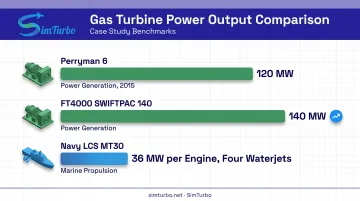
Notice these aren't the same architecture just scaled differently. A shared-generator power plant and a distributed waterjet naval drive solve different problems with the same "twin turbine" label.
Key Benefits and Engineering Challenges of Twin Turbine Configurations
Benefits
Twin-turbine layouts trade complexity for operational headroom. The gains show up most clearly in three areas:
- Mission continuity — one engine can hold a degraded load if the other underperforms or is shut down for maintenance
- Combined power output — load-sharing across two units can exceed a single larger turbine, with better partial-load flexibility
- Control-path redundancy — separate sensors, actuators, and limiters give operators more options when a channel fails
Challenges
Those advantages come with real engineering cost:
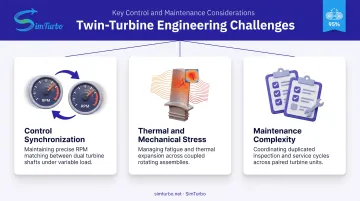
- Control synchronization — PID controllers and limiters on both engines must hold RPM match; the FAA notes sync systems specifically to cut vibration and "beat" effects between paired units
- Thermal and mechanical stress — rapid throttle changes can cause compressor rotor bow and uneven thermal growth, both treated as airworthiness risks in aeronautical literature
- Maintenance complexity — two engines mean two inspection histories, parts inventories, and overhaul cycles; hot-section inspections examine blades and related parts per engine, not per installation
Control-law validation and transient response testing get harder with twin-engine architectures. Equal-load tests are not enough: asymmetric failure modes need dedicated validation before any deployment decision. Component-based tools such as SimTurbo let engineers run those cases before hardware is committed.
How Simulation Software Supports Twin Turbine Engine Design and Validation
Physical prototyping is slow and expensive for validating control logic, especially when you're testing failure modes you hope never happen in the field. NASA's own engine research reflects this: modern control validation follows a progression from nonlinear transient modeling, to closed-loop simulation, to hardware-in-the-loop testing, and only then to physical rig or engine tests.
Component-based simulation platforms let engineers build compressors, combustors, turbines, and shafts as individual, re-parameterizable pieces rather than treating an engine as a black box. This is where SimTurbo fits into the workflow.
SimTurbo's real-time simulation environment includes:
- Configurable components — inlets, compressors, combustors, turbines, nozzles, shafts
- Built-in PID controllers and limiters for engine-level control-loop design
- Visualization of transient throttle response, RPM, EGT, and surge margin
- CSV/Excel export of transient time-series data for post-processing in MATLAB, Simulink, or Python
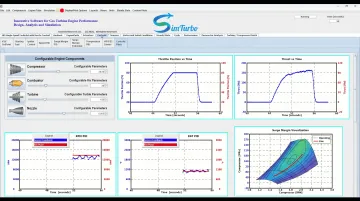
Engineers can run startup, shutdown, throttle-change, and fault-condition scenarios on an individual engine model before any hardware exists.
SimTurbo's single-spool J85-GE-21 turbojet model was validated against NASA Lewis Research Center test data within ±2% accuracy for thrust, flow rate, temperature, and fuel consumption. That figure is a useful benchmark for single-engine simulation fidelity.
SimTurbo's documented capabilities today cover single-spool and dual-spool turbojet and turbofan modeling at the individual-engine level. Coordinated twin-engine synchronization isn't a documented feature yet, but the same component-based approach that validates one engine's control logic is the right foundation as designs scale toward paired systems.
Frequently Asked Questions
What are the four types of turbine engines?
The four types are turbojet, turboprop, turbofan, and turboshaft. They differ in how they convert combustion energy into usable output: direct thrust, propeller-driven thrust, bypass-fan thrust, or shaft power.
What is the main advantage of a twin turbine engine setup?
Continued operation if one engine fails or needs maintenance, plus the option for higher combined power output. The FAA notes this benefit depends heavily on operator training and proficiency, not just having a second engine.
Are twin turbine engines more expensive to maintain than single turbines?
Generally, yes. Two engines mean two inspection cycles and two parts inventories. Redundancy can offset some downtime-related losses, but it doesn't eliminate the added maintenance burden.
How do engineers test twin turbine engine control systems before deployment?
Engineers model transient behavior in simulation first, then move to hardware-in-the-loop testing before physical certification. Platforms such as SimTurbo support that virtual control validation and lower the chance of finding problems on expensive hardware.
What industries rely most on twin turbine engine configurations?
Aerospace, marine propulsion, and power generation are the primary industries. Each uses twin configurations for different reasons: flight safety margins, vessel maneuverability, and combined generating capacity, respectively.
Can twin turbine systems use two different types of turbines together?
Most twin configurations pair identical engine types for balanced, predictable control behavior. Mixed setups exist in specialized industrial applications but add complexity to synchronization and maintenance planning.