Understanding how turbines generate electricity reveals the engineering principles that underpin power grids worldwide. This article explores the fundamental conversion process, the four primary turbine types used in commercial power generation, how each operates, and where they fit within modern energy systems.
Key Takeaways
- Turbines turn fluid energy into rotation that drives generators through electromagnetic induction
- Gas, steam, hydro, and wind turbines each fit niches defined by fuel, response time, and efficiency
- Combined-cycle plants pair gas and steam turbines to push thermal efficiency above 60%
- Gas turbines hit full output in about 13 minutes; most hydro units reach full load in under 10
How Turbines Generate Electricity
The fundamental principle behind turbine power generation traces back to 1831, when Michael Faraday and Joseph Henry independently demonstrated that moving magnets through coils of wire induce electrical current. Faraday moved a bar magnet through a coil and measured the resulting current, establishing that voltage appears only when the magnetic field changes relative to the coil.
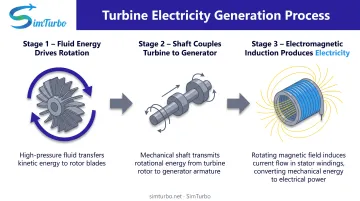
Modern turbines apply this principle at industrial scale. The basic conversion chain works like this:
- Fluid energy drives rotation: High-pressure steam, hot combustion gas, falling water, or moving air pushes against turbine blades
- Shaft couples turbine to generator: The spinning turbine rotor connects directly to the generator's rotor through a shared or coupled shaft
- Electromagnetic induction produces electricity: As the generator rotor spins, its magnetic field moves through stationary wire coils, inducing voltage and creating electrical current
Electrical power output depends on rotational speed and magnetic field strength. Most utility-scale generators, however, run at grid-synchronous speeds—set by electrical frequency and the number of magnetic poles—rather than variable RPM. At those fixed speeds, power output is set by torque (rotational force) on the shaft.
This same conversion chain drives nearly every large-scale power plant, from steam and gas turbines to hydro and wind.
Types of Turbines in Power Generation
Four turbine technologies dominate commercial electricity generation, each optimized for specific energy sources and operational roles.
Gas Turbines (Combustion Turbines)
Gas turbines compress incoming air, mix it with fuel, ignite the mixture, and use the expanding hot gases to spin turbine blades. The design delivers high power-to-weight ratios and rapid startup capability, making gas turbines ideal for peaking power plants, combined-cycle facilities, and aviation-derived applications.
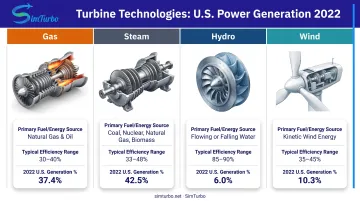
According to the U.S. Energy Information Administration's 2022 data, standalone combustion gas turbines supplied 3.6% of U.S. electricity generation, while combined-cycle plants, which integrate gas and steam turbines, contributed an additional 33.8%.
Steam Turbines
Steam turbines use high-pressure, high-temperature steam from boilers or heat exchangers to drive turbine blades. The steam expands through multiple turbine stages, progressively losing pressure and temperature while spinning the rotor. Exhaust steam is then condensed back to water and recirculated.
Steam turbines powered 42.5% of U.S. electricity generation in 2022, operating in coal-fired plants, nuclear reactors, natural gas facilities, concentrated solar thermal plants, most geothermal installations, and cogeneration systems.
Hydroelectric Turbines
Hydroelectric turbines convert the kinetic energy of falling or flowing water into rotational energy. Water pressure and flow volume determine power output, with turbine designs tailored to site-specific head (vertical drop) and flow characteristics.
The U.S. hydropower fleet generated 242 TWh in 2024. Hydropower represented 6.0% of total U.S. generation in 2022.
Hydroelectric turbines provide grid stability and respond to demand changes faster than fossil-fuel plants. Most U.S. hydro turbines reach full operation from cold start in under 10 minutes.
Wind Turbines
Wind turbines capture kinetic energy from moving air and convert it into rotational mechanical energy. Two basic configurations exist: horizontal-axis turbines (the familiar three-blade design) and vertical-axis turbines. Nearly all operating wind turbines use horizontal-axis configurations because vertical-axis designs do not perform as well.
Wind turbines supplied 10.3% of U.S. electricity generation in 2022, with preliminary 2025 figures showing approximately 11% of generation and 12% of utility-scale capacity.
Gas Turbines: Components and Operation
Gas turbines operate on the Brayton thermodynamic cycle. In idealized form, that cycle has four stages:
- Adiabatic compression
- Constant-pressure combustion
- Adiabatic expansion
- Constant-pressure cooling
Three core components execute this cycle.
Compressor Section
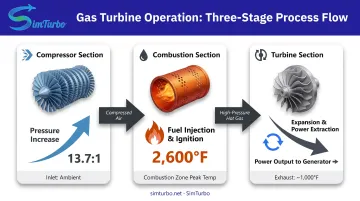
The compressor draws in ambient air and pressurizes it to several times atmospheric pressure using axial or centrifugal blade designs. Compression raises both the pressure and temperature of the incoming air, preparing it for efficient combustion. Industrial gas turbines often run compression ratios near 13.7:1 in smaller units, with advanced designs pushing well above that.
Combustion Section
Compressed air enters the combustor, where fuel is continuously injected and ignited. The U.S. Department of Energy's Advanced Turbine Systems program pushed firing temperatures to 2,600°F, though operational temperatures vary by design. Combustor designs must balance complete fuel combustion with emissions control and durability under extreme thermal stress.
Turbine Section
Hot, high-pressure gases expand rapidly through the turbine section, spinning blades mounted on a rotor shaft. The turbine must generate enough power to drive both the compressor and the electrical generator. Advanced materials and internal cooling techniques allow turbine blades to withstand sustained exposure to gas temperatures exceeding the melting point of the blade material itself.
Operating Cycle and Efficiency
Simple-cycle gas turbines convert fuel energy to electricity at 30%-40% thermal efficiency. However, combined-cycle configurations that capture exhaust heat to drive steam turbines achieve thermal efficiencies exceeding 60%, and advanced designs reach more than 64%.
Industrial gas turbines span a wide power range. For example, Siemens manufactures units from 2 MW to 593 MW, covering everything from small industrial installations to utility-scale power plants.
For power systems engineers working with aero-derivative gas turbines or detailed performance models, platforms like SimTurbo support that work with:
- Real-time Brayton-cycle analysis
- Compressor and turbine matching
- Control-system design and transient startup behavior
Engineers can check efficiency trades, validate control algorithms, and gauge performance before physical prototyping.
Steam Turbines: How They Work
Steam turbines rely on a heat source (typically a boiler burning coal, natural gas, or biomass, or a nuclear reactor) to convert water into high-pressure, high-temperature steam. In nuclear plants, reactor heat transfers to water in a separate loop; in fossil plants, combustion gases heat water tubes directly.
From there, the cycle runs in controlled steps:
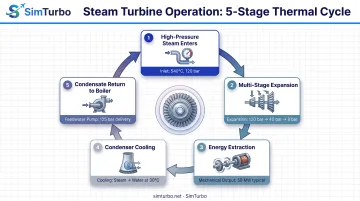
- High-pressure steam enters the turbine inlet and expands through multiple blade stages
- Each stage extracts energy, spinning the rotor as pressure and temperature drop
- Multi-stage designs stretch that expansion across steps instead of releasing it all at once
- Low-pressure exhaust flows to a condenser, cools, and returns to liquid water
- Condensate feeds back to the boiler in a closed-loop path that cuts water use and raises thermal efficiency
Utility steam turbines operate across a broad power range. Siemens manufactures units from 90 MW to 1,900 MW for fossil, nuclear, and combined-cycle applications—capacity that anchors many regional grids.
Efficiency and Performance Optimization
Turbine efficiency measures how effectively fuel or fluid energy converts to electrical energy. The U.S. Energy Information Administration defines heat rate as fuel energy consumed per net kilowatt-hour generated; efficiency percentage equals 3,412 Btu/kWh divided by heat rate.
Combined-cycle systems are the most efficient fossil-fuel generation technology in wide use. Gas turbines generate electricity directly, then exhaust heat feeds heat-recovery steam generators (HRSGs) that drive additional steam turbines.
The most common configuration uses two gas turbines and one steam turbine—a 2-on-1 arrangement. GE reported 62.22% net efficiency at its Bouchain plant in 2016 and 63.08% gross efficiency at a Japanese facility in 2018.
Cogeneration or combined heat and power (CHP) systems raise total-system efficiency further by routing turbine waste heat into industrial processes, district heating, or steam production. The U.S. Environmental Protection Agency reports that CHP systems typically achieve 65%–80% total-system efficiency.
Florida’s Eight Flags Energy facility is a clear case: a 20 MW gas turbine serves utility customers while supplying up to 200,000 lb/hr of process steam to an industrial partner, reaching roughly 75%–80% efficiency.
Simulation and modeling tools let engineers optimize turbine design before hardware is built. Platforms such as SimTurbo support control-system tests, compressor–turbine matching, transient startup analysis, and design validation against known engine data—cutting prototype cycles and catching mismatches early.
Typical optimization work includes:
- Steady-state thermodynamic cycle and heat-rate analysis
- Compressor and turbine matching across operating points
- Transient and startup dynamics under load changes
- Control-law checks with PID controllers, limiters, and sensors
Applications of Turbine Power Generation
Turbine power generation serves diverse applications across utility, industrial, and specialized markets.
Utility-scale power plants use gas and steam turbines to supply electricity to regional transmission grids. Combined-cycle plants dominate new natural gas generation because of their high efficiency and moderate capital cost. Large steam turbine installations remain the foundation of coal and nuclear baseload generation.
Peaking power plants provide rapid-response generation during high-demand periods. Gas turbines excel here because they start and reach full load quickly.
Siemens peaking configurations start from turning gear to full load in approximately 13 minutes, with ramp rates up to 60 MW per minute. That speed helps grid operators balance supply and demand as renewable generation fluctuates.
Industrial and commercial sites rely on turbines for on-site power, backup systems, and cogeneration. Facilities with high thermal loads—refineries, chemical plants, food processors, and hospitals—use CHP systems to produce electricity and useful heat from one fuel source.
The Eight Flags facility mentioned earlier shows this model in practice. Its setup combines:
- A gas turbine
- Heat-recovery steam generator
- Duct burner
- Inlet-air chiller
Together these components serve both electrical and thermal loads.
Marine propulsion and aerospace favor gas turbines for high power-to-weight ratios and compact packaging. Aero-derivative units adapted from aircraft engines power naval vessels, cruise ships, and fast ferries. Purpose-built aviation turbines propel commercial and military aircraft.
Frequently Asked Questions
How does a turbine generate power?
A turbine converts kinetic energy from moving fluids (steam, gas, water, or air) into rotational mechanical energy by pushing against blades mounted on a rotor. The spinning rotor drives a generator, which uses electromagnetic induction to produce electricity.
Can one turbine power a house?
Small wind or micro-hydro turbines can power individual homes if site conditions are favorable. The U.S. Department of Energy notes that a 1.5 kW wind turbine can meet 300 kWh/month at sites averaging 14 mph wind. Utility-scale gas or steam turbines generate enough electricity for thousands of homes.
What is the difference between a gas turbine and a steam turbine?
Gas turbines burn fuel internally to produce hot, high-pressure combustion gas that directly spins turbine blades. Steam turbines use externally generated steam from boilers or heat exchangers as the working fluid. Gas turbines start quickly and suit peaking duty; steam turbines offer high efficiency for baseload operation.
How efficient are combined-cycle power plants?
Modern combined-cycle plants achieve thermal efficiencies exceeding 60%, with advanced designs reaching more than 64%. This efficiency results from using both gas and steam turbines in sequence, capturing waste heat from the gas turbine to drive the steam turbine.
How fast can gas turbines start up?
Siemens peaking configurations can reach full load in about 13 minutes from turning gear. Most hydroelectric turbines are even faster, reaching full operation from cold start in under 10 minutes—both support grid flexibility and rapid demand response.
What is cogeneration (CHP) in turbine power generation?
Cogeneration, or combined heat and power (CHP), captures waste heat from turbines for industrial processes, district heating, or steam production. CHP systems typically achieve 65%-80% total-system efficiency by using energy that would otherwise be wasted.