Key Takeaways
- Gas turbines convert fuel to shaft power via compression, combustion, and expansion cycles
- Modern simple-cycle efficiency reaches 38–44%; combined cycle exceeds 60%
- Operability hinges on fuel flexibility, startup time, load-following, and maintenance intervals
- Ambient temperature, altitude, and component condition directly affect output and heat rate
Types and Applications of Industrial Gas Turbines
Heavy-Duty Frame Turbines
Heavy-duty turbines anchor utility-scale power plants with outputs spanning 119–593 MW per unit. They run at moderate pressure ratios (typically 13.7:1 to 21.0:1) and favor durability and long overhaul intervals.
Representative models include:
- Siemens SGT6 series: 119–440 MW
- Siemens SGT5 portfolio: 198–593 MW
- GE 9HA.01 / 9HA.02: 448 MW and 571 MW, at 42.9% and 44.0% LHV simple-cycle efficiency
Heavy frames serve baseload generation, large industrial facilities that need continuous power, and combined-cycle plants paired with heat-recovery steam generators. Robust construction supports long run periods, but size and thermal mass push startup times to 20–30 minutes.
Aeroderivative Turbines
Aeroderivative engines, derived from jet-engine technology, run at higher pressure ratios (often above 30:1) in compact, lightweight packages. Baker Hughes' lineup spans 20–110 MW, with models such as the LM9000 delivering 70.2 MW at 42.8% efficiency at ISO conditions. GE's LM6000 can start and reach full power in about 5 minutes, ramping at roughly 50 MW per minute.
This speed and portability make aeroderivatives ideal for:
- Marine propulsion
- Emergency and peak-shaving power
- Remote sites requiring rapid deployment
- Mechanical-drive applications (pipeline compression, LNG)
Their modular design also simplifies engine swaps, reducing downtime during overhauls.
Industrial Applications Across Sectors
Gas turbines serve diverse sectors, each with distinct operating profiles:
- Power generation utilities – Base, intermediate, and peaking load; grid stability; renewable firming
- Oil and gas – Pipeline compression, gas reinjection, offshore platforms, LNG liquefaction
- Petrochemical plants – Combined heat and power (CHP), process steam, mechanical drive
- Manufacturing – On-site generation, cogeneration, reducing grid dependence
Those operating profiles drive selection. Baseload plants favor large frames with strong combined-cycle efficiency; peaking units need fast starts and load-following; cogeneration sites prioritize waste-heat recovery. With natural gas supplying over 20% of global electricity in 2024, matching turbine type to duty cycle remains a primary design decision.
How Industrial Gas Turbines Work
Industrial gas turbines operate on the Brayton thermodynamic cycle: continuous flow of air through compression, combustion, and expansion. Unlike reciprocating engines with intermittent combustion, gas turbines sustain steady combustion at constant pressure and deliver uninterrupted power. Pressure ratio (compressor discharge pressure divided by inlet pressure) is a key performance parameter.
Compression and Combustion
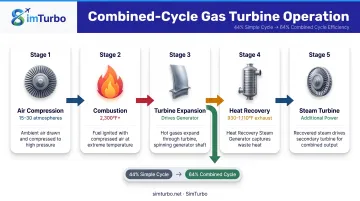
The compressor draws ambient air and pressurizes it to 15–30+ atmospheres, depending on design. Compression raises air temperature and density, creating conditions for efficient combustion. Compressor work is substantial: 40–60% of turbine power output drives the compressor, leaving the remainder for electricity generation or mechanical drive.
In the combustion chamber, fuel (natural gas, diesel, or alternatives) mixes with compressed air. Combustion temperatures exceed 2,300°F (1,260°C), and turbine inlet temperatures can reach 2,912°F (1,600°C), producing high-energy exhaust gases. Modern low-NOx systems balance performance with emissions limits through premixed flames, fuel staging, and diluent injection.
Expansion and Power Generation
Hot, high-pressure gases expand through alternating rows of stationary vanes and rotating blades. The turbine does two jobs at once:
- Driving the compressor via a common shaft
- Generating shaft power for the generator or mechanical load
Blade aerodynamics and energy-extraction efficiency determine how much gas enthalpy becomes useful work.
The turbine shaft drives a synchronous generator. In simple-cycle mode, exhaust vents to atmosphere. In combined-cycle configurations, exhaust heat (still about 930–1,110°F / 500–600°C) feeds a heat-recovery steam generator, which makes steam for a secondary turbine. Mitsubishi's M501JAC delivers 44.0% LHV efficiency in simple cycle but exceeds 64.2% in 2×1 combined cycle, a 20-percentage-point gain from heat recovery.
Component Materials and Temperature Management
Operating temperatures exceed the melting point of critical metals. Turbine blades face 2,300°F+ combustion gases, while blade alloys typically limit at 1,500–1,700°F. Engineers rely on:
- Internal air cooling: compressed air flows through passages inside the blades
- Thermal barrier coatings (TBCs): ceramic layers stable to 3,000°F (1,650°C) that insulate the metal
- Advanced nickel-based superalloys with strong creep resistance
Effective temperature management protects hardware and supports the high firing temperatures that raise cycle efficiency.
Performance Factors in Industrial Gas Turbines
Thermal Efficiency Metrics
Thermal efficiency (useful power output divided by fuel energy input) defines fuel economy. The U.S. Department of Energy cites 20–35% for older simple-cycle units, while modern designs reach:
- 38–44% simple cycle for advanced large frames
- Over 60% combined cycle for integrated plants
- 64.0–64.2% combined cycle for leading OEM configurations
Factors Affecting Power Output
Ambient Temperature:
Cooler inlet air is denser, increasing mass flow and power output. One OEM case study reported gas-turbine efficiency dropping more than 11% at 45°C compared to ISO conditions. Output can decline 0.5–1% per 1°C increase; sensitivity is model-specific.
Altitude:
Lower air density reduces airflow and output proportionally. Use manufacturer correction curves; generic rules oversimplify because heat rate effects vary by design.
Fuel Quality:
Heating value, Wobbe index, and contaminants affect combustion stability, emissions, and component life. Multi-fuel capability requires combustor hardware and control adjustments.
Engineers routinely model these ambient, altitude, and fuel effects in cycle simulation before site selection or derate commitments.
Pressure Ratio and Firing Temperature
Higher pressure ratios generally improve thermal efficiency by increasing the work extracted per unit mass. Increased firing temperatures also boost performance but demand advanced cooling and materials. GE's 9HA.02 achieved 44.0% LHV simple-cycle efficiency at 571 MW, from a high pressure ratio and elevated turbine inlet temperature.
Heat Rate and Fuel Consumption
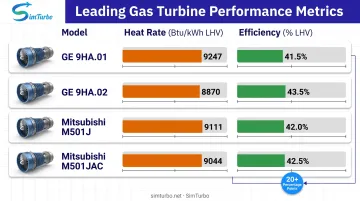
Heat rate, fuel energy per kilowatt-hour (Btu/kWh), inverts efficiency: lower is better. Representative values:
| Configuration | Heat Rate (Btu/kWh LHV) | Efficiency (% LHV) |
|---|---|---|
| GE 9HA.01 simple | 7,960 | 42.9 |
| GE 9HA.02 simple | 7,740 | 44.0 |
| Mitsubishi M501J simple | 8,105 | 42.1 |
| Mitsubishi M501JAC simple | 7,755 | 44.0 |
Lower heat rates translate directly to reduced fuel costs and emissions.
Performance Degradation Over Time
Compressor fouling, blade erosion, and seal wear gradually erode efficiency and output. One ASME field study documented up to 10% power loss over 4,000 hours without compressor cleaning, not a universal annual norm, but a clear example of fouling’s impact.
Regular performance monitoring and proactive maintenance such as compressor washing, seal replacement, and blade refurbishment restore baseline performance and extend intervals between major overhauls.
Operability Challenges in Gas Turbine Operations
Operability limits shape reliability, emissions compliance, and maintenance cost as much as peak efficiency does. Most field constraints cluster around three areas: start-stop cycling, load following, and fuel flexibility.
Startup and Shutdown Cycles
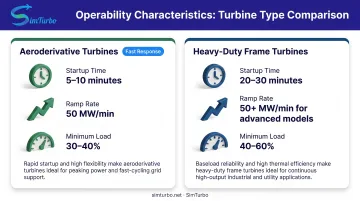
Rapid temperature changes during starts impose thermal stress and accelerate component fatigue. Startup times vary widely:
- Aeroderivatives: 5–10 minutes to full power
- Heavy-duty frames: 20–30 minutes, with models like Siemens SGT6-5000F reaching 95% load in 10 minutes
Frequent cycling shortens maintenance intervals and demands structured component life-management programs.
Load Following and Grid Flexibility
Renewable energy's intermittency demands turbines that ramp quickly and stay efficient across a wide load range. Operability limits include:
- Minimum load: Typically 40–60% of rated capacity; Siemens SGT6-5000F operates at 30% load within emissions limits
- Ramp rates: Up to 52.4 MW per minute for SGT6-5000F and approximately 50 MW/min for LM6000
Part-load efficiency: Heat rate and emissions rise at reduced load; the penalty curve is model-specific
Advanced combustion systems and control algorithms minimize efficiency loss during cycling.
Fuel Flexibility and Switching
Multi-fuel capability improves operational flexibility and supply security. OEM examples show how far dual-fuel and multi-fuel designs have come:
- GE LM6000: Natural gas, LPG, ethanol, diesel, and coke-oven gas, switching without interrupting power
- Siemens SGT6-5000F: Gas, liquid, biodiesel, and up to 30 vol% hydrogen, with gas-to-oil switching and no shutdown
Switching still brings engineering tradeoffs:
- Combustor hardware modifications
- Fuel-system pressure and atomization requirements
- NOx and CO emissions control
- Control-system recalibration
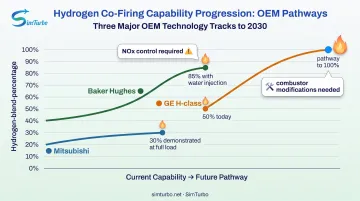
Hydrogen blending is the next pressure test for these systems:
- Mitsubishi: 30% hydrogen co-firing on a grid-connected 1,650°C-class M501JAC at full load
- Baker Hughes: portfolio capability up to 85% hydrogen with water injection for NOx control
- GE H-class: 50% hydrogen capability today, with a pathway to 100%
Transient simulation helps engineers stress-test start thermal loads, ramp limits, and fuel-switch dynamics before those cases reach the plant.
Maintenance and Performance Optimization Strategies
Preventive Maintenance Programs
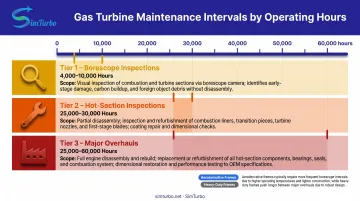
Structured inspection intervals prevent unplanned outages and extend component life:
- Borescope inspections: Every 4,000–10,000 hours
- Hot-section inspections: Every 25,000–30,000 hours
- Major overhauls: Every 25,000–60,000 hours
Baker Hughes' LM6000PF+ schedules borescope, hot-section, and major intervals at 10,000, 30,000, and 60,000 hours, improving on earlier 8,000/25,000/50,000-hour cycles. Siemens SGT-800 achieves up to 60,000 equivalent operating hours between major overhauls, with fleet reliability reaching 99.1% in 2024.
Key inspection points:
- Blade condition (erosion, oxidation, coating integrity)
- Seal integrity (labyrinth seals, packing rings)
- Combustor liner wear and cracking
- Rotor alignment and vibration
Performance Monitoring and Diagnostics
Real-time monitoring systems track temperatures, pressures, vibrations, and efficiency metrics. Critical variables include:
- Pressure ratio
- Turbine inlet temperature
- Compressor efficiency
- Diffuser recovery
- Combustor pressure loss
- Blade-metal temperature
Baseline performance data enable early detection of degradation trends. Compressor fouling shows as declining pressure ratio, while seal wear manifests as efficiency loss. Predictive maintenance uses data analytics to optimize timing, reducing both unplanned outages and unnecessary inspections.
Upgrades for Enhanced Performance
Common upgrade paths improve efficiency and output without full replacement:
- Compressor modifications (airfoil redesign, variable guide vanes)
- Firing temperature increases (advanced materials, enhanced cooling)
- Blade coatings (thermal barrier coatings (TBCs), erosion-resistant coatings)
- Improved sealing (reduced leakage, higher cycle pressure ratio)
Siemens' 2018 SGT-800 enhancement delivered up to 3.5% simple-cycle efficiency gain and 10 MW additional output, a model-specific maximum. GE offers rotor life extensions of 100,000–200,000 factored fired hours with one option permitting up to 240,000 factored hours and 5,000 starts.
Cost-benefit depends on plant-specific economics: fuel savings, outage costs, remaining asset life, and alternative investment options.
Design, Analysis, and Simulation Tools
Engineering Design Challenges
Gas turbine design demands optimization across thermodynamics, aerodynamics, materials science, and control systems. Engineers balance trade-offs:
- Higher firing temperatures boost efficiency but shorten component life
- Increased pressure ratios improve cycle efficiency but complicate compressor design
- Low emissions conflict with high efficiency and stability
- Rapid starts stress components yet meet grid demands
Performance Analysis and Modeling
Simulation software predicts turbine performance across operating conditions such as altitude, ambient temperature, load, and fuel composition. That lets engineers map system interactions and lock in configurations before physical testing.
Component-level modeling shows how compressor, combustor, and turbine behavior combine to set overall efficiency, output, and emissions. Platforms like SimTurbo give engineers a Windows-based environment for performance design, analysis, and validation. Teams can:
- Model component behavior and compressor-turbine matching
- Examine thermodynamic cycles and test control strategies in real time
- Use interactive graphs to watch startup, load changes, and throttle response
- Spot issues early, including compressor stall and thermal lag
Control System Development and Validation
Turbine control systems manage fuel flow, airflow, and operating parameters to optimize performance while protecting equipment from overspeed, overtemperature, and surge. Validating control algorithms before deployment prevents costly operational issues and safety risks.
Simulation tools support control-law validation and virtual prototyping with a physics-based turbine model in closed loop with candidate controllers. Engineers can exercise:
- Speed control and fuel scheduling
- Acceleration and deceleration logic
- Gain scheduling and protection systems
Tests cover startup, shutdown, load changes, and fault conditions. Teams cut development time and risk by refining controllers before field commissioning.
Gas Turbine Engineering Education and Training
Academic and Professional Training Needs
Gas turbine engineering requires specialized knowledge spanning thermodynamics, fluid mechanics, heat transfer, materials science, and control systems. Universities incorporate turbine topics into mechanical engineering, aerospace engineering, and energy systems programs. Professional training addresses design, operation, maintenance, and performance optimization for power-generation, aerospace, and marine applications.
Simulation-Based Learning
Interactive simulation platforms let students visualize turbine operation, test design changes, and study transient behavior. Tools like SimTurbo offer university pricing so classrooms and labs can run hands-on engine models on standard PCs.
Students work through Brayton-cycle processes on real-time Temperature–Entropy diagrams, examine compressor and turbine maps, and see how control inputs (throttle position, fuel flow, variable guide vanes) change engine response.
Simulation bridges theoretical concepts and practical engineering applications by allowing students to:
- Assemble component-based engine architectures
- Run transient scenarios (startup, load changes, surge)
- Export performance data for analysis in Excel, MATLAB, or Python
- Validate control algorithms in closed-loop operation
This approach moves beyond design-point calculations, helping students understand off-design operation, degradation, and the dynamic interplay between components.
Frequently Asked Questions
What are the four types of gas turbines?
Gas turbines are typically classified as heavy-duty industrial turbines (large frames for utility power), aeroderivative turbines (compact, jet-derived engines), aircraft turbines (propulsion), and micro turbines (small distributed generation). Distinctions center on size, application, design origin, and operating characteristics.
What is the lifespan of a gas turbine?
Lifespan depends on maintenance and operating conditions. With proper care, turbines operate continuously for 25–30+ years. Major overhauls occur every 25,000–60,000 operating hours, with component-specific intervals for inspections and refurbishment.
How efficient are modern industrial gas turbines?
Modern simple-cycle turbines achieve 38–44% efficiency, while combined-cycle plants exceed 60% and the latest advanced designs approach 65%. Combined-cycle configurations recover exhaust heat, adding 20+ percentage points to overall plant efficiency.
What fuels can industrial gas turbines use?
Natural gas is the primary fuel, but turbines can also run on diesel, kerosene, crude oils, biofuels, and hydrogen blends. Combustor design sets the limits: some units switch gas-to-liquid without shutdown, and others handle up to 85% hydrogen with water injection for emissions control.
What factors affect gas turbine performance?
Key factors include ambient temperature and altitude (affecting air density), fuel quality (heating value, contaminants), component condition (fouling, erosion), load level (part-load efficiency), and maintenance status (seal wear, blade degradation). Ambient temperature has the most immediate impact, with output dropping as inlet air warms.
Why is operability important for gas turbines?
Operability covers reliability, startup speed, load-following, and fuel flexibility. Those traits support grid stability and renewable integration: turbines must ramp quickly, hold part-load efficiency, and cycle without excessive wear. Weak operability raises costs and cuts availability in dynamic power markets.
Understanding industrial gas turbine performance and operability helps engineers design and run modern power systems well. Brayton-cycle fundamentals still matter, but so do cycling, degradation, and multi-fuel operation when you balance efficiency against reliability and flexibility.
Simulation and control-design tools, paired with solid maintenance and continuous performance monitoring, help turbines deliver reliable power across decades of service.