Introduction
Aerospace and power-systems engineers often discover too late that static models miss how hardware behaves under real load. Failure modes and control issues surface only during physical testing, when fixes cost the most.
Digital twin simulation closes that gap with dynamic virtual models that continuously sync with physical systems through sensor data. Engineers can monitor performance, predict failures, and validate control strategies before hardware is at risk.
This article covers what digital twin simulation is, how bidirectional data flow and IoT connectivity distinguish it from traditional methods, and where it delivers impact in aerospace engine monitoring and power-system optimization. We also address data infrastructure, sensor integration, modeling fidelity, and validation methods that help teams get started.
Key Takeaways
- Live sensor feeds keep digital twins synced with real assets for continuous monitoring and prediction
- Bidirectional IoT data and physics-based forecasting set twins apart from static simulation models
- Aerospace, manufacturing, and power users report 6% faster production and 99.77% predictive accuracy
- Phased rollout with cloud/edge infrastructure, validated models, and sensors drives successful adoption
What is Digital Twin Simulation?
Digital twin simulation is a computational model that serves as the real-time digital counterpart of a physical product, process, or system. It continuously updates through sensor data, creating a "living" representation that evolves as operating conditions change.
Three Fundamental Components
Every digital twin relies on three elements:
- Physical entity — the actual hardware, machine, or system being monitored
- Virtual model — a physics-based computational replica that simulates behavior
- Digital thread — the bidirectional communication channel connecting sensors, cloud platforms, analytics engines, and control systems
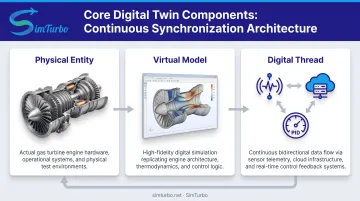
This architecture enables continuous synchronization between the real and virtual worlds, distinguishing true digital twins from static CAD models or one-time simulations.
Historical Development
The concept traces back to NASA's Apollo program, where engineers maintained "living models" of spacecraft for mission planning and accident reconstruction. However, modern digital twins emerged when Dr. Michael Grieves formalized the idea in 2002 within product lifecycle management. Today's implementations use IoT sensors, cloud computing, and machine learning that were unavailable during the Apollo era.
Defining the Strict Standard
ISO 23247 defines a manufacturing digital twin as a fit-for-purpose representation with synchronization to its observable manufacturing element. This standard excludes static simulations that lack operational data feeds. Many vendors market any virtual model as a "digital twin." True synchronization is the critical test: sensor data automatically updates the model, and insights flow back to operators or controllers.
Taxonomy of Digital Twin Types
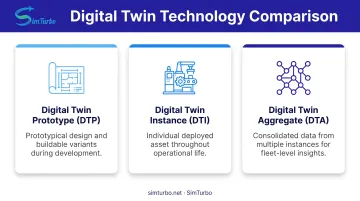
The field recognizes three main categories:
- Digital Twin Prototype (DTP) — represents the prototypical design and buildable variants during development
- Digital Twin Instance (DTI) — mirrors an individual deployed asset throughout its operational life
- Digital Twin Aggregate (DTA) — consolidates data from multiple instances to generate fleet-level insights and benchmarks
How Digital Twin Simulation Works
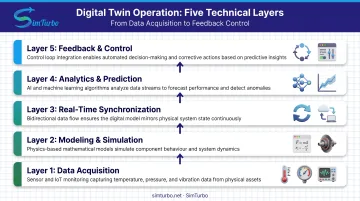
Digital twin simulation integrates five technical layers that transform sensor data into actionable predictions and control decisions.
Data Acquisition Layer
IoT sensors continuously monitor parameters such as temperature, pressure, vibration, RPM, flow rate, and power output. These devices transmit measurements—often sampled at 1 Hz or faster—to edge gateways or cloud platforms. A gas-turbine twin, for example, may ingest spindle speed, exhaust-gas temperature, fuel flow, thrust, and compressor-surge margin in real time.
Modeling and Simulation Layer
Physics-based models replicate system behavior using thermodynamic equations, component maps, real-gas effects, and pressure-loss correlations. Engineers assemble interconnected components—inlets, compressors, combustors, turbines, nozzles, shafts—into complete system architectures. These models run in steady-state or transient mode, capturing startup sequences, load changes, and fault conditions.
Platforms such as SimTurbo let engineers build gas-turbine twins through drag-and-drop component assembly and run real-time transient simulations on standard PCs. Its J85-GE-21 turbojet model was validated against NASA Lewis Research Center test data, with accuracy within ±2% for thrust, airflow, temperature, and fuel consumption.
Real-Time Synchronization Mechanism
Sensor streams feed the virtual model dynamically, updating temperature maps, efficiency curves, and performance forecasts as conditions evolve. This synchronization creates a "living" representation that reflects the current state of the physical counterpart, not a historical snapshot.
Analytics and Prediction Layer
Machine learning algorithms analyze patterns, detect anomalies, and forecast future states. A 2023 study of gas-turbine flight data used multivariate Gaussian density modeling and Wasserstein distance classification to achieve an F1 score of 0.99 for anomaly detection across 26 normal and three abnormal flights.
Feedback and Control Loop
Insights inform operator decisions or, in advanced implementations, send commands back to the physical system. A 2021 factory twin improved short-term prediction precision by 35% and sent shutdown signals directly to robots and conveyors, demonstrating true bidirectional control.
Digital Twin Simulation vs Traditional Simulation
Both tools model system behavior, but they serve different stages of the engineering lifecycle.
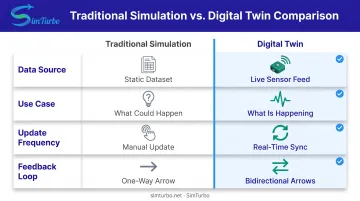
| Dimension | Traditional Simulation | Digital Twin |
|---|---|---|
| Data Source | Static datasets, predefined scenarios | Continuous live sensor feeds from operating assets |
| Use Case | "What could happen" in hypothetical conditions | "What is happening" with specific hardware right now |
| Update Frequency | Manual recalibration and periodic re-runs | Automatic, real-time synchronization as conditions change |
| Feedback Loop | One-way: input → output | Bidirectional: physical ↔ digital influence |
Traditional simulations answer design questions and explore possibilities. Digital twins monitor actual assets, predict their next behavior, and (when configured for closed-loop operation) adjust physical systems autonomously.
Digital Twin Simulation Applications Across Industries
Aerospace and Gas Turbine Engineering
Digital twins are already embedded in how engine makers monitor fleets, validate controls, and train teams.
- Aircraft engine monitoring: Rolls-Royce uses onboard sensors and satellite connectivity to continuously relay engine data to digital twins for predictive maintenance and fewer unscheduled groundings.
- Performance and control validation: Pratt & Whitney’s F119 twin supported an F-22 software update and deferred selected part replacements. The program projected an $800M+ lifetime saving while improving velocity and acceleration in parts of the flight envelope.
- Virtual prototyping and training: Engineers trial new engine configurations, test FADEC logic under faults, and rehearse transients—startup, slam acceleration, compressor stall—without risking hardware.
Manufacturing and Production Systems
The same live-model approach shows up on the factory floor, where twins tie sensors to throughput and scrap goals.
- Production line optimization: A 2022 automotive-line twin ingested temperature, dust density, robot status, and CNC frequency via MQTT. It delivered 87.56% targeted downtime improvement and 6.01% faster total production time. Warnings still needed manual review, so the twin acted as decision support.
- Quality control and scrap reduction: A thermoforming case cut scrap 50% and raw-material use 10% by feeding real-time line sensors into a simulation twin.
- Bottleneck identification: Workflow-level twins flag constraints before physical changeovers, so teams spend fewer cycles on trial-and-error line tweaks.
Energy and Power Systems
Utilities and plant operators apply twins to forecast output, plan maintenance, and manage aero-derivative assets.
- Renewable energy monitoring: A 2025 solar-PV twin combining MATLAB/Simulink physics and gradient-boosting regression trees reported 99.77% predictive accuracy, giving grid operators tighter performance forecasts.
- Grid management: Utilities model equipment behavior and fault risk; public studies still offer limited twin-only reliability metrics.
- Aero-derivative turbine management: Operators track efficiency, fuel burn, and component health in real time to plan outages and optimize dispatch.
Benefits and Implementation Considerations
Digital twins improve maintenance planning, testing safety, and development speed. Capturing those gains still depends on realistic cost planning, clean data pipelines, and rigorous model validation.
Key Benefits
- Predictive maintenance: Twins forecast failures before they occur, so teams schedule interventions instead of absorbing unplanned downtime. Vendor downtime claims vary widely; no single verified percentage applies across industries.
- Risk-free testing: Engineers validate control laws, fault responses, and operating limits virtually, cutting physical test cost and safety exposure.
- Performance optimization: Real-time feedback helps operators adjust setpoints, raise efficiency, and extend asset life.
- Faster product development: Virtual prototyping shortens design cycles. McKinsey reports about 50% faster time to market, 25% better quality, and 10% revenue uplift, though these are consultancy benchmarks without named case attribution.
Implementation Challenges
- Infrastructure costs: NIST research shows spend scales with model fidelity, complexity, company size, software, sensors, data standards, cybersecurity, and specialist labor. Scope sets the investment; no universal minimum applies.
- Data quality and integration: Heterogeneous sensor streams, format standards, and latency targets demand deliberate architecture—not a bolt-on dashboard.
- Sensor deployment: Retrofitting IoT on legacy equipment, keeping calibration current, and maintaining connectivity add ongoing operational overhead.
- Organizational readiness: NIST identifies gaps in vocabulary, interoperability, trustworthiness, and evaluation standards that raise cost and slow rollout.
Validation and Accuracy Considerations
Digital twins must track their physical counterparts through:
- Calibration against known test data: compare model outputs to measurements from instrumented hardware
- Continuous refinement: update parameters as asset behavior evolves
- Cross-validation: test predictions against independent datasets
Without that rigor, a twin is an unverified model that can mislead operators. For gas turbine work, credible calibration means agreement with published engine test data; SimTurbo, for example, reports results within ±2% of NASA Lewis J85-GE-21 measurements.
Getting Started with Digital Twin Simulation
Assessment Phase
Identify high-value assets or processes where real-time monitoring and prediction deliver significant ROI. Prioritize systems with:
- High downtime costs or safety risks
- Complex operating envelopes requiring continuous optimization
- Regulatory or performance-reporting requirements
Once priorities are clear, confirm the infrastructure can feed and run the twin.
Infrastructure Requirements
Sensor networks: Deploy IoT devices to measure critical parameters—temperature, pressure, vibration, flow, power—at sampling rates that capture the dynamics you intend to model.
Data connectivity: Choose edge computing for low-latency local processing or cloud platforms for scalable centralized analytics. Deloitte's architecture places signal processing near sensors and aggregation in the cloud.
Computational resources: Provision servers, storage, and analytics engines capable of running physics models and machine-learning algorithms in real time.
Integration platforms: Use APIs, middleware, or digital-thread frameworks to connect sensors, models, and control systems.
With the stack defined, roll the twin out in stages so the team can learn and prove value before scaling.
Phased Implementation Approach
McKinsey recommends a three-stage rollout:
- Create a blueprint: map assets, define data flows, and establish business cases
- Build the base twin: develop the core model and integrate initial sensors (three to six months)
- Add capabilities: layer analytics, simulation, prescriptive controls, and expanded sensor coverage incrementally
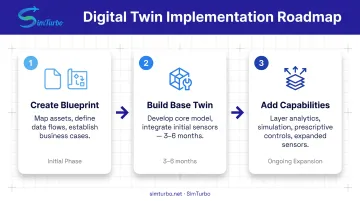
Treat the first twin as a bounded pilot: build expertise, confirm ROI, then expand coverage and controls.
Frequently Asked Questions
What are digital twin simulations?
Digital twin simulations are virtual replicas of physical systems that update in real time through sensor data. They support monitoring, prediction, and optimization by mirroring how the real asset or process is operating.
What are the four types of digital twins?
The main classifications are Component twins (individual parts), Asset twins (complete systems), System twins (multiple interacting assets), and Process twins (end-to-end workflows). Each covers a different scope, from a single part to an entire facility.
How is digital twin simulation different from traditional CAD simulation?
Traditional CAD simulations use static data and hypothetical scenarios for design validation. Digital twins sync with live sensor feeds from the physical system, so they stay asset-specific and can forecast behavior from current conditions.
What industries benefit most from digital twin simulation?
Aerospace, manufacturing, energy and utilities, healthcare, automotive, and smart cities use them heavily. Common uses include predictive maintenance, production optimization, urban planning, and clinical decision support.
What are the main challenges in implementing digital twin simulation?
Main hurdles include data integration, sensor costs, model validation, and the need for engineering, data science, and IT skills together. A Capgemini survey of 1,000+ organizations found teams still planned a 36% rise in deployment over five years despite those barriers.
Can small engineering teams or universities access digital twin simulation technology?
Yes. Enterprise builds can be expensive, but education-focused and smaller-scale platforms lower the barrier. SimTurbo’s discounted academic programs, for example, let students and researchers run real-time gas turbine models and control checks on standard PCs.