Digital twin technology addresses these pain points by creating a virtual replica of your gas turbine that mirrors real-world behavior. Instead of guessing when maintenance is needed, operators monitor real-time performance indicators and predict failures before they happen. Engineers test control strategies in a safe virtual environment before deploying them to production. Design teams validate new configurations without building physical prototypes.
This guide explains what gas turbine digital twins are, how they deliver measurable value, which components power them, and how organizations implement them—from power plants monitoring combined-cycle units to aerospace OEMs tracking fleet performance.
Key Takeaways
- Digital twins fuse live sensor data with physics or AI models into continuously updated virtual gas turbines
- Teams deploy twins for predictive maintenance, performance optimization, design validation, and operator training
- Essential stack: sensors, physics-based or data-driven simulation engines, and analytics dashboards
- Successful rollout needs quality data, validated models, and multidisciplinary teams
- ROI shows up as longer component life, less unplanned downtime, and faster development cycles
What is a Digital Twin for Gas Turbines?
A digital twin is a virtual replica of a physical gas turbine system that mirrors real-world operations using real-time sensor data combined with physics-based or data-driven models. Unlike traditional one-time simulations that analyze static conditions, digital twins update continuously as operating conditions change, creating a living model that evolves with the physical asset.
Two Modeling Approaches
Gas turbine digital twins typically use one of two modeling philosophies:
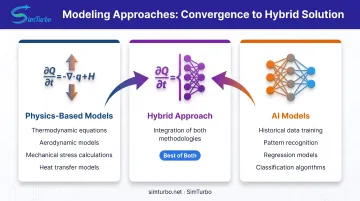
Physics-based models rely on thermodynamic and aerodynamic equations to simulate component behavior. They calculate mass flow, pressure ratios, temperatures, and efficiencies using conservation laws, gas property tables, and component characteristic maps.
Recent validation work on an LM2500+ pipeline gas turbine demonstrated that physics-based models can achieve accuracy within ±1.5%, with most predictions falling within ±1% of measured performance.
Data-driven models use machine learning algorithms trained on historical operational data to predict performance, detect anomalies, and forecast failures. These models identify patterns in sensor readings that correlate with degradation or faults, often catching subtle changes that fixed thresholds miss.
Many production systems combine both approaches. Physics models supply fundamental accuracy and extrapolation capability, while AI layers add anomaly detection and predictive maintenance intelligence.
Key Components of the Architecture
Four elements work together to enable digital twin functionality:
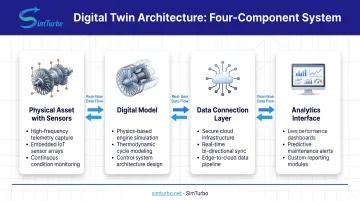
- Physical asset with sensors - Temperature, pressure, vibration, fuel flow, rotational speed, and emissions sensors capture real-time operational data
- Digital model - Simulation software (thermodynamic solvers, statistical algorithms, or hybrid systems) that replicates turbine behavior
- Data connection layer - IoT platforms, SCADA systems, or historians that collect, transmit, and store sensor data
- Analytics and visualization interface - Dashboards displaying real-time KPIs, 3D representations, alert systems, and scenario testing tools
How Digital Twins Differ from Static Simulations
Traditional gas turbine simulations analyze a fixed operating point or transient event, produce results, and stop. Digital twins stay synchronized with the physical asset and update predictions as conditions change.
When a plant increases load, ambient conditions shift, or a component degrades, the twin reflects those changes right away. Operators can spot deviations from expected behavior and act before problems escalate.
Key Benefits of Digital Twin Technology for Gas Turbines
Predictive and Condition-Based Maintenance
Traditional scheduled maintenance follows calendar intervals regardless of actual equipment condition. That produces unnecessary inspections or unexpected failures between outages.
Digital twins monitor real-time indicators such as compressor efficiency trends, vibration signatures, and temperature deviations, then predict when specific components need attention.
EPRI reports that planned maintenance causes more than 70% of gas turbine unit unavailability, with a typical hot-gas-path inspection costing $750,000-$1M plus $100,000-$150,000 for technical oversight. Extending intervals on healthy equipment and catching degradation early cuts total outage hours and focuses spend where it matters.
In one validated LM2500+ implementation, five monitored parameters achieved 100% early-warning accuracy with zero false alarms or missed detections during the validation period.
Performance Optimization and Operational Insight
Digital twins identify inefficiencies by comparing actual performance against expected behavior. They surface fuel-consumption anomalies, temperature variations, pressure deviations, and efficiency losses tied to fouling, seal wear, or combustion issues.
Operators also see behaviors traditional monitoring only shows indirectly:
- Surge margin
- Combustion stability
- Thermal stresses
- Control system response
What-if scenarios let teams test changes before touching hardware. Questions such as "How will heat rate change if we adjust firing temperature?" or "How will this control logic modification affect surge margin during load rejection?" get virtual answers instead of trial-and-error on expensive assets.
Faster Design Validation and Virtual Prototyping
Engineers use digital twins to test design changes, control strategies, and new components in a virtual environment before physical implementation. That shortens development cycles and lowers the risk of costly errors found only in hardware testing.
Pratt & Whitney's work on the F119 engine for the F-22 demonstrated this value: using digital copies and engine-specific usage histories, the team delivered a control software update in nine months, including regression testing and 100 hours of wind tunnel engine testing. No baseline comparison was published, but the compressed schedule shows how virtual testing supports rapid iteration.
Reduced Operational Costs and Extended Equipment Lifespan
Real-flight usage data from the F119 program showed that parts in the core and low-pressure module could last up to 20% longer than originally predicted. By deferring replacements until components actually need attention, the program projected more than $800M in lifetime savings across the F-22 fleet.
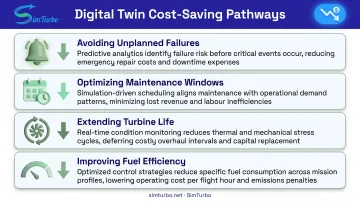
Cost savings stack up through several paths:
- Avoiding unplanned failures
- Optimizing maintenance windows to cut downtime
- Extending turbine life with better monitoring
- Improving fuel efficiency through performance tuning
Core Components of a Gas Turbine Digital Twin
Data Acquisition Layer
A gas turbine digital twin depends on sensors that stream live operating conditions into the model. Monitoring setups typically include:
Essential sensor types:
- Temperature sensors at compressor inlet/discharge, combustor exit, turbine inlet/exit, and exhaust
- Pressure transducers measuring ambient, compressor stages, combustor, and turbine sections
- Vibration sensors on bearings and casings to detect mechanical issues
- Fuel flow meters tracking consumption and injection rates
- Speed sensors monitoring rotor RPM
- Emissions analyzers measuring NOx, CO, and unburned hydrocarbons
Data collection considerations:
- Sampling frequency typically ranges from 1 Hz for steady-state monitoring to 1 kHz or higher for vibration analysis
- Integration with existing SCADA systems, distributed control systems (DCS), or historians ensures data flows to the digital twin platform
- Sensor calibration, drift detection, and validation checks so bad readings do not skew the model
The validated LM2500+ study used a 1-second acquisition interval, with input parameters including ambient temperature, ambient pressure, fuel flow, compressor inlet pressure, and compressor inlet temperature. Each simulation completed in under one second, enabling real-time synchronization.
Simulation Engine
The simulation engine is the computational core that transforms sensor inputs into predictions, diagnostics, and performance metrics.
Physics-based modeling relies on:
- Thermodynamic equations governing Brayton cycle behavior
- Aerodynamic models for compressor and turbine component maps
- Mechanical stress calculations for rotor dynamics
- Heat transfer models for combustor and cooling systems
- Calibration against measured performance data to tune model parameters
Statistical and AI models use:
- Historical operating data to train algorithms
- Pattern recognition to detect anomalies
- Regression models to predict degradation rates
- Classification algorithms to diagnose fault types
Hybrid approaches combine physics models for fundamental accuracy with machine learning layers that adapt to operating history and catch subtle deviations. The physics foundation ensures the model behaves correctly across the operating envelope, while AI components improve anomaly detection and failure prediction as more data accumulates.
Visualization and Analytics Interface
Dashboards and analytics tools turn simulation output into decisions operators and engineers can act on.
Essential interface capabilities:
- Real-time dashboards showing KPIs such as efficiency, heat rate, emissions, and surge margin
- 3D representations of the turbine with color-coded temperature, pressure, or stress distributions
- Performance trending to identify gradual degradation over weeks or months
- Alert systems that notify operators when parameters exceed thresholds or deviate from expected patterns
- Scenario testing tools that let engineers adjust inputs and evaluate predicted outcomes
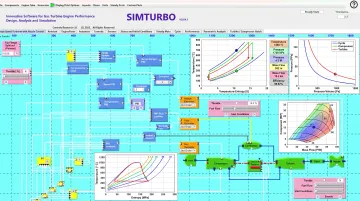
SimTurbo applies the same ideas in practice. The platform shows real-time RPM, temperature PID behavior, surge-margin tracking, and thermodynamic T-S and P-V diagrams that update as conditions change.
Engineers can watch how throttle moves affect the cycle, review control response during transients, and export data to Excel, MATLAB, or Python for deeper analysis.
Real-World Applications of Gas Turbine Digital Twins
Power Generation and Combined-Cycle Plants
Power plants use digital twins to run cleaner, more efficient operations. Common applications include:
- Optimizing dispatch strategies and heat rate
- Predicting component failures before outages
- Reducing emissions under changing load
- Tracking HRSG performance and balancing load across turbines
- Adjusting firing temperatures for ambient conditions
GE Vernova's deployment at A2A monitors six sites with 9-10 gas turbines from multiple OEMs. The implementation uses customized models tailored to each turbine type, though challenges included overcoming skepticism, filling gaps in historical data, and maintaining models as conditions evolved.
Siemens Energy's Thermal Digital Twins can model individual turbines or complete plants, monitor them in real time, and run what-if scenarios. Public case data has not yet quantified specific performance gains.
Aerospace and Marine Propulsion
Aerospace OEMs build digital twins for both development and in-service monitoring.
GE Aerospace creates a part-number-level digital replica for every GE9X engine, tracking configuration, parts, cycles, service history, and maintenance. These twins supported Boeing 777X flight testing by helping establish engine operating instructions.
Rolls-Royce's IntelligentEngine program equips civil aero engines with onboard sensors and satellite connectivity that continuously update twins for real-time operating-state tracking and maintenance prediction.
Marine operators apply the same approach to aero-derivative turbines used in ship propulsion. Fleet-wide twins support performance monitoring, predictive maintenance, and day-to-day operational optimization.
Control System Design and Validation
Digital twins enable safe testing of control algorithms before deployment to physical hardware. Engineers develop PID controllers, limiters, and protection logic, then validate them against virtual engine behavior.
Hardware-in-the-loop (HIL) applications connect real control hardware to the digital twin, creating a realistic test environment. The control system sends commands to the simulated engine and receives sensor feedback, allowing complete closed-loop validation without risk to expensive physical assets.
Pratt & Whitney's work with a small turbofan adapted for unmanned combat aircraft conducted inlet-distortion tests alongside a digital twin model to support integration and reduce risk, demonstrating up to 20% more qualified thrust for unmanned applications.
Engineering Education and Training
Universities and training programs use digital twins to teach gas turbine concepts through interactive simulation rather than static diagrams or equations.
Students can visualize transient behavior, watch thermodynamic cycles in action, and see how control systems respond to disturbances. Typical lab exercises run entirely in a virtual environment:
- Startup sequences
- Slam acceleration events
- Compressor stall recovery
- Sensor failure scenarios
SimTurbo is built for this kind of teaching. Its component-based architecture lets students assemble engines from inlets, compressors, combustors, turbines, nozzles, sensors, actuators, and controls. Real-time T-S diagrams, P-V plots, and component maps tie abstract thermodynamics to observable engine behavior.
Universities can use discounted licensing for classrooms, laboratories, and capstone projects.
Fleet Operations and Asset Management
Operators managing multiple turbines across different sites use digital twins to optimize maintenance schedules, track degradation trends, and identify systemic issues affecting multiple units.
Fleet-level analytics reveal whether one turbine is degrading faster than siblings, indicating a localized problem, or whether all units of a particular model show similar behavior, suggesting a design-related issue. Aggregated data improves predictive models and helps allocate maintenance resources efficiently.
How to Implement a Digital Twin for Gas Turbines
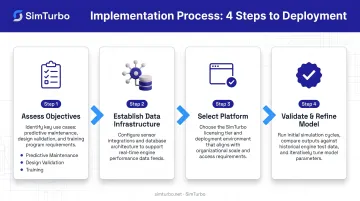
Step 1: Assess Objectives and Requirements
Define what you want the digital twin to accomplish before selecting technology or installing sensors:
- Predictive maintenance focus? Prioritize sensors that detect degradation: vibration, temperature spreads, efficiency trends
- Design validation? Invest in high-fidelity physics models and control system integration
- Operator training? Emphasize visualization, scenario testing, and transient simulation
Identify which turbine systems or components to model first. A full turbine twin takes significant effort. Start with hot-section components, control systems, or one critical asset to cut scope and reach value faster.
Step 2: Establish Data Infrastructure
Twin accuracy tracks the quality of the data feeding it.
Sensor installation:
- Audit existing instrumentation and identify gaps
- Install additional sensors where needed (temperature arrays, vibration monitors, emissions analyzers)
- Ensure proper calibration and establish maintenance procedures
Data integration:
- Connect sensors to SCADA, DCS, or historian systems
- Set up data pipelines to the digital twin platform
- Implement validation checks to catch sensor failures or corrupted readings
- Ensure adequate sampling frequency for the intended use case
Legacy system considerations:
- Older turbines may have limited sensor coverage requiring retrofit instrumentation
- Legacy control systems may not support modern communication protocols
- Bridge data silos across operations, maintenance, and engineering
Step 3: Select Platform and Modeling Approach
Choose software and modeling philosophy based on your objectives, budget, and team expertise.
Physics-based simulation tools:
- High accuracy when properly validated
- Ability to extrapolate beyond training data
- Clear physical interpretation of results
- Tradeoff: need thermodynamics and turbomachinery expertise
Data analytics platforms:
- Rapid deployment on existing data
- Strong anomaly detection once trained
- Continuous improvement as more data accumulates
- Tradeoff: depend on representative training datasets
Specialized platforms like SimTurbo provide component-based turbine simulation with validated physics models, real-time visualization, and integrated control system design. That mix fits engineering teams focused on design validation, education, and control algorithm development. SimTurbo's J85-GE-21 validation showed accuracy within ±2% for thrust, flow rate, temperature, and TSFC versus NASA test data.
Step 4: Validate and Refine the Model
Initial models require validation against real operational data before they can be trusted for decision-making.
Validation process:
- Compare model predictions to measured performance across the operating envelope
- Identify discrepancies and adjust model parameters
- Test transient behavior during startups, shutdowns, and load changes
- Verify alarm thresholds minimize false positives while catching real issues
Continuous refinement:
- Update models as more operational data becomes available
- Adjust for component degradation over time
- Incorporate lessons learned from maintenance findings
- Re-validate after hardware modifications or control system updates
The LM2500+ study reached convergence in under 0.2 seconds, versus 0.9 to 2.35 seconds for comparison high-precision models. Properly tuned physics models can deliver both speed and accuracy for real-time use.
Challenges and Considerations
Data Quality and Integration
Legacy systems with incomplete historical data, skepticism about new technology, and ongoing model maintenance are real barriers in fleet deployments, as GE Vernova’s A2A case documents. Additional challenges include:
- Insufficient sensor coverage on older turbines requiring retrofit instrumentation
- Data silos across operations, maintenance, and engineering departments that prevent holistic analysis
- Lack of standardized formats complicating integration across OEM and third-party systems
- Cybersecurity concerns when connecting operational technology to cloud platforms or enterprise networks
Required Expertise and Training
Digital twin projects demand multidisciplinary teams:
- Turbine engineers who understand thermodynamics, aerodynamics, and mechanical behavior
- Data scientists who can build and tune predictive models
- Control systems experts who design and validate algorithms
- Software developers who integrate platforms and maintain data pipelines
- Operations staff who interpret results and take action
Training does not stop at go-live. Maintenance teams must act on predictions, engineers need to know when to update models, and management has to read analytics for strategic decisions.
Cost and ROI Considerations
Initial investments include sensors, software licenses, integration labor, and model development. For large industrial turbines, sensor installations alone can require significant capital.
Software licensing varies widely: enterprise APM platforms often run six figures annually, while specialized tools like SimTurbo offer subscriptions starting at $59.99/month.
Long-term savings come from reduced downtime, extended component life, optimized maintenance intervals, and improved efficiency. The F119 program projected more than $800M in lifetime savings from usage-based life extension on a high-value military engine program.
Smaller operations or teams new to digital twins often start with a focused pilot. Monitoring one critical component or asset can prove value before scope expands.
Frequently Asked Questions
Is digital twin technology still relevant for gas turbines?
Yes. Adoption is accelerating as IoT infrastructure matures and operators chase predictive maintenance and efficiency gains. OEMs now ship engines with individual digital replicas, and fleet operators run monitoring centers covering dozens of units.
What are the four main types of digital twins?
Component twins model individual parts (turbine blades, combustor liners), asset twins represent complete turbines, system twins encompass turbines plus auxiliaries (HRSG, generators, fuel systems), and process twins model entire operational workflows including maintenance and logistics.
What are the four types of gas turbines?
Industrial units are heavy-duty machines for stationary power. Aero-derivatives adapt aircraft engines for power, marine, or mechanical drive; micro turbines cover 25–500 kW distributed power; and turboshafts deliver shaft power for helicopters, pumps, or compressors.
What data is needed to create a gas turbine digital twin?
You need real-time ops data (temperatures, pressures, flows, speeds), maintenance history, design specs (maps, geometry, materials), and ambient conditions. Sampling typically runs from 1 Hz for steady-state monitoring to 1 kHz for vibration analysis.
How accurate are digital twin predictions for gas turbines?
Physics-based models can achieve accuracy within ±1.5%, with most predictions within ±1%, when properly validated against measured data. Data-driven models improve as training datasets grow, often excelling at anomaly detection but requiring more data to achieve comparable fundamental accuracy. Hybrid approaches combine the strengths of both methods.
Can digital twins be used for control system design and validation?
Yes. Engineers can test control algorithms, PID tuning, and protection logic in simulation before deployment, without risking hardware. Hardware-in-the-loop setups connect real control processors to a virtual engine for realistic, lower-risk validation.