What is a jet engine simulator used for?
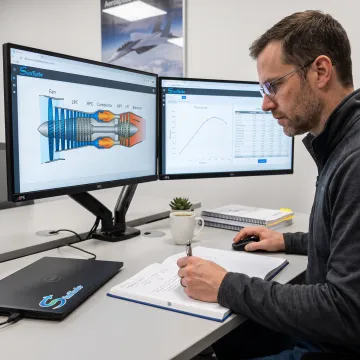
A jet engine simulator is used to model how a propulsion system performs before physical testing. It can predict thrust, fuel consumption, temperatures, pressures, spool speeds, and component operating points. Engineers use it for concept development, component matching, off-design studies, control development, troubleshooting, and virtual prototyping. Universities also use simulation to connect thermodynamics and propulsion theory with observable engine behavior.
Can SimTurbo model both steady-state and transient engine operation?
Yes. SimTurbo supports steady-state analysis for cycle performance, efficiency, thrust, fuel consumption, and component operating points, as well as transient simulation for startup, shutdown, acceleration, deceleration, throttle changes, actuator dynamics, and sensor response. Using both modes helps users understand not only where an engine settles, but also how it behaves while moving between operating conditions.
What jet engine configurations can be simulated?
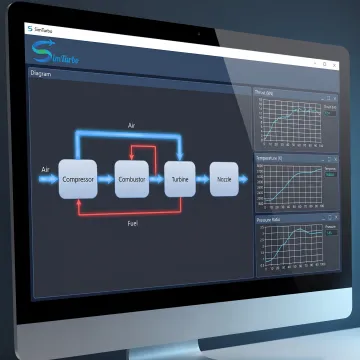
The platform supports component-based modeling for turbojet and related gas turbine configurations. Users can work with single-spool and dual-spool turbojet models and assemble architectures using elements such as inlets, compressors, combustors, turbines, shafts, nozzles, recuperators, and afterburners. This structure supports baseline engines as well as studies of regenerative, reheated, intercooled, and afterburning concepts.
Can I use SimTurbo to design gas turbine control systems?
Yes. SimTurbo supports control-system design and validation for gas turbines, including PID controllers, fuel scheduling, engine start and shutdown logic, protection functions, limiters, actuator and sensor models, and FADEC-oriented control concepts. Closed-loop transient simulation helps users evaluate response, stability, operating limits, and fault scenarios before progressing to higher-fidelity implementation or hardware-in-the-loop workflows.
How accurate is the jet engine simulation platform?
Simulation accuracy depends on the engine configuration, component data, model assumptions, and calibration approach. SimTurbo reports validation against NASA Lewis Research Center J85-GE-21 engine test data with accuracy within plus or minus 2 percent. Users should still verify input data, operating assumptions, and model outputs against applicable test results, specifications, or project requirements for each individual application.
Can simulation data be exported for further analysis?
Yes. SimTurbo supports exporting simulation data for post-processing in commonly used engineering tools, including Excel, MATLAB/Simulink, and Python. This allows teams to create custom plots, compare cases, automate calculations, document findings, or incorporate model outputs into broader analysis workflows. Export capability is particularly useful when simulation results need to support reports, research, or control-development activities.
Are student and university licenses available?
Yes. SimTurbo offers educational options for university students, faculty, engineering departments, research groups, and classroom or laboratory programs. Available arrangements include discounted student licensing, class and lab programs, research access, and campus-oriented deployments. These options are designed to support propulsion courses, thermodynamics instruction, capstone projects, laboratory experiments, and simulation-based engineering education.
Is there a trial or demonstration available?
A free 30-day trial is available for the gas turbine control-system design offering and includes full product features during the trial period. SimTurbo also offers a free, 30-minute online demonstration for single-spool turbojet simulation by appointment through its booking calendar. A demonstration can help users see the interface, component workflow, and real-time simulation capabilities before selecting a license.