Introduction
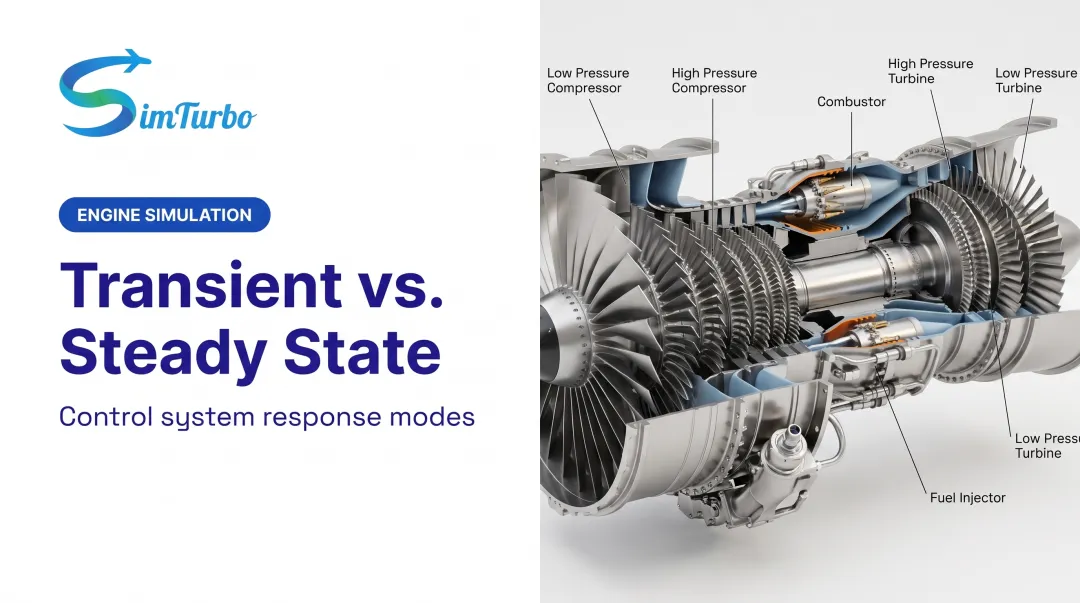
When an engineer designing a gas turbine presses the throttle forward, the engine doesn't respond instantly. Pressure waves propagate through the compressor. Temperatures spike before turbine blades have time to adjust. Fuel flow surges, and for a critical few seconds, the surge margin collapses from a comfortable 25% to below 5%, flirting with compressor stall. Miss these dynamics in your design, and your system fails in the field.
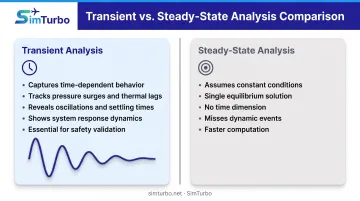
Transient analysis studies exactly this: how engineering systems respond and transition between operating states over time. Unlike steady-state analysis, which assumes constant conditions, transient simulation captures the pressure surges, thermal lags, oscillations, and settling times that determine whether your design is safe, efficient, and reliable.
According to NASA, pressure-transient events have caused overload and fatigue failures across aerospace, oil, chemical, and nuclear systems. Dynamic strain can reach 3.5 times static strain during these events.
This guide covers what transient analysis software does, how the simulations work, and how to choose the right tool for your application.
Key Takeaways
- Transient analysis captures time-dependent system behavior during state changes: dynamics steady-state tools miss entirely
- Applications range from millisecond power-grid disturbances to hour-long thermal missions, each needing matched solver strategies
- Software spans general SPICE simulators, hydraulic waterhammer tools, and specialized platforms like SimTurbo for gas turbine dynamics
- Selection depends on physics match, validated accuracy, real-time needs, and component-based vs. black-box modeling
What is Transient Analysis?
Transient analysis studies how systems behave over time when inputs change: throttle movements, load rejections, startup sequences, fuel-flow changes. Systems don't jump instantly to new equilibrium; they transition through dynamic states governed by mass, momentum, and energy conservation.
Why it matters:
- Safety: Prevents overpressure, thermal shock, and mechanical failure
- Performance: Minimizes response lag, oscillation, and inefficiency
- Validation: Confirms designs meet dynamic requirements under real operating scenarios
Key parameters tracked:
- Pressure and temperature profiles over time
- Flow rates and velocity transients
- Mechanical stresses and vibration response
- Oscillation frequencies and settling times
- Control-system stability
Transient analysis operates in the time domain, producing second-by-second or millisecond-by-millisecond histories that reveal how fast an engine or plant responds, whether it overshoots, and when it settles to a stable operating point.
Types of Transient Analysis
Transient analysis is usually grouped in two ways: by time scale and by physics domain. Both views matter when you pick methods, time steps, and software.
Short-Term vs Long-Term Transient Analysis
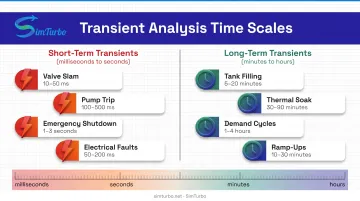
Short-term (milliseconds to seconds):
- Captures sudden events such as valve slam, pump trip, emergency shutdown, and switching transients
- Dominated by rapid wave propagation, pressure surges, and electrical spikes
- IEEE/CIGRE treats 3–5 seconds as the typical power-system transient-stability window (up to 10–20 seconds on very large grids)
- Use for waterhammer protection, surge analysis, and fault response
Long-term (minutes to hours):
- Models gradual changes: tank filling, daily demand cycles, slow ramp-ups, thermal soak
- NIST thermal studies show heat moving in seconds under a package, tens of seconds across centimeters, and hundreds of seconds toward heat-sink steady state
- Use for operational planning, performance trending, and system interactions
Domain-Specific Transient Analysis Types
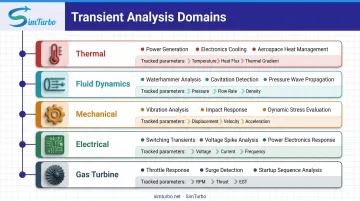
Thermal transient analysis:
- Tracks temperature distribution changes over time
- Critical in power generation, electronics cooling, and aerospace thermal protection
- Helps prevent thermal-stress failures in turbine blades, heat exchangers, and semiconductor packages
Fluid dynamics transient analysis:
- Models pressure waves, flow reversals, cavitation, and hydraulic transients
- Essential for piping systems, water networks, fuel delivery, and gas transmission
- NASA lists common waterhammer initiators: valve actuation, priming, discharge, and pump-power loss
Mechanical/structural transient analysis:
- Analyzes vibration, impact loads, and dynamic stress in rotating machinery and structures
- NASA validation work showed dynamic strain reaching 3.5× static strain in transient events
- Requires test-correlated modal surveys for spacecraft and launch-vehicle structures
Electrical transient analysis:
- Uses SPICE-type simulators for circuit response to switching, startup, and nonlinear devices
- Examines voltage/current waveforms, rise times, ringing, and oscillations
- Covers power electronics, control circuits, and electromagnetic compatibility
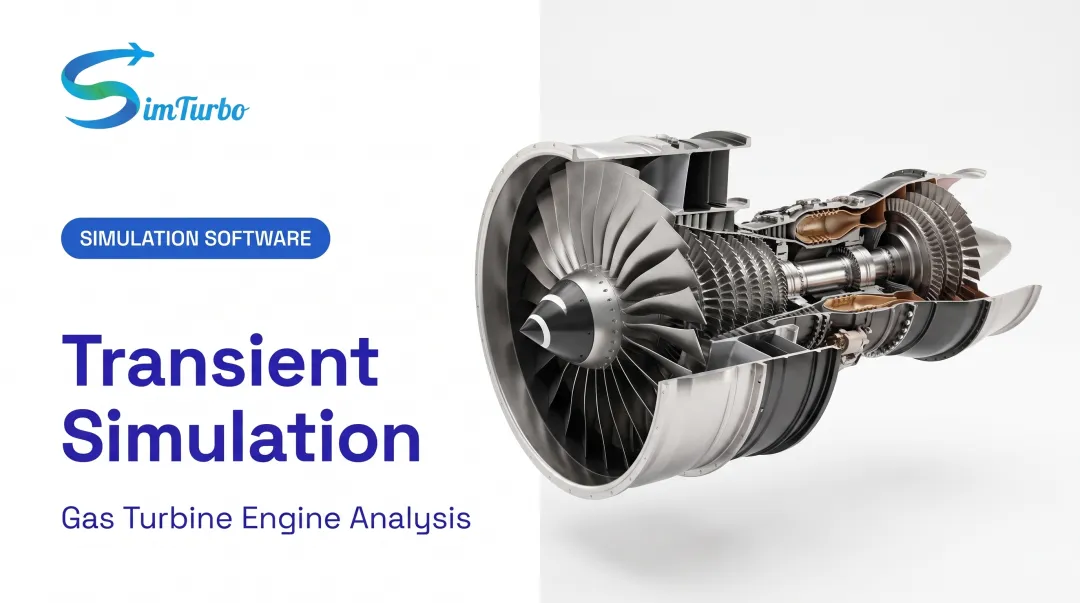
Gas turbine transient analysis:
- Combines thermodynamic, fluid, and mechanical transients in one integrated model
- Simulates throttle changes, start-up/shut-down, compressor surge, and control-system response
- Supports component-level engine behavior for thrust, flow, temperature, and fuel burn during off-design and transient operation
How Transient Analysis Software Works
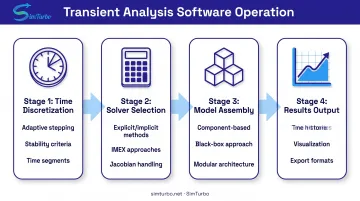
Transient analysis software divides simulation time into discrete steps, solving the governing equations (mass, momentum, and energy conservation) at each increment to build a complete time history.
Time step selection:
- Smaller steps capture fast dynamics but increase computation
- Larger steps run faster but may miss rapid events or become numerically unstable
- Adaptive stepping adjusts size automatically—PETSc and SUNDIALS reject steps when error exceeds tolerance, shrink the step, and retry
Solver methods:
- Explicit (Euler, Runge-Kutta): No Jacobian needed; fast per step but limited to non-stiff problems
- Implicit (backward Euler, BDF, Crank-Nicolson): Requires Jacobians and nonlinear solves; costlier per step but handles stiff, multiscale systems
- IMEX: Treats stiff terms implicitly and other terms explicitly, balancing cost and stability
Modeling approaches:
- Component-based: Assemble systems from individual physics-based elements (compressors, valves, heat exchangers). Transparent, flexible, and grounded in first principles
- Black-box: Treat subsystems as input-output relationships without internal detail. Faster but less insight; FMI standard enables platform-independent model exchange
Real-time simulation:
When models and solvers are efficient enough, the software can match real-world speed. That enables hardware-in-the-loop (HIL) testing, where simulated plants interact with actual controllers. In 2023, NASA reported real-time HIL testing of a partially turboelectric aircraft control design.
Key Features of Transient Analysis Software
Strong transient analysis software pairs fast model building with reliable numerics and clear results. Use the capabilities below to separate production-ready tools from basic solvers.
Graphical modeling interfaces:
- Drag-and-drop component libraries (pumps, pipes, turbines, sensors, actuators)
- Visual schematics that cut setup time and errors compared with text input
- Property editors for parameters like pressure limits, material properties, and initial conditions
Solver capabilities:
- Method selection: implicit/explicit, order, time-step/end-time control
- Convergence criteria and stability algorithms
- Adaptive time-stepping that balances accuracy and speed
- Event handling for discontinuities (valve closures, contact, switching)
Validation and verification:
- Code-verification requirements per AIAA S-141-2024 (CFD and heat transfer)
- Comparison with experimental data to confirm model fidelity
- Sensitivity and uncertainty analysis tools
- NASA validation example: predicted peak pressure within 7% of test measurements
Results visualization:
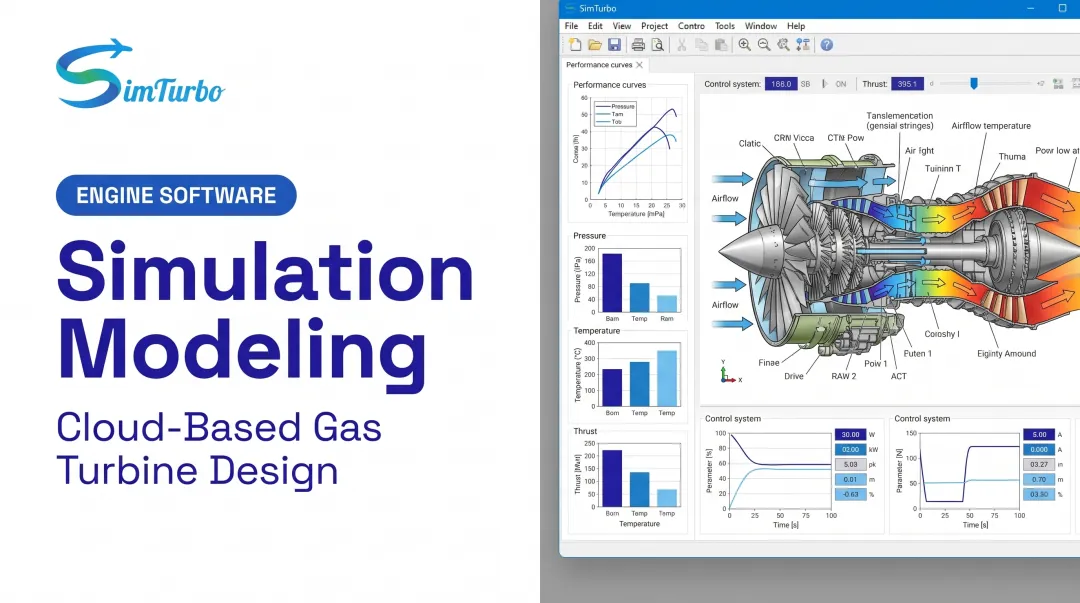
- Time-history graphs (pressure, temperature, flow, speed)
- Animated system behavior and color-coded parameter displays
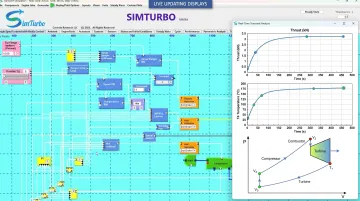
- Thermodynamic-cycle plots (T-S, P-V diagrams) updated in real time
- Data export to Excel, MATLAB, Python for post-processing
Specialized capabilities:
- Industry-specific component libraries (aerospace, power, water, marine)
- Physics for compressible flow, cavitation, real-gas effects, multiphase flow
- Control-system integration (PID, FADEC, limiters) for closed-loop simulation
Industry Applications of Transient Analysis
Transient analysis shows up wherever gas turbines must change speed, load, or operating mode without stalling, overheating, or tripping protection. Aerospace, power generation, and marine teams rely on it to prove control logic before hardware sees the same event.
Aerospace
- Model throttle transients, start-up, slam acceleration, and compressor surge margins
- Predict fuel-system response to maneuvers and flight-profile changes
- Stress-test control logic for snap acceleration (NASA work cut high-pressure-compressor operability-stack use by 31% in one study)
- Simulate environmental control system dynamics during ascent and re-entry
Power Generation
- Run turbine start-up/shutdown sequences and grid load-response cases
- Evaluate transient thermal stress in boilers and heat exchangers
- Validate controls for stable operation across load swings
- Combine internal-pressure and thermal-transient stresses at vulnerable locations (as in EPRI-style plant studies)
Marine Propulsion
- Capture engine response to Crash Stop, Full Astern, and Full Ahead maneuvers
- Analyze propulsion-system transients during acceleration and deceleration
- Study controllable-pitch propeller and hull interaction under dynamic load
- Benchmark models against test-cell data (for example, ASME validation on a 500 kW engine)
SimTurbo for Gas Turbine Transient Analysis
The same failure modes appear across these industries: surge risk, thermal limits, and control lag. SimTurbo maps those problems into a component-level model you can run and inspect on a standard PC:
- Component-based aero-thermodynamic architecture (not a black-box engine model)
- Real-time simulation with live graphs and cycle diagrams
- Reported agreement within ±2% of NASA J85-GE-21 data for thrust, flow, temperature, and fuel consumption
- Classroom and lab use for university propulsion and thermodynamics programs
- Control-law checks with PID, FADEC logic, limiters, sensors, and actuators
- Export of transient traces (RPM, EGT, thrust, SFC) to CSV, Excel, MATLAB, and Python
Choosing the Right Transient Analysis Software
The right tool depends on your physics domain, time scales, and how much validation and support you need. Use the checks below before you commit.
Match physics and time scale to your application:
- Short-term surge/waterhammer versus long-term thermal soak require different solvers
- Gas turbine, electrical grid, and hydraulic network problems each need specialized tools
- Confirm it handles your initiating events, nonlinearities, couplings, and boundary conditions
Learning curve and usability:
- Evaluate interface intuitiveness, documentation quality, and training availability
- Prefer graphical modeling unless your team already relies on custom programming
- Easier-to-learn tools cut user errors, training time, and long-term maintenance cost
Vendor support and validation:
- Look for companies with documented verification studies and industry expertise
- Active user communities and responsive technical support
- Application-relevant experimental validation, not just marketing claims
Try before you buy:
Many vendors offer free trials. SimTurbo provides a 30-day trial at $0 so engineers can test component-based gas turbine modeling, real-time transient runs, and control-system integration on their own cases before buying.
A 30-minute online demo is also available if you want a guided look at fit for your workflow.
Frequently Asked Questions
What is transient analysis in engineering?
Transient analysis studies how engineering systems respond over time when conditions change. It tracks the dynamic transition period between steady states, capturing pressure surges, temperature spikes, oscillations, and settling behavior that steady-state tools cannot see.
How is transient analysis different from steady-state analysis?
Steady-state analysis assumes disturbance transients have settled and calculates a single equilibrium solution. Transient analysis preserves time dependence, revealing how fast systems respond, whether they overshoot, and how long they take to stabilize.
What is the best software for thermal simulation?
"Best" depends on your application—electronics thermal transients need different tools than gas turbine analysis. Choose software validated for your industry, time scale, and the thermal phenomena you need to capture.
What industries commonly use transient analysis software?
Aerospace, power generation, oil and gas, water/wastewater, nuclear, marine propulsion, electronics, and manufacturing all rely on it. Typical uses include engine design, turbine operations, pipeline surge protection, and process control.
What are the main challenges in transient simulation?
Stiffness, multiple time scales, and time-step selection make numerical stability and convergence hard to guarantee. Teams also wrestle with model validation, compute cost, discontinuous waves, fluid-structure coupling, and turning results into design decisions.
Can transient analysis software be used for education and training?
Yes. Tools like SimTurbo support propulsion and controls courses with real-time throttle response, startup, and surge demos. Educational pricing is common, and students can export data to Excel, MATLAB, or Python for assignments.