For power generation, aerospace, and marine operators, that gap between "still running" and "running well" determines everything: fuel costs, heat rate, safety margins, and how long the asset lasts before a major overhaul.
Poor maintenance strategy carries real financial risk. While there's no single industry-wide dollar figure for forced-outage costs, individual events tell the story. Enel's Dock Sud plant suffered a six-week forced outage from a burner installation issue that cost more than $2 million in repairs alone, not counting lost generation revenue.
This guide covers why monitoring matters, the maintenance types available, key indicators to track, realistic schedules, and mistakes that turn manageable issues into major failures.
Key Takeaways
- Performance monitoring protects efficiency, reliability, and equipment lifespan simultaneously
- Blend routine, corrective, predictive, and major overhaul work into one maintenance strategy
- Heat rate, vibration, and exhaust temperature spread are core indicators worth tracking daily
- Predictive programs can save 8-12% over preventive-only approaches, per PNNL research
- Simulation tools like SimTurbo let engineers validate control logic before touching hardware
Why Performance Monitoring and Maintenance of Gas Turbines Is Important
A gas turbine that's monitored consistently retains more of its original value over its operating life. One that isn't tends to surprise you, usually at the worst possible time.
Tracking heat rate and corrected output lets engineers catch losses before they compound. A turbine running 2% below its expected corrected output today often means compressor fouling or seal wear that will cost far more to fix in six months.
Early degradation detection also defers costly major inspections. Catching hot-section wear during a routine borescope check is far cheaper than discovering it after a forced shutdown.
Deviations in exhaust temperature spread or vibration can signal hazardous conditions. GE's guidance flags exhaust temperature and spread as core parameters operators should trend continuously. Unusual spread patterns can indicate combustion problems before they become dangerous.
Those same habits show up in maintenance cost:
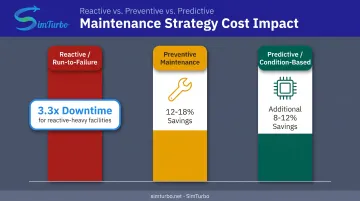
- Preventive maintenance delivers an estimated 12-18% savings over reactive, run-to-failure approaches, according to PNNL's O&M Best Practices research
- Predictive/condition-based maintenance adds another 8-12% savings on top of preventive programs
- Facilities in the top reactive-maintenance quartile experienced 3.3x the downtime of facilities in the bottom quartile, per NIST manufacturing data
Reactive-heavy operations don't just cost more. They cost more unpredictably, which makes budgeting and planning nearly impossible.
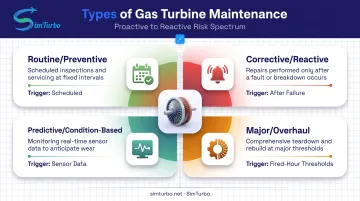
Types of Maintenance for Gas Turbines
There's no universal maintenance strategy. The right mix depends on duty cycle, criticality, fuel type, and OEM guidance for your specific frame.
Routine / Preventive Maintenance
This is your baseline. Scheduled inspections happen on a calendar or run-hour basis, regardless of actual condition.
Typical tasks include:
- Lube-oil analysis and filter changes
- Borescope inspections at set intervals
- Calibration checks on instrumentation
- General cleaning and housekeeping
This baseline approach works well for low-criticality units or peaking plants that run infrequently, where the cost of over-maintaining is lower than the risk of missing something.
Corrective / Reactive Maintenance
Corrective maintenance kicks in after something's already gone wrong: an unexpected trip, alarm, or outright failure.
Relying too heavily on this approach is risky. It means you're always paying the highest price for repairs, and damage can cascade before anyone notices the initial problem.
Predictive / Condition-Based Maintenance
Instead of fixed schedules, predictive maintenance uses real sensor data. Engineers trend vibration, exhaust temperature spread, and compressor efficiency to decide when work is actually needed.
Simulation platforms strengthen that call. Tools like SimTurbo let engineers model compressor and turbine matching with compressor maps, corrected mass flow, and pressure ratio data, so efficiency trends show up before a physical inspection or hardware change.
Teams can also prove control-law changes in simulation first. A documented afterburner transient drops surge margin from 20-25% to below 5%, so engineers can validate fuel-flow modulation and adaptive logic before anything reaches the test cell. Fewer surprises follow when that control code moves to hardware.
Major / Overhaul Maintenance
When fired-hour counters and condition data both point to deeper work, plants move into overhaul territory. That means hot-section inspections, rotor work, and part replacement, typically on OEM fired-hours or starts thresholds.
For GE frames, as one example, major inspection intervals commonly fall between 48,000 and 64,000 factored fired hours, depending on the specific frame and duty cycle. This is distinct from hot-gas-path inspections, which often occur at shorter intervals.
How to Check If a Gas Turbine Needs Maintenance
Waiting for a full trip or shutdown means you've already missed the early warning signs. Here's what to watch instead.
Performance or Output Changes
- Reduced output at given ambient conditions compared to baseline
- Rising heat rate without a corresponding operational change
- Efficiency losses that don't match normal degradation curves
Unusual Behavior or Operation
These operational signs often point to developing mechanical issues:
- Abnormal vibration signatures
- Unexpected trips
- Compressor surge events
ISO 20816-2 frames vibration evaluation for land-based turbines above 40 MW; specific alarm thresholds remain OEM- and configuration-specific.
Visible Wear, Errors, or Irregularities
Borescope inspections often catch what sensors miss:
- Blade erosion or coating loss
- Hot-section spalling or material loss
- Cracks, nicks, or rub contact indications
DCS/SCADA alarms flagging out-of-range parameters also warrant immediate review.
Increased Resource Consumption
Rising fuel flow for the same output is one of the clearest efficiency red flags. It usually points to compressor fouling, seal degradation, or combustion changes.
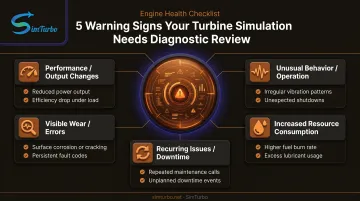
Recurring Issues or Downtime
Repeated minor trips or "temporary fixes" that keep coming back usually signal a deeper root cause that hasn't been addressed. Treat the third occurrence as a diagnostic priority, not routine.
Gas Turbine Maintenance Schedule (General Guidelines)
Schedules vary significantly by frame type, duty cycle, and OEM recommendation. There's no single universal timetable, but here's a general structure operators commonly follow.
| Frequency | Typical Tasks |
|---|---|
| Daily / per-run | Fuel and power accounting, trend logging, startup data collection |
| Weekly / periodic | Filter inspection, vibration trend review |
| Quarterly / periodic | Borescope checks (for some fuel types), oil analysis |
| Annual / major | Combustor inspection, hot-gas-path review, overhaul planning |
Note on borescope frequency: For gas or distillate-fired units, borescope inspection typically occurs at the combustion inspection interval or annually, whichever comes first. Heavy-fuel units often require semiannual inspection due to faster fouling rates.
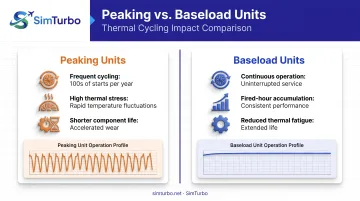
Peaking vs. Baseload Operation
Cycling accelerates wear in ways continuous baseload operation doesn't:
- Peaking units experience more thermal cycling stress, which shortens component life relative to fired hours alone
- Baseload units accumulate fired hours faster but experience less thermal-cycling fatigue
Fast starts, trips, and off-frequency operation also shorten maintenance intervals compared with steady, controlled running.
Adjust your schedule based on actual duty cycle, not just a generic calendar.
Conclusion
Performance monitoring and maintenance sit at the center of turbine operation. They determine whether an asset delivers its full design life or falls short.
The right strategy balances cost, reliability, and uptime using both field data and simulation-based validation. Field sensors tell you what's happening now. Simulation tools help you understand why, and what to do about it, before you commit resources to a physical change.
Platforms like SimTurbo support this by letting engineers validate performance trends and control-law changes in a modeled environment first. Used alongside physical testing and field monitoring, that step cuts unknowns before you commit hardware or outage time.
Frequently Asked Questions
What is CCGT and OCGT?
CCGT (combined cycle gas turbine) recovers exhaust heat to drive a steam turbine, boosting overall efficiency. OCGT (open cycle gas turbine) runs standalone as a simple-cycle unit, typically for peaking power needs.
What are the common causes of turbine engine performance loss?
Leading contributors include compressor fouling, hot-section wear from erosion and corrosion, seal or clearance degradation, inlet filter clogging, and instrumentation drift. Each affects efficiency differently and requires different fixes.
What is the API standard for gas turbines?
API 616 covers "Gas Turbines for the Petroleum, Chemical and Gas Industry Services," addressing design and performance requirements for turbines in those specific applications.
How often should a gas turbine undergo a major inspection?
Intervals depend on OEM-specified fired hours or starts. For many GE frames, major inspection baselines fall between 48,000 and 64,000 factored fired hours, though this varies by frame type and duty cycle.
Can simulation software replace physical performance testing?
No. Simulation tools like SimTurbo complement field testing rather than replace it. SimTurbo's own J85-GE-21 validation against NASA test data showed accuracy within ±2% for thrust and TSFC, useful for pre-validation, not a substitute for physical results.
What's the difference between preventive and predictive maintenance for gas turbines?
Preventive maintenance runs on a fixed schedule, regardless of actual condition. Predictive maintenance uses real-time sensor data, like vibration and exhaust spread, to trigger work only when the equipment actually needs it.