That gap between "turbine runs out of room" and "scramjet starts working" is the entire reason Turbine-Based Combined Cycle (TBCC) engines exist. Traditional turbojets and ramjets each excel in a narrow speed band. Next-generation aerospace vehicles need one propulsion system that spans the whole envelope.
This article breaks down what a TBCC engine is, how it actually works, where it's being used, and how simulation platforms like SimTurbo help engineers validate these designs before committing to expensive hardware.
Key Takeaways
- TBCC engines pair a turbojet/turbofan with a ramjet or scramjet to cover subsonic through hypersonic speeds in one system
- Mode transition between turbine and ramjet/scramjet operation remains the hardest technical problem in TBCC design
- Power-plant "combined cycle gas turbines" for electricity generation are unrelated to aerospace TBCC propulsion
- Component-based simulation software lets engineers model and refine TBCC architectures before physical prototyping
What Is a Turbine-Based Combined Cycle Engine?
A TBCC engine is a hybrid propulsion system. It pairs a turbine engine for low-speed operation with a ramjet or scramjet for high-speed flight. That mix lets one vehicle cover a flight envelope that no standalone engine type can handle.
The core problem: no air-breathing engine cycle works well from a standstill through hypersonic cruise.
NASA's reference TBCC architecture uses a turbine flowpath for takeoff and low supersonic speeds, then hands off to a dual-mode scramjet (DMSJ) as Mach rises, per NASA's 2012 TBCC modeling report.
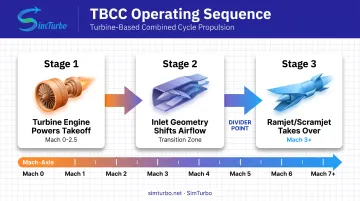
Typical operating sequence:
- Turbine engine powers takeoff through low supersonic speeds.
- Inlet geometry shifts air toward the high-speed flowpath.
- Ramjet or scramjet takes over as Mach number climbs.
U.S. programs have pushed the concept further, including NASA's Fundamental Aeronautics Program TBCC work and AFRL/Aerojet integrated-inlet tests at Wright-Patterson Air Force Base. Those efforts proved components and inlet operability—not a flight-ready aircraft.
Don't Confuse This With Power-Plant "Combined Cycle"
A power-generation combined cycle pairs a gas turbine with a steam turbine, using waste heat to drive the second turbine and make electricity, per the U.S. Energy Information Administration's glossary. TBCC shares the phrase "combined cycle" and little else. It is a flight propulsion architecture, not a power plant.
How a TBCC Engine Works: Key Components and Modes
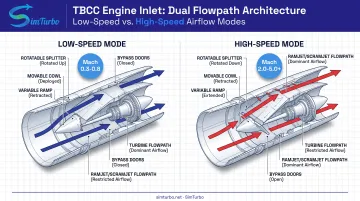
TBCC architecture splits into two flowpaths sharing a vehicle inlet.
Low-Speed Turbine Mode
At takeoff and through low supersonic speeds, the engine functions like a conventional jet:
- Compressor raises incoming air pressure
- Combustor burns fuel with compressed air
- Turbine extracts energy to drive the compressor
In this mode the engine covers the same flight regime as a standard turbojet or turbofan.
High-Speed Ramjet/Scramjet Mode
Above the turbine's practical ceiling, the flow path shifts:
- Ram compression from vehicle speed alone—no rotating machinery
- Combustor runs in ramjet or scramjet mode
- Turbine flowpath bypassed entirely
The Inlet Challenge
Feeding air to whichever mode is active requires variable geometry inlets. A NASA-studied configuration uses a rotatable splitter, movable cowl, variable ramp, and bypass doors to redirect airflow during transition, while preserving shock stability and avoiding inlet unstart.
Mode Transition: The Hard Part
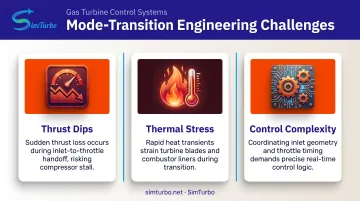
This supersonic-to-low-hypersonic handoff is widely considered TBCC's defining engineering problem. Issues include:
- Thrust dips if one flowpath spools down before the other spools up
- Thermal stress from sustained high-speed operating conditions
- Control complexity in coordinating inlet geometry with propulsion mode
NASA's 2021 CCE-LIMX ground campaign ran 156 tests at Mach 3 and 495 simulated-Mach 4 tests, generating data used to build transfer functions for closed-loop control, according to NASA's Technical Memorandum on CCE-LIMX system identification. Those transfer functions support closed-loop control design on the ground before any flight attempt.
Advanced control laws, including PID-based schemes, use that kind of data to coordinate throttle and inlet geometry through the handoff. Shared nozzles and shafts further cut weight versus two fully separate engines.
Why TBCC Engines Matter: Applications and Benefits
TBCC concepts target a specific class of vehicles:
- Hypersonic aircraft requiring sustained high-Mach cruise
- Reusable launch vehicles that need runway takeoff without disposable rocket boosters
- High-speed military and UAV platforms for reconnaissance or strike missions
DARPA's stated goal for its AFRE program was a reusable aircraft capable of taking off at low speed and reaching Mach 5 or above without a rocket boost stage.
Key benefits over alternative approaches:
- Single-engine, wide-envelope operation instead of carrying multiple dedicated engines
- Weight and fuel efficiency advantages over rocket-based combined cycles during atmospheric flight phases
- Reduced integration complexity compared to strapping a separate scramjet onto an airframe
Defense investment in hypersonics is substantial. The DoD's FY2024 budget request included $145 billion for research, development, testing, and evaluation across all programs. Billions of that go toward hypersonic weapons development and testing infrastructure, according to the Department of Defense's FY2024 budget release. That funding covers hypersonics overall, not a dedicated TBCC line item.
Engineering Challenges in TBCC Design
Three challenges dominate TBCC development:
Thermal management. Sustained high-speed flight puts extreme heat loads on combustor liners and structures. One AIAA thermal model recirculated fuel through afterburner and DMSJ liners, targeting 500 K with a 550 K limit. It held mass/energy balance in simulation, but had no physical test data behind it—simulation results are not validated hardware performance.
Aerodynamic and structural complexity. Variable-geometry inlets and nozzles must work efficiently across widely different regimes, from static takeoff to hypersonic cruise. Each geometry change adds actuator loads, seal wear, and structural fatigue.
Control validation without flight testing. Mode-transition algorithms need extensive testing, yet flight tests at these speeds are expensive and risky. Engineers therefore lean on ground-based rigs and simulation for most iteration, reserving flight tests for final confirmation.
Simulating and Validating TBCC Designs Before Prototyping
Physical hypersonic testing carries real costs and real risk. NASA's own Advanced Modeling and Simulation seminar puts it plainly: computer simulation is a key-enabling technology for hypersonic vehicle design, given the extreme costs of flight testing and the limited capabilities of ground wind tunnels.
That's the logic behind simulation-first design: model early, validate against ground data, then commit to costly flight tests only once the design is well understood.
Component-Based Modeling Instead of a Black Box
SimTurbo is built for that workflow. Rather than treating an engine as a single opaque unit, its component-based architecture lets engineers build and modify individual pieces:
- Inlets, compressors, combustors, turbines, nozzles, and shafts
- PID controllers, limiters, actuators, and sensors
- Advanced configurations including afterburners, recuperators, and reheating
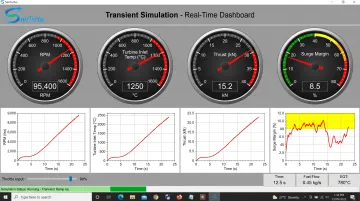
Engineers get real-time transient simulation on a standard Windows PC. RPM, turbine-inlet temperature, thrust, and surge margin update live as throttle or geometry inputs change.
Validation against NASA Lewis Research Center J85-GE-21 test data showed accuracy within ±2% for thrust, flow rate, temperature, and TSFC—a usable baseline for turbine-mode fidelity on TBCC work.
Transient data (RPM, EGT, thrust, SFC) exports to CSV or Excel. Built-in PID/FADEC logic can also ship as plant responses so teams can check externally developed control laws in MATLAB/Simulink or Python.
Supporting University Research
Academic licensing—discounted student pricing and classroom/lab program specials—gives capstone teams and graduate researchers a practical way to study advanced propulsion without million-dollar test facilities.
A 30-day free trial lets teams evaluate the platform before committing.
Frequently Asked Questions
What is a combined cycle gas turbine?
In power generation, a combined cycle gas turbine pairs a gas turbine with a steam turbine, using waste heat to run the steam turbine and boost electricity output. This is unrelated to aerospace TBCC engines, which combine turbine and ramjet/scramjet propulsion for flight.
What is the difference between a turbojet and a TBCC engine?
A turbojet operates efficiently only within a limited speed range, roughly up to Mach 2.5. A TBCC engine integrates a turbojet with a ramjet or scramjet, extending usable thrust across a much broader flight envelope.
Why is the mode transition in TBCC engines so difficult to engineer?
The handoff between turbine and ramjet/scramjet operation risks thrust dips, thermal stress on structures, and complex inlet airflow management as geometry shifts between flowpaths. Coordinating all three simultaneously is the central design challenge.
Are TBCC engines currently used in operational aircraft?
No. TBCC remains largely in research and demonstrator stages, with NASA and DARPA programs having tested individual components and ground-based control systems rather than flying a complete operational aircraft.
How does simulation software help in designing TBCC engines?
Component-based platforms let engineers model inlets, compressors, and turbines individually, run real-time transient analysis, and validate control laws before committing to expensive and risky flight or wind-tunnel testing.
Can students and universities work with TBCC-related simulation tools?
Yes. Platforms like SimTurbo offer discounted educational pricing and classroom/lab licensing, giving engineering programs practical tools for studying gas turbine and advanced propulsion concepts.